June 16, 2026
Jailed PTI leaders urge ‘Charter of Pakistan’ instead of economy accord
Jailed PTI leaders have turned down Prime Minister Shehbaz Sharif’s call for a Charter of Economy, saying constitutional supremacy and political stability must come first. In a letter sent through their lawyer, they proposed a broader Charter of Pakistan instead.

June 16, 2026
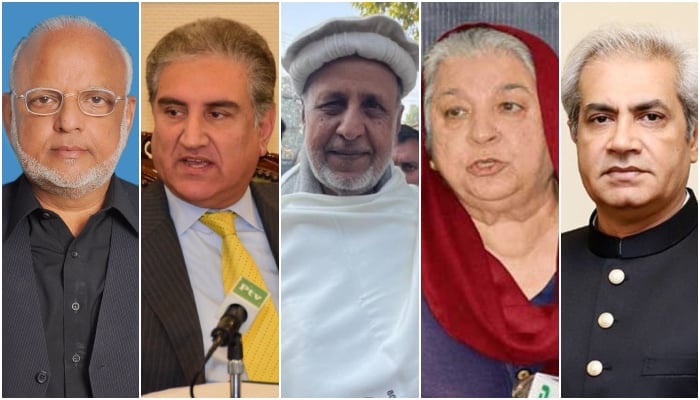
ISLAMABAD: Senior Pakistan Tehreek-e-Insaf (PTI) leaders currently in jail have rejected Prime Minister Shehbaz Sharif’s proposal for a Charter of Economy, saying the country first needs a broader political and constitutional settlement which they described as a Charter of Pakistan.
According to a letter sent through their lawyer Rana Mudassir, Shah Mahmood Qureshi, Dr Yasmin Rashid, Mian Mahmood-ur-Rashid, Ejaz Chaudhry and Omar Sarfraz Cheema said Pakistan required a framework centred on constitutional supremacy and political stability before any meaningful economic reform could succeed. Referring to the prime minister’s proposal, they said Pakistan undoubtedly needed a charter to overcome its current difficulties, but maintained that Pakistan needs a ‘Charter of Pakistan’ before it needs a Charter of Economy.
Prime Minister Shehbaz had renewed his call for both a Charter of Economy and a Charter of Democracy during his June 13 address to the National Assembly, urging opposition parties to rise above political disputes in the national interest. He said he had repeatedly invited his political opponents to work together on the two proposed charters and stressed that Pakistan remained the shared bond among all political forces despite differences in ideology and politics. He also said his government had no fight with PTI and described opposition members as our brothers, while emphasising the need for national unity over partisan division.
PTI leaders link economy to constitutional order
In their response, the jailed PTI leaders questioned whether an economy-focused agreement on its own could place the country on the right course when, in their view, constitutional supremacy existed only in books and both political and economic stability had become remote goals.
They argued that economic recovery could not be separated from the political environment and wrote that "Everyone is aware of the fact that economic stability cannot be achieved without political stability."
The letter said investment and growth were only possible where the rule of law prevailed, political and economic stability existed, and the Constitution held supremacy.
"When the constitution carries no more weight than a piece of paper, what practical value can a Charter of Economy have?" it stated.
To underline their argument, they used an analogy, saying: "There is an old saying that if the water in a well is dirty, changing the bucket will not solve the problem; first, the source of the contamination must be removed."
They added that unless and until the root cause of the crisis was removed, no meaningful reform could succeed.
What PTI says the proposed charter should include
The leaders said a Charter of Pakistan should secure agreement among all political parties, state institutions and centres of power on the complete supremacy of the Constitution. They said such an arrangement should ensure constitutional supremacy, guarantee that the people’s vote and mandate are respected, end political engineering, keep institutions within their constitutional limits, provide across-the-board accountability, and protect implementation of the National Action Plan and core economic policies from disruption.
The letter further argued that countries which later achieved strong economic outcomes first settled their political rules of the game. In that context, the PTI leaders maintained that political stability gives birth to economic stability, not the other way around.
In the concluding part of the letter, they said that if the prime minister was genuinely serious about confronting the country’s challenges, he should, instead of issuing yet another political statement, lay the foundation for a national dialogue on a Charter of Pakistan.
0 Comments
No comments yet. Be the first to join the discussion!