

June 4, 2026
Vast unveils astronaut mission as race to build post-ISS stations gathers pace
US company Vast has announced a crewed mission to its planned Haven-1 station, sharpening the race to replace the ISS. The company says the outpost could become the first operational commercial space station in 2027.

June 4, 2026
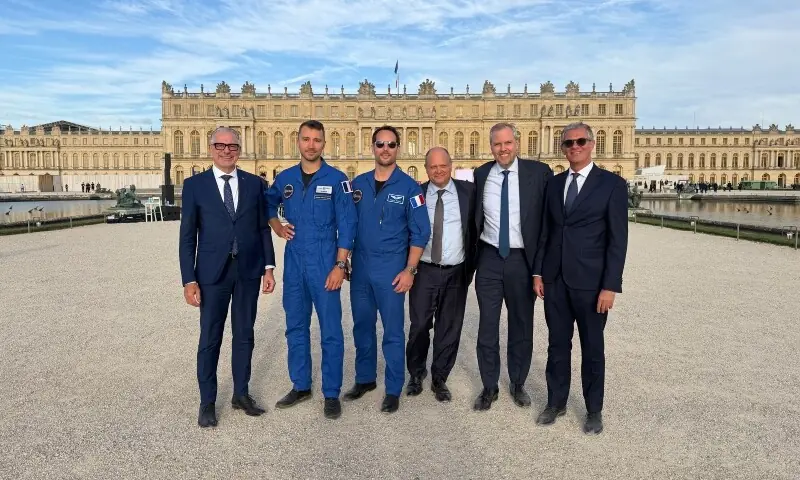
WASHINGTON: Competition to succeed the ageing International Space Station is intensifying after US company Vast announced a mission to send an astronaut to its planned Haven-1 outpost next year, according to an AFP report carried by Dawn.
If Haven-1, which has faced repeated delays, is placed into orbit on schedule in early 2027, it would become the first commercial space station in operation, ahead of rival projects. Its launch would also signal the beginning of a post-ISS phase in human spaceflight as Western countries seek to reduce reliance on Russian space operations following the war in Ukraine.
The ISS, which has been continuously inhabited for 25 years, is due to be deorbited in 2030. On Tuesday, Vast said it had become the first aerospace company to announce a crewed mission to a future commercial station.
Vast chief executive Max Haot told AFP that French astronaut Arnaud Prost would be part of the inaugural crew for Haven-1. He said Prost would conduct testing on board in preparation for scientific work similar to experiments currently carried out on the ISS.
Haot described the move as a key step in expanding human spaceflight while lowering costs and dependence on Russia. He said the privately financed Haven-1 would consist of a single module, unlike the ISS, which currently has 16. He added that over its three-year operational period, the station would host four missions, each lasting two weeks.
“This is an important milestone in a new era in crewed spaceflight that is less expensive — and less reliant on Russia,”
Vast is also planning a larger successor, Haven-2, which the company said would eventually comprise nine modules introduced over time. Haot said this phased deployment would cut module costs to “five to 10 times lower” than those for the ISS, where individual modules often cost more than $1 billion.
“This will allow us to increase the number of crewed flights and offer more attractive prices to our customers,”
He also said the company hoped to launch three modules a year for its future station and wanted at least one of them to be carried by a European rocket. Vast aims to have four modules in orbit by 2030, enough to support missions lasting six months.
Other US firms are also developing commercial space stations, including Axiom Space and Blue Origin, the company backed by Amazon founder Jeff Bezos. California-based Vast, founded in 2021 by cryptocurrency billionaire Jed McCaleb, says it entered the field later than its competitors but now considers itself two years ahead, citing its NASA contracts.
European expansion and ISS mission
Vast also announced on Tuesday that it would send French astronaut Thomas Pesquet to the ISS next year. In addition, the company said it would establish its European headquarters in Paris.
For both newly announced missions, Vast plans to use SpaceX Falcon 9 rockets and the Dragon 2 capsule. Asked about depending on Elon Musk’s company, Haot told AFP that SpaceX stood out for its focus on speed and reusable rockets.
“It’s a model for everyone, and it’s the future of space,”
Haot said SpaceX’s success had been crucial for the wider sector, adding that without the Dragon spacecraft, Vast would not exist and the United States and Europe would still rely on Russia for sending people into space.
Despite a broader breakdown in many international cooperation arrangements after Russia’s 2022 invasion of Ukraine, the United States and other ISS partners have continued to work with Russia on the space station.
0 Comments
No comments yet. Be the first to join the discussion!


