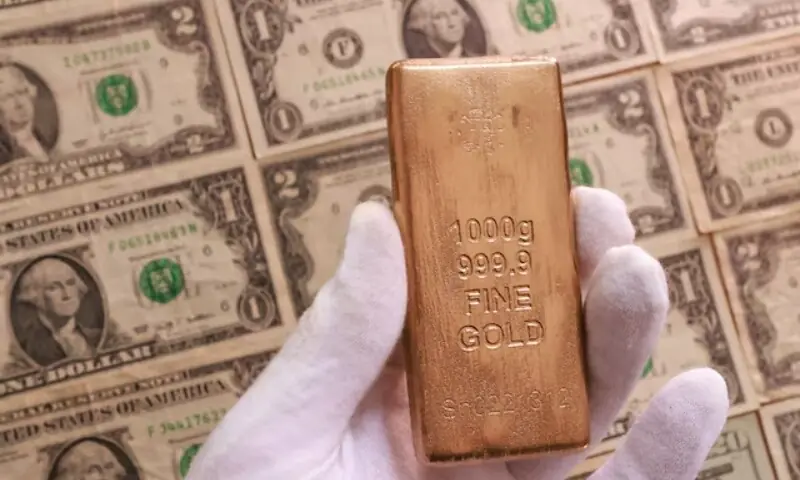
Gold surpasses US Treasuries as top reserve asset, ECB says
The European Central Bank says gold overtook US Treasuries as the largest reserve asset held by central banks by the end of 2025. The shift reflects strong buying, rising prices and reserve diversification amid geopolitical and debt concerns.


ISLAMABAD: Gold has moved ahead of US government bonds to become the largest reserve asset held by central banks worldwide, according to the European Central Bank's latest report.
The ECB said gold made up about 27% of global official reserve assets at the end of 2025, compared with 22% for US Treasuries. The shift marked a notable change in the make-up of international reserves and reflected changing views on risk, security and monetary stability amid a more fragmented geopolitical environment.
For many years, US Treasury securities were the main pillar of global reserve management because central banks regarded them as the safest and most liquid assets, supported by the scale of the US economy and the dollar's central role in global trade and finance. The ECB report said central banks now collectively hold more than 36,000 tonnes of gold, close to levels seen during the Bretton Woods period.
Gold's share of reserves climbed from 20% in 2024 to 27% in 2025, while the share of US Treasuries dropped from 25% to 22%. Even so, dollar-denominated assets remained the biggest category overall at roughly 42% of global reserves, indicating that the move represents diversification rather than a wholesale departure from dollar assets.
Drivers behind gold buying
Rising geopolitical uncertainty has been a major reason behind central bank demand for gold. Analysts cited the freezing of Russia's foreign reserves after its 2022 invasion of Ukraine as a key turning point, as it underscored that reserves held in another country's financial system can be affected by political decisions and sanctions.
By contrast, analysts said, gold is seen as politically neutral because it carries no counterparty risk and cannot be frozen by a foreign government when it is held domestically. As tensions persist in different regions, central banks have increasingly treated bullion as a strategic safeguard against political and financial shocks.
Central bank purchases have remained strong. For the three years before 2025, annual net buying exceeded 1,000 tonnes, while purchases eased to 850 tonnes in 2025 but stayed historically elevated. China, India, Poland and Turkey were among the most active buyers since 2022, reflecting a broader effort to diversify reserves and lower reliance on dollar-denominated assets.
The ECB also noted that Tether, the world's largest stablecoin issuer, was the single biggest buyer of gold in 2025, acquiring more than 100 tonnes.
Price gains and reserve valuation
Analysts also linked gold's rise in reserve portfolios to its sharp price increase. Gold prices have nearly doubled over the past two years and climbed above $5,500 per troy ounce in January 2026, a record high. Because reserve shares are measured by market value, the increase in prices lifted gold's weight in central bank holdings.
The ECB said valuation effects were an important reason gold overtook Treasuries. If gold had been priced at 2023 levels, US Treasuries would probably still have ranked as the largest reserve asset.
Analysts also pointed to concerns over US public debt as another factor behind diversification away from Treasuries. Persistent fiscal deficits, increased Treasury issuance, limited dealer balance sheet capacity and rising financing needs have all raised questions about the long-term stability of the Treasury market, even though it remains highly liquid.
Traditionally, gold's lack of income has been seen as a drawback compared with Treasury bonds, which pay interest. However, lower Treasury yields and expectations of monetary easing have reduced the opportunity cost of holding gold, improving the appeal of a non-yielding asset in an environment of geopolitical uncertainty and inflation risks.
Limits and wider reserve trends
The ECB said gold still has limitations. It described the metal as a volatile asset whose price can fluctuate sharply, while physical storage, transport and security also create costs for central banks. Unlike government bonds, it does not generate interest income.
According to analysts, a continued shift from Treasuries into gold could gradually soften demand for US government debt, which may require higher yields to draw buyers and could raise borrowing costs for the US government. At the same time, claims of the dollar's decline may be overstated because dollar-denominated assets still account for the largest share of global reserves and the US currency remains deeply embedded in global trade, finance and capital markets.
The ECB report also highlighted increased international use of the euro. Issuance of euro-denominated international debt rose by 30% in 2025 to nearly €1 trillion, while foreign investors bought about €850 billion in euro-area assets.
Gold's move above US Treasuries reflects a broader shift in the international monetary system, driven by geopolitical tensions, reserve diversification, sanctions-related concerns, sovereign debt risks and the strong rise in gold prices.
Comments
No comments yet. Be the first to join the discussion!