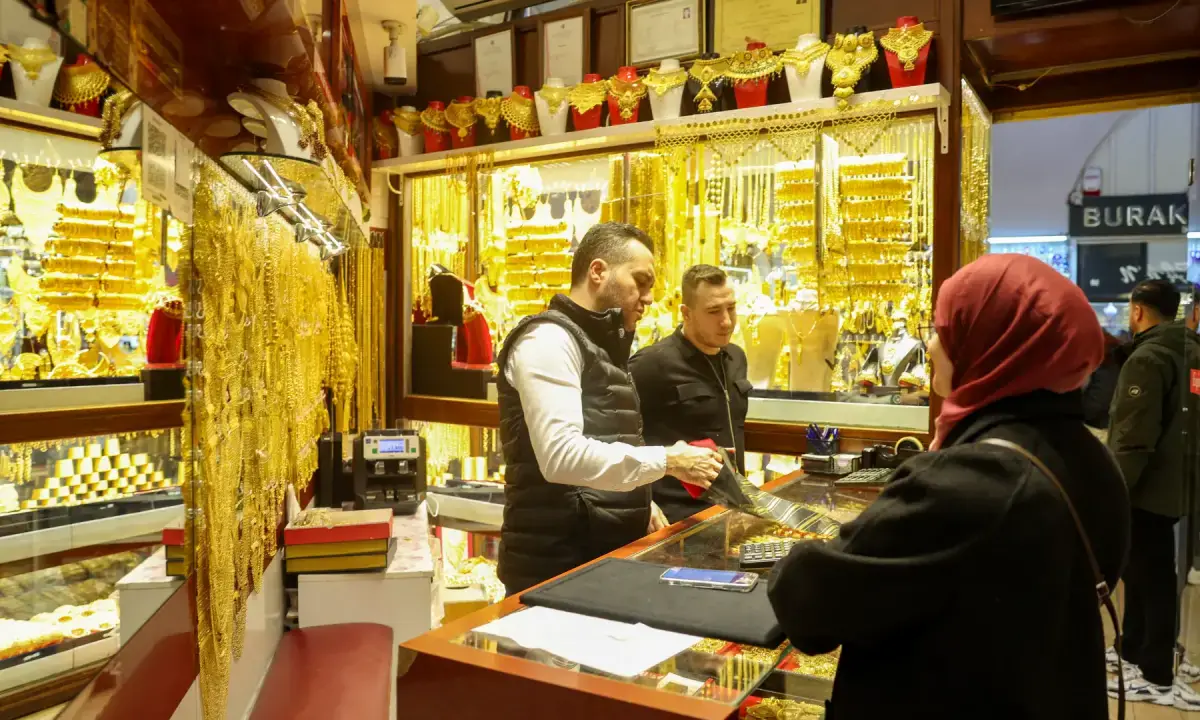
When the World Wavers, Gold Glitters

Gold has soared to a historic high of $3,455.04 per troy ounce, according to the latest figures from Trading Economics. Just a year ago, on April 23, 2024, gold was trading at $2,330, marking a $1,125 increase over the year. This remarkable surge reflects a 48.66% annual rise, with a 14.75% jump in the past month alone, signaling a powerful shift toward gold as investors seek safety amid mounting global and political uncertainty. What triggered the sharp rise in gold prices over the past year, reaching a record high in April 2025?
Gold had been on a steady upward path, but the pace of its ascent sharpened notably around January 20, 2025—the day Donald Trump returned to the presidency. On December 20, 2024, just two months before he assumed office, gold prices moved modestly from $2,595 to $2,659, a 2.47% increase. However, following his inauguration, the rally accelerated dramatically. By April 22, 2025, gold had surged to $3,455, reflecting a sharp 29.94% gain in just two months—a move that underscores shifting investor sentiment amid renewed political and economic uncertainty.
The ongoing U.S.-China trade war has sent ripples through global markets, fueling a sharp rise in gold prices as investors flee to safe-haven assets. Trade tensions between the world’s two largest economies have heightened economic uncertainty, a trend clearly reflected in the World Uncertainty Index, which soared from 20,372 in September 2024 to 53,189 by March 2025. Tariffs and trade restrictions not only strain bilateral ties but also slow global growth, unsettle financial markets, and erode investor confidence. In response, capital shifts away from riskier assets like equities and currencies into gold—long revered as a stable store of value. Resultantly, a global surge in gold demand and a sharp upward trajectory in its price.
Meanwhile, rising geopolitical tensions—most notably in the Middle East and the enduring Russia-Ukraine conflict—have added fresh layers of uncertainty to an already fragile global landscape. Escalating violence in key regions, energy supply disruptions, and fears of broader conflict have rattled markets and deepened investor anxiety. With nerves frayed and confidence shaken, investors are doing what they have always done in turbulent times: turning to gold. As faith in traditional assets wavers, gold’s reputation as a timeless store of value is reaffirmed. Consequently, a surge in demand continues to drive prices skyward, underscoring how economic and geopolitical unrest is reshaping the dynamics of global financial markets.
In the post-pandemic world, global annual inflation has been on a gradual decline—falling from 8.6% in 2022 to 5.8% in 2024, and projected to reach 4.3% in 2025. However, escalating tensions from the U.S.-China trade war threaten to undermine this outlook. Yet, even this moderated outlook remains elevated compared to the previous decade (2011 to 2020), which averaged 3.3% and fluctuated between 2.7% and 4.9%. This persistent inflation erodes currency value, prompting investors to seek protection in gold—a traditional hedge against inflation. The rising gold prices in 2025 directly reflect this trend, as declining purchasing power drive demand for safer, value-retaining assets.
As inflationary pressures linger, central banks across the globe have adopted expansionary monetary policies, cutting interest rates in an effort to stimulate economic growth. Notably, the Federal Reserve, the People’s Bank of China, and the European Central Bank eachslashed rates by 25 basis points in their most recent monetary policy decisions. When interest rates fall, traditional interest-bearing assets like savings accounts and bonds become less appealing due to diminished returns. As a result, the opportunity cost of holding gold decreases, making it a far more attractive store of value. Investors seeking stability in an uncertain environment increasingly turn to gold—driving its price ever higher.
De-dollarization—the global shift away from the US dollar—is steadily transforming international financial dynamics. Nations such as China, Russia, and India are increasingly conducting trade in local currencies and bolstering their gold reserves, signaling a strategic move to reduce reliance on the dollar and assert greater monetary independence. Driven by sanctions and a quest for financial sovereignty, this shift is fueling a surge in gold demand among central banks—and, in turn, soaring prices. As dollar dominance weakens, gold is fast reclaiming its role as the world’s ultimate safe haven.
Over the past three months, the U.S. Dollar Index (DXY) has tumbled from above 108.49 to below 98, signaling a marked weakening of the dollar against a basket of major global currencies. This decline is closely intertwined with the recent surge in gold prices. When the dollar weakens, gold—priced in U.S. dollars—becomes cheaper for investors using other currencies. For instance, if €1 equals $1.15, then after a 10% depreciation of the dollar, €1,000 would buy $1,265—up from $1,150. A stronger euro can now purchase more dollars, effectively lowering the relative cost of gold for Eurozone buyers. This dynamic fuels global demand and, in turn, drives gold prices higher as investors seek both value and stability.
A rapid and sustained surge in gold prices—such as a 48.66% annual rise—can raise serious concerns about the formation of a speculative bubble. When prices skyrocket in a short span, not due to fundamentals but driven by fear, speculation, and herd behavior, market conditions become ripe for a bubble. Investors, anxious to capitalize on rising prices, often buy gold not for its intrinsic value but for short-term gains, pushing prices even higher. As gold becomes increasingly detached from its real economic value, it grows vulnerable to sharp corrections. If uncertainty begins to ease—through stabilized inflation or easing geopolitical tensions—investors may rush to exit, leading to a mass sell-off and a sudden crash. This scenario is not hypothetical; it echoes the 2011 gold spike, when prices surged to nearly $1,900 per ounce before collapsing as market fears subsided and the dollar regained strength.
In an era defined by inflation, geopolitical conflict, monetary easing, and de-dollarization, gold has reasserted itself as the ultimate refuge for anxious investors. Its historic surge is not just a reaction to short-term shocks but a reflection of deep, structural shifts in global finance and sentiment. As traditional assets falter and uncertainty dominates headlines, gold has become the symbol of safety and value preservation. Yet, this remarkable ascent is not without risks—signs of speculative excess are emerging. Whether gold’s rally proves sustainable or veers into bubble territory will depend on how the world navigates the turbulence ahead.

Waqas Shair holds the position of Lecturer at Minhaj University Lahore, Pakistan. He is pursuing a PhD at Punjab University. He can be reached at [email protected] and [email protected] and tweets @waqasshair689
View all articles →Comments
No comments yet. Be the first to join the discussion!