Lt-Gen Zakria says May 2025 response reshaped South Asia’s war calculus
Lt-Gen Nauman Zakria tells Shangri-La Dialogue that Pakistan’s May 2025 response reshaped South Asia’s war calculus, cutting prospects for conventional conflict. He calls for escalation control, crisis management, and norms for AI, cyber and space.

Lt-Gen Zakria addresses Shangri-La Dialogue in Singapore, saying Pakistan’s response removed ‘space for war’ in region
Cites May 2025 conflict as turning point in regional security dynamics, highlighting multi-domain operations and tri-service synergy
Describes China as stabilising factor in regional balance, calling for global norms on AI, cyber, autonomous systems and space
Warns misinformation and tech disruption threaten strategic stability
SINGAPORE/ISLAMABAD: A senior Pakistan Army commander has said that Pakistan’s “resolute response” during the May 2025 conflict with India effectively “debunked the notion of space for war in South Asia,” adding that, despite the complexities of great power competition, China continues to act as a constructive and stabilising factor contributing to regional balance, connectivity, and economic cooperation.
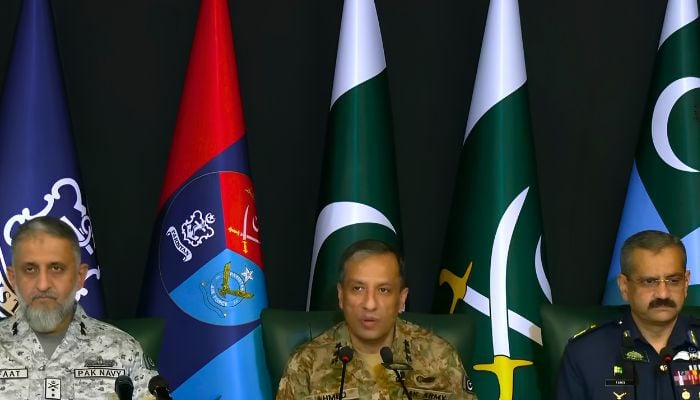
Commander I Corps Lieutenant General Nauman Zakria made the remarks during a special session at the Shangri-La Dialogue in Singapore on Saturday.
Recalling the May 2025 confrontation, he said a four-day conflict was triggered after an attack on tourists in Indian Illegally Occupied Jammu and Kashmir (IIOJK), which New Delhi, without evidence, linked to Pakistan. Islamabad rejected the allegations and called for a neutral investigation.
Following Indian air strikes on May 7 targeting Punjab and Azad Kashmir, Pakistan stated it downed five Indian aircraft in air-to-air combat, later increasing the tally to eight. Subsequent tit-for-tat strikes on airbases escalated tensions until US diplomatic intervention on May 10 led to a ceasefire.
Lt Gen Zakria said strategic stability in South Asia remained shaped by nuclear deterrence, conventional asymmetry, persistent political tensions, and unresolved territorial and ideological disputes between India and Pakistan.
He added that China, amid broader great-power competition, remained a stabilising factor contributing to strategic balance, regional connectivity, and economic cooperation.
The commander said the May 2025 conflict demonstrated Pakistan’s effective multi-domain operations enabled by tri-service synergy, integrating cyber capabilities, electronic warfare, intelligence, surveillance and reconnaissance (ISR), space-based assets, and coordinated information manoeuvre to generate cross-domain effects.
“Pakistan’s resolute response has effectively debunked the notion of space for war in South Asia,” he said.
He noted that post-conflict dynamics had further reduced the prospects of conventional war. However, he warned that continued Indian militarisation, adversarial rhetoric, and the absence of robust crisis management mechanisms continued to undermine regional stability.
“In this evolving environment, South Asia’s strategic equilibrium is increasingly dependent on escalation control and effective crisis communication frameworks,” he said.
Lt Gen Zakria stressed the need to shift from competition-only postures to cooperative risk management across multiple domains while adhering to international norms.
He said responsible governance of emerging technologies was essential, adding that technological innovation must remain tied to ethical responsibility and strategic accountability.
He called for internationally accepted norms governing military use of artificial intelligence, autonomous systems, cyber operations, and space technologies, stressing that human oversight must remain central in decisions involving use of force.
He also highlighted the importance of confidence-building measures, transparency mechanisms, and sustained technical dialogue to reduce misunderstandings and prevent destabilising arms races.
Secondly, he said institutionalised crisis-management mechanisms and strategic communication channels must be strengthened, noting that “even during periods of geopolitical rivalry, dialogue must never collapse.”
“Strategic stability is preserved not only through deterrence but also through communication,” he added.
Thirdly, he urged cooperation in codifying norms on space testing, protection of civilian infrastructure, and human oversight in autonomous weapon systems, stressing that norms define “boundaries that make deterrence more calculable.”
He said international law and multilateral institutions must evolve to match rapidly advancing technologies, warning that innovation was outpacing existing frameworks.
Lt Gen Zakria also called for enhanced global cooperation on cyber governance, AI development, space security, digital ethics, and information integrity.
“No country, regardless of size or technological capability, can manage these emerging risks alone,” he said, describing them as inherently transnational challenges requiring collective responses.
He further said strategic stability was not only military but societal, stressing the importance of cyber resilience, protection of critical infrastructure, digital literacy, and institutional credibility.
“Public trust is a strategic asset,” he said, adding that resilient societies are less vulnerable to misinformation, polarisation, and technological disruption.
At its core, he said, strategic stability depends on responsible statecraft.
“Technology itself is not inherently destabilising. The real challenge lies in how it is governed, integrated, and employed,” he said, urging balance between innovation, national security, and global stability.
He cautioned against viewing technological advancement solely through the lens of competition and militarisation, and instead called for alignment between innovation and responsibility, as well as strategic competition and collective survival.
Earlier in his address, he said the emergence of new domains alongside traditional warfare had significantly complicated the strategic stability landscape.
He noted that rapid advances in AI, autonomous systems, cyber capabilities, quantum technologies, and multi-domain operations were reshaping military decision-making, command structures, and strategic competition, while introducing new risks including miscalculation, attribution challenges, and unintended escalation.
He added that increasing reliance on interconnected technological ecosystems was eroding predictability and compressing decision-making timelines, fundamentally reshaping deterrence and interstate conflict dynamics.
Lt Gen Zakria said information was becoming increasingly fragmented, with digital platforms, AI-generated content, and disinformation campaigns eroding trust and distorting narratives.
“In this evolving landscape, control of information and data integrity has emerged as a critical determinant of strategic stability,” he said.
Comments
No comments yet. Be the first to join the discussion!