Trump links Iran peace deal to wider sign-up for Abraham Accords
US President Donald Trump has said countries involved in efforts to end the Iran conflict should join the Abraham Accords as part of the settlement. The proposal names Pakistan, Saudi Arabia, Qatar and other regional states.

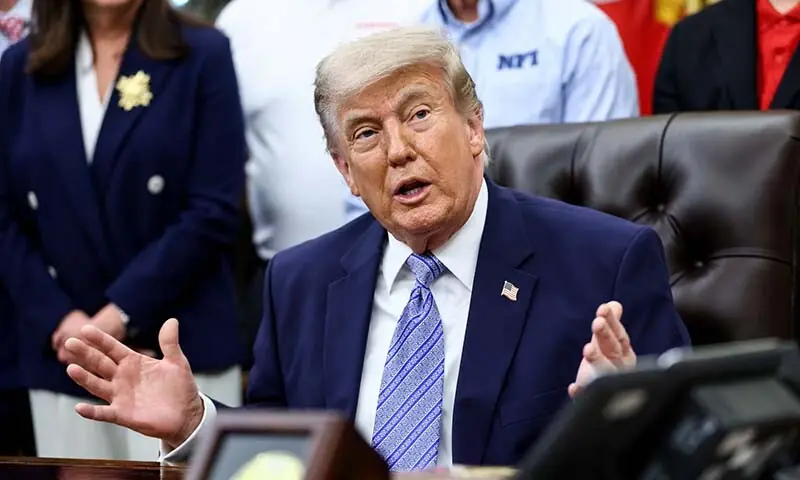
Washington: US President Donald Trump said on Monday that Muslim-majority countries involved in discussions around an emerging peace arrangement with Iran should also normalise ties with Israel by joining the Abraham Accords.
In a social media post, Trump listed the countries whose leaders he said he had spoken with on Saturday about efforts to end the war with Iran. He wrote that the countries under discussion were Saudi Arabia, the United Arab Emirates, Qatar, Pakistan, Turkiye, Egypt, Jordan and Bahrain, while noting that the UAE and Bahrain were already members of the accords.
Trump said US efforts to assemble a broader settlement should be matched by regional states signing on to the Israel normalisation framework brokered during his first term in 2020. The accords established diplomatic normalisation between Israel and countries that had long been hostile to it, but they have remained unpopular in parts of the region because they do not address the Israeli-Palestinian conflict.
Pakistan, Saudi Arabia and Qatar have traditionally supported a two-state solution to the Palestine-Israel dispute before any move towards normalisation with Israel.
In his Truth Social post, Trump wrote:
"After all the work done by the United States to try and pull this very complex puzzle together, it should be mandatory that all of these countries, at a minimum, simultaneously sign onto the Abraham Accords"He added:
"Those countries discussed are Saudi Arabia, the United Arab Emirates (already a Member!), Qatar, Pakistan, Turkiye, Egypt, Jordan, and Bahrain (already a Member!)"Trump also said some exceptions might be accepted, but argued that most of the countries should be prepared to join the accords as part of a broader settlement with Iran. He specifically called for Saudi Arabia and Qatar to sign immediately and said countries that refused should not be included in the deal.
He wrote:
"It may be possible that one or two have a reason for not doing so, and that will be accepted, but most should be ready, willing, and able to make this settlement with Iran a far more historic event than it would otherwise be"Trump continued:
"It should start with the immediate signing by Saudi Arabia and Qatar, and everybody else should follow suit. If they don’t, they should not be part of this deal in that it shows bad intention"A day earlier, US Senator Lindsey Graham, a close Trump ally, also backed linking any Iran arrangement to wider Arab and Muslim recognition of Israel. In a post on X, he said such a step would amount to one of the most consequential agreements in Middle East history and warned that refusal to join would make the proposal unacceptable.
Graham wrote:
He added:
"Now is the time to be bold for the future of a new Middle East"Graham said he expected Arab and Muslim countries to join the accords, which he said would effectively end the Arab-Israeli conflict. He also warned:
"If you refuse to go down this path as suggested by President Trump, it will have severe repercussions for our future relationships and make this peace proposal unacceptable. Further, it would be seen by history as a major miscalculation"Talks with Iran
Trump also suggested that support and cooperation with Arab and Muslim countries would be strengthened if they joined the Abraham Accords, adding that Iran itself might even choose to do so.
Pakistan is continuing efforts to revive the stalled Iran-US peace process after a planned second round of negotiations in Islamabad did not take place last month. Trump said on Wednesday that talks with Iran were in their final stages and warned that strikes could resume if no agreement was reached within what he called a limited timeframe.
Over the weekend, however, he said a memorandum of understanding on a peace deal had been largely negotiated and would reopen the Strait of Hormuz, with further details to be announced later.
Meanwhile, Chief of Defence Forces and Chief of Army Staff Field Marshal Asim Munir visited Tehran on Saturday in the most significant mediation effort since direct talks hosted by Pakistan last month. According to the Inter-Services Public Relations, he held high-level meetings with the Iranian leadership as part of ongoing mediation aimed at de-escalation and constructive engagement.
In a statement, ISPR said:
It added:
"The intensive negotiations over the last twenty-four hours have resulted in encouraging progress towards a final understanding"Munir met Iranian President Masoud Pezeshkian, parliament speaker and chief negotiator Mohammad Bagher Ghalibaf, Foreign Minister Abbas Araghchi and Interior Minister Eskandar Momeni. The statement did not announce a breakthrough, though late-night media reports suggested an agreement was close.
Since the opening US and Israeli strikes on Iran on February 28, Tehran had responded with missile attacks on US bases in neighbouring Gulf states, widening the conflict. A ceasefire was reached on April 8 with the help of mediators Pakistan, and was later extended indefinitely on April 21 at Islamabad’s request shortly before it was due to expire.
A congressional report said the United States lost 42 aircraft, including fighter jets and support planes, during its military campaign known as Operation Epic Fury.
Comments
No comments yet. Be the first to join the discussion!