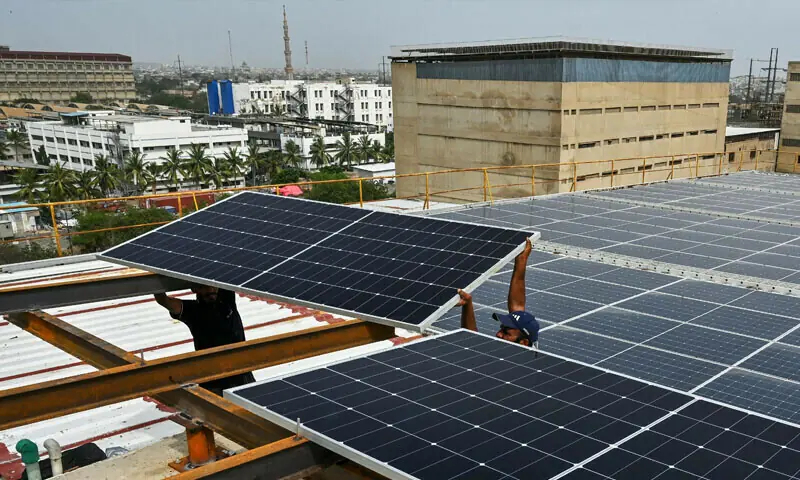
Govt remains committed to coal despite solar surge
A new Global Energy Monitor report says Pakistan’s rapid solar expansion is eroding the economics of coal power, even as coal remains central to energy policy. The report estimates solar met 25% of electricity consumption in 2025, mostly through off-grid systems.

ISLAMABAD: Pakistan’s fast-growing use of solar energy is weakening the economic case for coal-fired power generation, but the government is still treating coal as a key part of its energy security strategy, according to a new report by Global Energy Monitor.
The report, Boom and Bust 2026, said Pakistan is undergoing a bottom-up expansion in solar power, with an estimated 25% of the country’s electricity consumption in 2025 coming from solar energy. Most of that power is being produced through off-grid systems.
Despite that shift, Pakistan has not pledged to phase out coal-fired power plants. None of the country’s operating coal plants has a scheduled retirement date, and that coal retirement does not feature in Pakistan’s climate commitments under its Nationally Determined Contributions.
Continued dependence on coal could add to financial pressure in the power sector as lower-cost renewable energy becomes more widely used. Lucy Hummer, senior researcher at GEM’s Global Coal Plant Tracker, said the issue was no longer only about ensuring electricity supply.
Hummer said Pakistan was on the front line of a wider global effort to move away from coal arrangements that had become uneconomical as power systems evolved.
Concerns over long-term coal commitments
The report also pointed to concerns about attempts by coal-based independent power producers to obtain extended long-term guarantees. Such arrangements could keep coal embedded in Pakistan’s energy mix for another decade and limit the space for cheaper renewable options.
Shaheera Tahir, head of the Energy Transition Department at the Policy Research Institute for Equitable Development, said regional tensions and the war involving Iran had created a policy dilemma for Pakistan. According to her, policymakers are increasingly leaning towards converting plants that run on imported coal to indigenous coal in order to reduce vulnerability to external supply disruptions.
At the same time, she said households are continuing to turn to distributed solar power despite fresh obstacles, including a 10% tax on solar panels and steps that discourage grid-connected solarisation.
Zahra Naeem, communications specialist at PRIED, said a renewed push for local coal risked locking Pakistan into another period of fossil-fuel overcapacity at a time when consumers were already shifting to distributed solar systems to avoid what she described as a costly and unreliable national grid.
Global coal trends
At the global level, the report found that coal power capacity continued to grow in 2025 even though actual coal-fired electricity generation declined. Worldwide coal capacity rose by 3.5%, while coal generation fell by 0.6%, showing an increasing mismatch between new coal development and real electricity demand.
China and India remained the main contributors to new coal development, although both countries also recorded declines in coal generation as renewable energy increasingly met additional electricity demand.
The number of countries proposing or constructing new coal plants dropped from 38 in 2024 to 32 in 2025, suggesting that coal expansion is becoming concentrated in a smaller group of countries.
Comments
No comments yet. Be the first to join the discussion!