Islamabad orders lighter school bags, moves to remove banned O-level book
Islamabad authorities have introduced a lighter school bags policy for private schools and ordered stricter enforcement against unregistered institutions and fee violations. Separately, officials moved to remove copies of a banned O-level Pakistan Studies book still being sold in the market.

ISLAMABAD: Authorities in the federal capital have announced a new policy to reduce the weight of school bags in private schools, while the federal government has separately directed action to remove copies of a banned O-level Pakistan Studies book that officials said remain available in the market.
The Private Educational Institutions Regulatory Authority (Peira) took up the issue of heavy school bags carried by children at a meeting held on Wednesday. The meeting was chaired by acting Peira chairperson Dr Ghulam Ali Mallah and resulted in several decisions concerning private educational institutions in Islamabad.
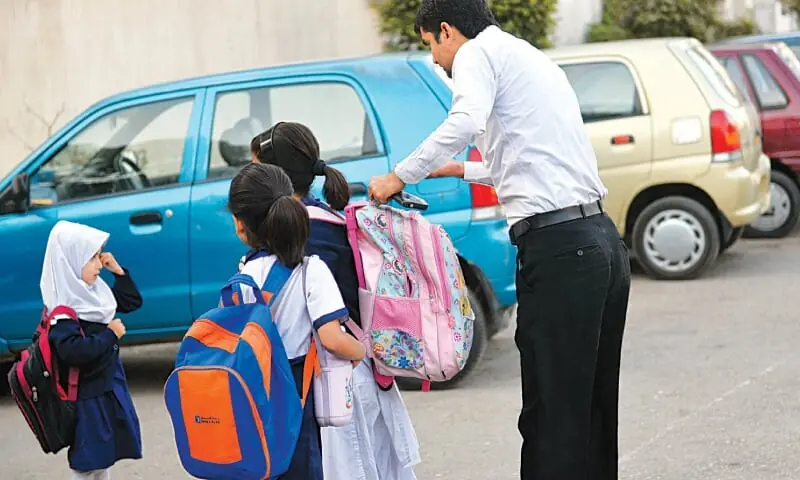
According to an official statement, private schools have been instructed to ensure that the weight of school bags does not exceed 10 per cent of a student’s body weight. Schools were also told to adopt measures such as rationalised timetables, provision of lockers, and reduction of unnecessary books and study materials to lessen the physical burden on students.
The statement specified weight limits for different age groups and classes. For pre-school students, the maximum bag weight has been set at 1.5kg. For grades 1 and 2, the range is 1.5kg to 2.5kg; for grades 3 to 5, 2.5kg to 4.5kg; for grades 6 to 8, 4.5kg to 6kg; and for grades 9 to 12, 6kg to 8kg.
Action against unregistered schools and fee violations
Peira also decided to begin strict legal action against unregistered private educational institutions operating without lawful registration. A press release said the authority had approved a mechanism under which enforcement teams, working with the Islamabad district administration and relevant law enforcement agencies, would raid defaulting institutions.
The authority further directed that no private educational institution would be allowed to charge fees beyond the approved academic session of 12 months, whether running from April to March or August to July. Tuition fees must be collected strictly on a monthly basis. Peira also decided to conduct forensic audits of institutions to check compliance, and a dedicated complaint counter has been established for parents and other complainants.
Speaking to the media after the meeting, Dr Mallah said the authority remained fully committed to ensuring transparency, lawful regulation and promotion of quality education in all private educational institutions. He added that no institution would be allowed to operate unlawfully or exploit students and parents through unauthorised fee collection or other illegal practices.
Meeting reviews banned O-level book
Separately, a meeting in Islamabad attended by officials from the ministries of interior and education, the National Curriculum Council (NCC), Cambridge and others discussed the issue of a controversial O-level book, along with the paper leakage matter.
Officials of the Ministry of Education and the NCC told the meeting that the Pakistan Studies book, The History and Culture of Pakistan (fifth edition), authored by Nigel Kelly for O-level students, had already been banned in Pakistan in April 2023. However, the meeting was informed that the same book was still available in bookshops.
Sources said Cambridge officials told the meeting that the book in question is not an endorsed Cambridge book. They said that because no endorsed Pakistan Studies book is available in Pakistan, students independently use this title for O-level examinations.
The meeting directed the education ministry and the NCC to seek assistance from the district administration to remove all copies of the book from bookshops. Sources said the education ministry, the private school regulator and the NCC, with the help of the district administration, would ensure implementation of the ban.
Chapter 15 of the book appears biased towards one political party and highlights several alleged scandals from the 1990s. When banning the book in 2023, the NCC had said it contained controversial material against selected political leaders and linked issues such as inflation, unemployment, crime and drug trafficking to specific leaders, thereby presenting opinion as fact and distorting history. The council had further said that unproven allegations of corruption and assigning national problems to a particular political leader were intellectually dishonest and harmful to national harmony.
Comments
No comments yet. Be the first to join the discussion!