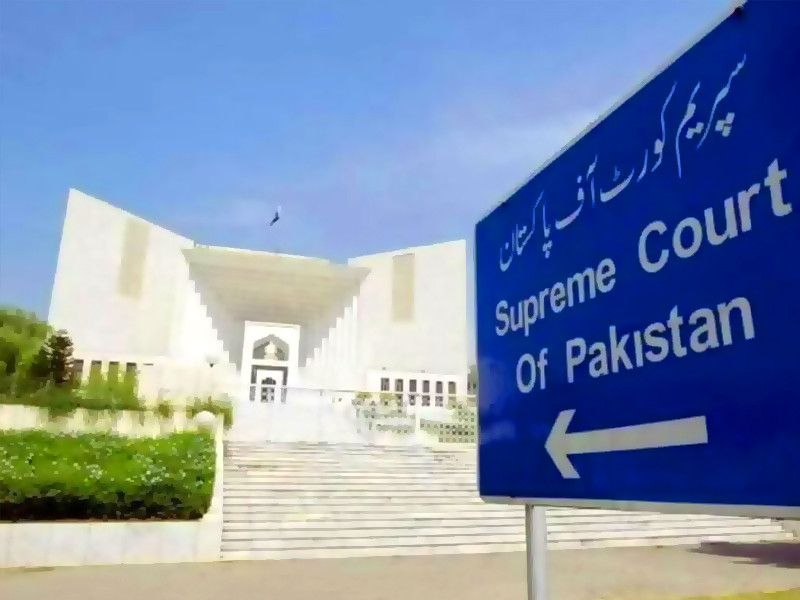
SC sets rules for probe in narcotics case, flags complainant-led investigations
The Supreme Court has ruled that a complainant should not also act as investigation officer in a narcotics case, saying the practice undermines fairness. The court acquitted a petitioner whose life sentence had been upheld by the Sindh High Court.


ISLAMABAD: The Supreme Court has ruled that a police officer who files a criminal complaint should not ordinarily act as the investigation officer (IO) in the same matter, particularly in narcotics cases carrying severe penalties.
The observation came in a six-page judgment authored by Justice Jamal Khan Mandokhail in a drug-related case, where the court described the practice of a complainant also serving as IO as strongly discouraged.
The petitioner in the case was arrested in 2019 and convicted under Section 9(c) of the Control of Narcotic Substances Act, 1997, receiving a life sentence from the trial court. The Sindh High Court later upheld the conviction. However, a three-judge bench of the Supreme Court, headed by Justice Mandokhail, subsequently acquitted the appellant.
In its ruling, the court stated that if a complainant is appointed as an IO, the appointing authority must record clear and justified reasons; otherwise, such an arrangement weakens the prosecution’s case. It stressed that investigations should be entrusted to an impartial officer with the authority and independence to conduct proceedings without bias.
The judgment underscored that the purpose of investigation is to uncover the truth, in line with police rules, and that it must be conducted in a fair and neutral manner. Assigning the task to the complainant creates an inherent risk of bias, as the complainant is naturally inclined towards securing a conviction.
The court observed that such a role overlap may result in selective collection of evidence, where the focus remains on proving allegations rather than examining facts both for and against the accused. This approach could consciously or unconsciously affect the fairness of the investigation.
The bench also questioned whether it is appropriate for a complainant to continue in a dual capacity as IO, stating that while such an appointment may not be technically illegal, it raises serious concerns regarding impartiality and transparency.
According to the judgment, an IO is required to determine the truth of the matter and collect all relevant evidence. However, a complainant acting in that role may find it difficult to maintain the objectivity required under criminal procedure standards.
The court further noted that it would be unrealistic to expect a complainant-turned-IO to conclude that their own complaint was false after investigation, making such inquiries potentially unreliable and prejudicial to justice.
Examining the case record, the court also pointed to deficiencies in the investigation process, including handling of evidence, forensic procedures and its custody, stating that these did not meet the standards of due process and fair trial requirements.
It reiterated that in criminal law, even the slightest doubt in the prosecution’s case must benefit the accused, particularly where investigative independence is compromised.
The judgment concluded that both lower courts had misread the evidence and failed to extend the benefit of doubt to the appellant, rendering their decisions unsustainable.
Comments
No comments yet. Be the first to join the discussion!