Punjab wheat procurement policy under pressure amid delayed rollout, rising prices
Punjab’s wheat procurement policy is under pressure after delays in the new private-sector-led system left farmers exposed during peak harvest. Rising prices have since made the government’s 3m-tonne procurement target harder to achieve.


ISLAMABAD: Punjab’s wheat procurement approach is facing renewed scrutiny after a delayed rollout of the new private-sector-led system left farmers exposed during peak arrivals, while a subsequent rise in prices has complicated the government’s effort to build reserves.
The Punjab government had decided in principle two years ago to stop direct wheat purchases from farmers because of the growing financial burden linked to procurement debt. Outstanding liabilities tied to wheat procurement had climbed to Rs680 billion by June 2023 due to delayed repayments, while annual interest payments alone reached about Rs110bn in 2023-24.
Last year, the government placed major emphasis on introducing the Electronic Warehouse Receipt (EWR) system, but it did not produce the intended results. This year, a new system led by the private sector was introduced with three stated aims: maintaining strategic reserves of three million tonnes, stabilising the wheat market, and ensuring farmers receive Rs3,500 per 40 kg.
Target price was close to import parity, though still not fully in line with rising production costs. It also contrasted with last year, when farmers had to sell wheat at Rs2,000 to Rs2,200 per 40 kg.
Delayed intervention during harvest
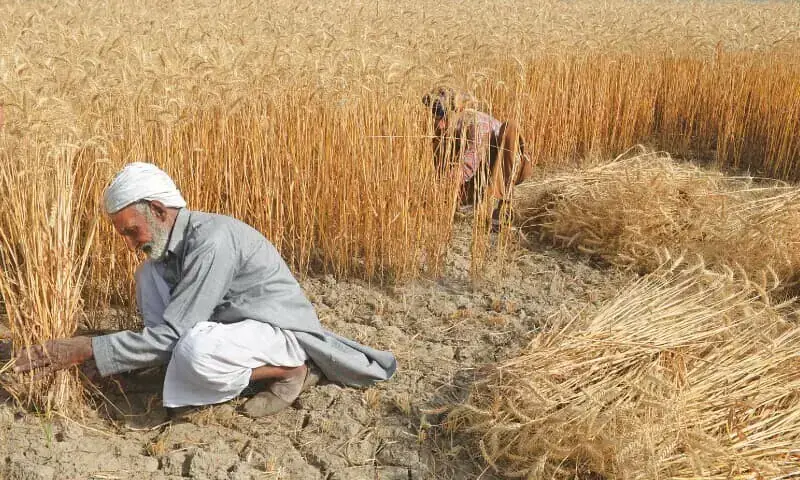
However, the new arrangement, centred on a limited number of selected private companies, did not become operational in time. By mid-April, when around 40 per cent of the crop had been harvested and market arrivals were at their highest, prices had dropped to nearly Rs3,000 per 40 kg, leaving many farmers to make distress sales.
The government had failed to account for changing harvesting patterns. With combine harvesters now more widely used and the risk of erratic rainfall in March and April increasing, farmers are harvesting earlier and more quickly. In many districts, the harvesting period has narrowed to about a month, causing a sharp but brief surge in market arrivals before supplies fall back within days.
Stakeholders criticised the delayed execution, and farmers in particular feared another unsuccessful intervention after the EWR experience. The procurement target of 3m tonnes itself appeared too limited to effectively stabilise the market.
Prices rise as supply concerns emerge
The market shifted unexpectedly in the third week of April, when wheat prices began to move upward. By the fourth week, prices in several grain markets had crossed Rs3,500 per 40 kg, with premium-quality wheat selling at even higher rates for domestic consumption.
It identified several reasons for the increase. Reported yields in different districts were said to be three to five maunds per acre lower than last year. A heatwave shrivelled grain, while untimely rain in March caused lodging and affected both output and quality.
Last year’s sharp difference between prices in April-May and those in December-January — nearly doubling within eight months — had encouraged stockists, whether licensed or otherwise, and flour mills to buy aggressively in expectation of similar gains. Farmers able to hold stocks were also releasing only small quantities to meet immediate cash needs.
This pattern, was reinforced by lower yields and a steep fall in opening wheat stocks at harvest time, estimated at around 2m tonnes this year compared with more than 4m tonnes last year. On that basis, conservative estimates suggested the country could face a wheat shortfall of 2m to 4m tonnes this year.
Expectations were being shaped by global uncertainty. The ongoing war in Iran and disruptions in fertiliser supplies in several countries could reduce production of crops that compete with wheat, potentially lifting wheat prices further. Citing World Bank commodity price data, wheat prices had risen from $250 to $276 per tonne between January and March 2026.
Procurement target becomes harder to meet
Against this backdrop, the government is now facing difficulty in reaching its 3m-tonne procurement goal. With procurement centres becoming functional late and harvesting nearing completion, the target appears increasingly difficult to achieve, particularly when farmers are already receiving Rs3,500 per 40 kg at the farm gate.
After April 29, the government reportedly used heavy administrative measures in several districts to contain prices. It questioned why the government had remained largely inactive when prices had fallen close to Rs3,000 and farmers were incurring losses, but was now intervening as prices recovered.
A similar pattern was noted for last year, when district-level price controls of Rs2,800 to Rs2,900 were imposed and legal action was taken against violators in the early months. Later, when prices rose above Rs4,500 in December and January and large stockists sold their inventories, the government largely tolerated the situation.
Under these conditions, farmers fear that in an effort to meet procurement targets, authorities may use coercive steps, including forced seizure of stocks. This could mean producers, despite output being verified through crop Girdawari, may be compelled to sell against their will.
The latest developments highlight the need for stronger analytical capacity in government, based on computer-based scientific modelling rather than an incremental approach, to estimate supply, demand and future prices while accounting for national and international variables.
Comments
No comments yet. Be the first to join the discussion!