May 3, 2026
Japan’s Takaichi pledges stronger push for ‘free and open' Asia
Japanese Prime Minister Sanae Takaichi said in Hanoi that Japan would play a more proactive role in promoting a ‘free and open Indo-Pacific’. China criticised the initiative, with Beijing accusing Tokyo of ‘stirring up confrontation between camps’.

May 3, 2026
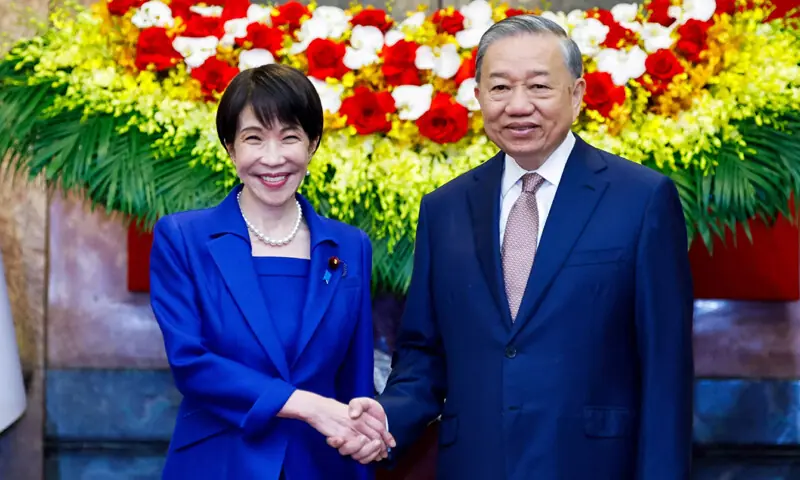
HANOI: Japanese Prime Minister Sanae Takaichi said on Saturday that Japan would step up its efforts to support a ‘free and open Indo-Pacific’, using a speech in Vietnam to underline a regional policy that has long drawn criticism from China.
Addressing an audience at a university in Hanoi, Takaichi said, ‘I am renewing my determination to fulfil Japan’s responsibilities and to play an even more proactive role than ever before in building an international order based on freedom, openness, diversity, inclusiveness, and the rule of law.’
She said Asian countries were facing an era of ‘intensifying geopolitical competition, accelerating technological innovation’ and called on them to build ‘resilience’ and the capacity to ‘determine their own future’.
Japan and Vietnam have shared concerns over China’s territorial claims in the East China Sea and the South China Sea. Both countries have also sought to reduce exposure to trade disruptions driven by the United States by expanding their economic and security cooperation.
At the same time, Vietnam has continued to pursue its traditional ‘bamboo diplomacy’, an approach aimed at maintaining balanced relations with major powers. Japan, by contrast, has seen its already tense ties with Beijing worsen significantly in recent months.
Vietnam speech highlights regional strategy
Vietnam was a notable venue for the speech because Takaichi used it to promote a strategy that is backed by Washington and closely linked with US President Donald Trump.
The concept of a ‘free and open’ Indo-Pacific was first set out a decade ago by former Japanese prime minister Shinzo Abe, who was Takaichi’s mentor. Since then, the framework has been adopted by several US allies and partners seeking to limit China’s influence across the region.
China has strongly criticised the initiative. Beijing has described it as a disguised effort to encourage bloc-based confrontation.
Takaichi’s remarks in Hanoi come against the backdrop of growing strategic competition in Asia, where questions of trade, security and regional influence continue to shape ties among major powers and their neighbours.
Her speech also reflected the differing approaches of Tokyo and Hanoi toward managing relations with China and the United States. While Japan has more openly aligned itself with a broader strategic framework supported by Washington, Vietnam has sought to preserve working ties with all sides.
The address nevertheless underscored common ground between Japan and Vietnam on regional security concerns, particularly over maritime disputes involving China, as well as their shared interest in broadening economic and security links.
0 Comments
No comments yet. Be the first to join the discussion!