

April 30, 2026
Independent press under growing pressure in Pakistan: Hameed Haroon
Speaking at an APNS event in Karachi, Hameed Haroon said independent journalism in Pakistan was under severe pressure and described the current environment as deeply restrictive. He also urged media organisations to innovate and provide job security to journalists.

April 30, 2026
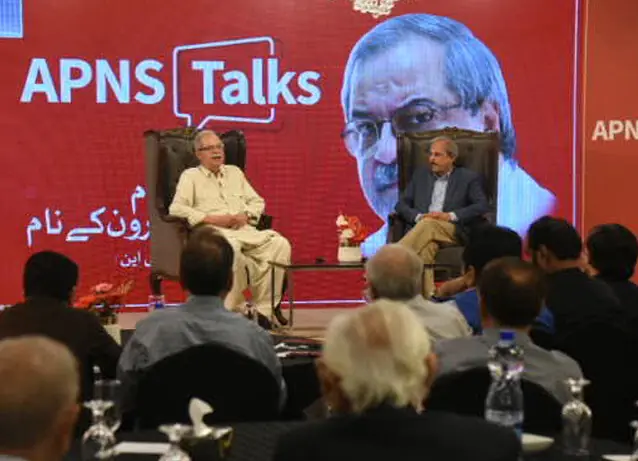
KARACHI: Former All Pakistan Newspapers Society (APNS) president and DawnMedia Chief Executive Hameed Haroon said on Wednesday that independent journalism in Pakistan was facing mounting pressure, arguing that successive governments had maintained what he described as an anti-media approach that had constrained the growth of a free press.
He was speaking at a programme titled APNS Talks, organised by the society at a local hotel in Karachi.
At the start of the session, APNS President Senator Sarmad Ali said the event was intended to draw attention to the pressures and challenges confronting the media industry in Pakistan, as well as the fast-changing environment in which it operates. He said the programme also focused on Haroon’s life, achievements and his struggle for press freedom in the country.
Journalist Mazhar Abbas, who moderated the discussion, asked Haroon to explain how Dawn, which he described as the dream of Jinnah and Liaquat Ali Khan, was being weakened through conspiracies and advertisement bans because of its independent journalism.
In response, Haroon said much of the press in Pakistan had been tamed and that media organisations and journalists attempting to preserve an independent voice and professional standards were often singled out and weakened.
"It is surviving on a shoestring," he said referring to Dawn and added that advertisement restrictions were not limited to the government, saying private advertising was also being blocked through pressure.
Haroon said media houses had faced attacks and pressure in the past as well, but maintained that the government’s anti-media attitude had now reached a new level. "It’s the law of the jungle now," he said. He also said that, apart from the media, the judiciary was under attack as well, referring to the way judges’ transfers had been carried out.
Asked about the future of a free press, Haroon said the outlook under present conditions appeared weak. Even so, he said media organisations could improve their position by acting collectively and by ensuring job security and dignity for journalists. "Unless you learn to provide permanent jobs to journalists, you cannot run a newspaper," he said.
He also said newspapers needed to adapt and bring in innovation to appeal to younger readers instead of simply complaining that young people no longer read newspapers.
On a question regarding coverage of Balochistan, Haroon said reporting from the province had long been subject to restrictions. He said the military, intelligence agencies and tribal sardars had historically exercised strong influence there, limiting the freedom of journalists.
During the session, Haroon also spoke about his personal interests, saying that although he had a deep interest in art, history and literature, music remained his greatest passion. When asked whether he planned to enter politics, he replied in the negative, saying, "You cannot be in politics and in the media at the same time."
Earlier, a documentary was screened at the event. According to the programme details, it highlighted Haroon’s life and achievements, the honours he had received, and his role in strengthening Dawn’s international standing. It also traced his work as a reporter, analyst and publisher.
0 Comments
No comments yet. Be the first to join the discussion!


