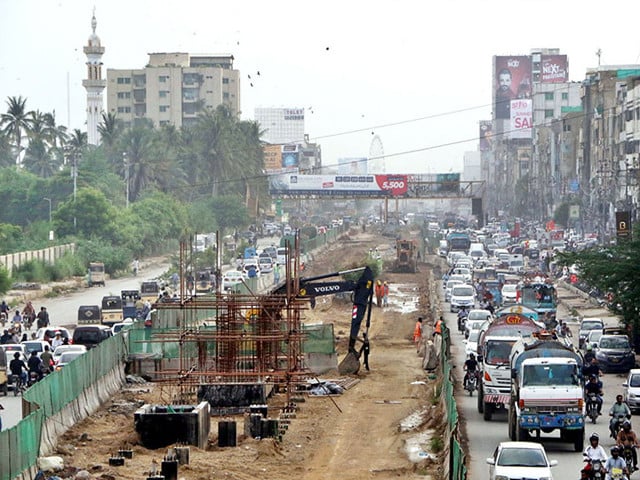
SHC says KSDP-2020 to stay in force until new master plan is notified
The Sindh High Court has ruled that Karachi Strategic Development Plan 2020 will remain operative until a new master plan is lawfully approved and notified. The court also directed authorities to comply with earlier orders on framing rules and regulatory consistency.


KARACHI: The Sindh High Court (SHC) has ruled that the Karachi Strategic Development Plan (KSDP-2020) will continue to remain in effect until another master plan is lawfully approved and notified.
A two-member bench headed by Justice Adnan-ul-Karim Memon issued the ruling while disposing of a petition that had sought immediate, coordinated and effective implementation of the notified KSDP-2020.
"Until any new plan, including the proposed Greater Karachi Regional Plan, 2047, is lawfully approved and notified, the KSDP-2020 shall remain operative," the ruling stated.
The bench further ruled that any departure from the plan would carry legal consequences in accordance with the law, subject to the final policy decisions of the Sindh government on the matter.
The court also directed provincial authorities to comply with its earlier orders concerning the timely framing of rules, consistency in the regulatory framework and adherence to the KSDP-2020.
Petition and contempt plea
The petition was initially filed in 2024 by Advocate Tariq Mansoor, who sought effective implementation of the KSDP-2020. He later moved a contempt application against the Sindh chief secretary, local government secretary and other respondents, alleging non-compliance with SHC orders issued in August and October 2025 regarding implementation of the development plan.
The petitioner argued that despite clear judicial directions, the respondents had failed to implement the KSDP-2020 and, instead of filing compliance affidavits, were resorting to delaying tactics, including review and recall applications. He further contended that such conduct infringed the fundamental rights of around 30 million Karachi residents and was also contrary to international instruments.
Government response and court observations
A provincial law officer, along with counsel for some respondents, submitted counter-affidavits and para-wise comments, raising preliminary objections to the maintainability of the petition. They argued that the matter involved questions that could not be adjudicated under Article 199 of the Constitution. They also stated that although a legislative framework for integrated master planning was under process, it had not yet been finalised.
The assistant advocate general also informed the court that a review application had been filed seeking recall or expunction of an order passed in October last year. He further submitted that the impugned order had wrongly attributed to the Advocate General office an undertaking that was never given, saying enforcement of the KSDP fell within the domain of the relevant authorities, including the Karachi Metropolitan Corporation and the Master Plan Department.
After hearing both sides, the bench observed that the petitioner’s main grievance related to non-implementation of the KSDP-2020 and the failure of the respondent authorities to act in line with the constitutional mandate and binding judicial pronouncements.
At the same time, the court noted that the dispute involved multiple authorities, evolving statutory frameworks, and issues of policy implementation, coordination and regulatory harmonisation, which prima facie ordinarily fall outside the strict scope of the high court’s constitutional jurisdiction.
Reference to earlier SHC order
The bench noted that the SHC had already issued detailed directions on Feb 10, 2026, in another petition, providing a clear mechanism for framing rules, ensuring consistency with KSDP-2020 and restraining authorities from acting in deviation from it until such a framework was duly notified.
According to the order, that earlier ruling adequately addressed concerns relating to regulatory alignment, implementation framework and adherence to the notified master plan, and would continue to hold the field unless set aside by the Federal Constitutional Court.
In its latest order, the bench said the petition and all pending applications were being disposed of with directions to the competent authorities to strictly comply with the Feb 10, 2026 order passed in CP No. D-6603 of 2021, particularly regarding timely framing of rules, consistency of the regulatory framework and adherence to KSDP-2020 in line with binding Supreme Court judgments.
The court recalled that in its Feb 10 order, it had directed the respondents to finalise, frame and notify the Sindh Building Planning, Construction, Control, Demolition and Disposal Rules within three months. It had also ordered that such rules must be strictly in consonance with the parent statute, binding judgments and directions of the Supreme Court, including those related to unlawful commercialisation and change of land use, as well as the objectives and mandatory provisions of the KSDP-2020.
During the intervening period, the SHC had also ruled that neither the Sindh Building Control Authority nor any other authority could exercise powers in deviation of the KSDP until the required rules were framed and notified in conformity with it and in accordance with binding Supreme Court judgments.
Comments
No comments yet. Be the first to join the discussion!