April 28, 2026
Pakistan warns UN maritime disruptions threaten trade, energy and global stability
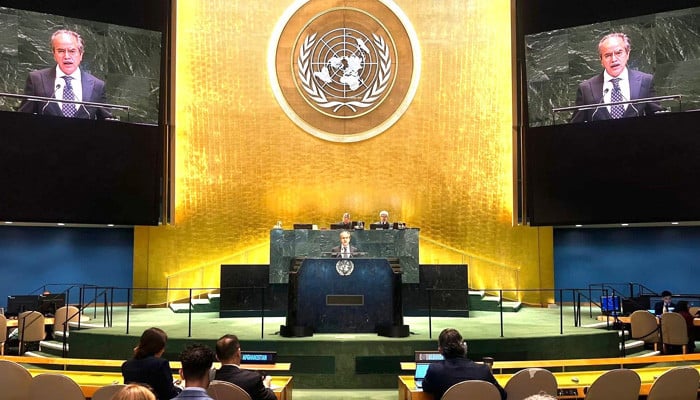
Pakistan told the UN Security Council that disruptions to maritime routes, including the Strait of Hormuz, threaten trade, energy security and economic stability. Ambassador Asim Iftikhar Ahmad said developing countries would be hit hardest if the crisis persists.

April 28, 2026
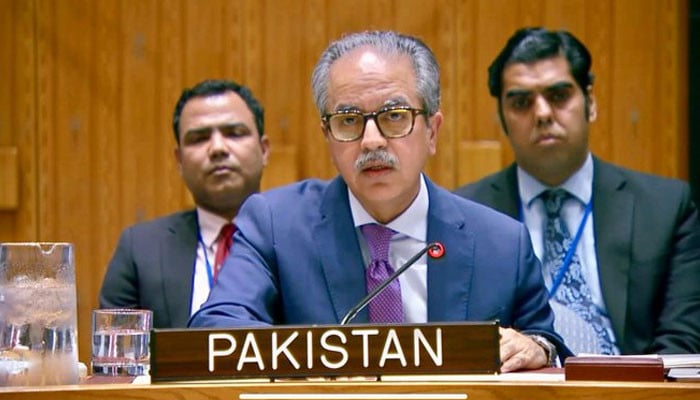
NEW YORK: Pakistan told the United Nations Security Council that growing threats to maritime routes are endangering global trade, energy supplies and wider economic stability, while stressing that the safety of waterways is central to international peace and development.
Pakistan’s Permanent Representative to the United Nations, Ambassador Asim Iftikhar Ahmad, presented the country’s position during the High-Level Open Debate on The Safety and Protection of Waterways in the Maritime Domain.
At the outset, Ahmad congratulated Bahrain on its presidency of the Security Council and for convening the debate. He said the participation of the Bahraini leadership reflected the importance attached to maritime security, which he described as vital for both peace and development.
"Allow me to take this opportunity to express Pakistan’s complete support and solidarity with all brotherly countries of the Gulf region and to their sovereignty, territorial integrity, and political independence," he said, expressing Pakistan’s support for Gulf countries.
The envoy thanked UN Secretary-General Antonio Guterres for his remarks, particularly his emphasis on international law, dialogue, cooperation and the peaceful settlement of disputes. He also acknowledged briefings by International Maritime Organisation Secretary-General Arsenio Dominguez and maritime expert Nick Childs.
Ahmad said maritime spaces had become a major geostrategic arena in the 21st century, describing them as essential to commerce, the environment and marine resources. He told the council that international trade had become more dependent than ever on sea-borne transport due to economic globalisation and advances in transport and connectivity.
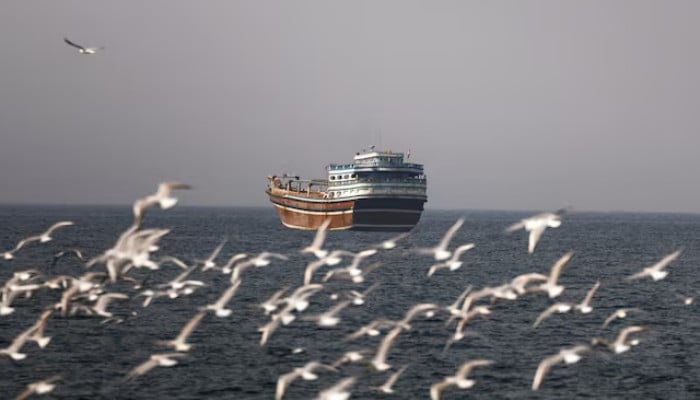
He warned that any interruption in normal maritime traffic could seriously affect global commerce, harm the world economy and create instability with implications for international peace and security. "Closure of the Strait of Hormuz and its cascading effects on food and energy security, and supply-chain disruption is a case in point," he said.
Ahmad added that if the crisis continued, immediate effects on the procurement and pricing of oil, gas and essential commodities such as fertilisers would increasingly lead to broader consequences for inflation, growth, current account pressures and balance of payments, with developing countries likely to suffer the most.
Pakistan says it is directly affected
The ambassador said Pakistan, as a littoral state in the Indian Ocean region located near major maritime chokepoints and heavily reliant on sea-borne trade, was fully aware of the importance of secure waterways. "Like many developing countries from the region and beyond, Pakistan is concerned and directly impacted by the closure of the Strait of Hormuz," he said.
Ahmad also said Pakistan, with support from China, Saudi Arabia, Türkiye and Egypt, had led constructive diplomatic efforts aimed at de-escalation and broader stability between the United States and Iran. He said Pakistan remained committed to diplomacy and dialogue and would continue to pursue all possible steps in that direction.
Broader maritime challenges highlighted
Expanding on the issue, Ahmad said maritime security was not limited to trade routes and piracy. He said it also covered climate change, environmental protection, the security of critical coastal and underwater digital infrastructure, and the protection of human rights at sea.
He said addressing these issues required collective and coordinated action rooted in international law, dialogue and diplomacy. He described the United Nations Convention on the Law of the Sea as one of the key foundations of the international maritime order since its adoption.
Operational role outlined
The envoy said Pakistan had remained a responsible partner in international efforts to improve maritime security. He noted that earlier this year Pakistan took command of Combined Task Force 150 to conduct maritime security operations outside the Arabian Gulf for the protection of commercial shipping.
He added that Pakistan had also commanded CTF-151 last year, a force tasked with counter-piracy operations and ensuring the uninterrupted flow of maritime trade. In addition, he said, Pakistan had launched Regional Maritime Security Patrols to help maintain a safe and secure maritime environment.
Ahmad said the global governance system was facing increasing pressure with far-reaching consequences, and that international waterways had not been spared. He warned that rules and norms developed collectively to prevent confrontation were being challenged or disregarded.
"This is an untenable situation whose prolongation would only further undermine international peace and security, and development, to the detriment of us all," he said, adding, "most consequentially, it will erode trust in the rules-based order."
In his concluding remarks, Ahmad said Pakistan would continue engaging with the UN secretary-general, the Security Council and like-minded countries to preserve gains achieved through international law and diplomacy. "This is a sacred trust that history has placed upon us, and we cannot afford to fail. We must succeed, together," Ambassador Ahmad said.
0 Comments
No comments yet. Be the first to join the discussion!