Naval Chief warns Indian Ocean risks could disrupt global trade, shape future warfare
Pakistan’s Naval Chief Naveed Ashraf says future warfare will be shaped in the Indian Ocean, warning that any disruption could disrupt global supply chains and energy markets. He urged closer industry-academia collaboration on emerging technologies.

KARACHI: Chief of the Naval Staff Naveed Ashraf on Thursday cautioned that the future of warfare is increasingly being shaped in the Indian Ocean, warning that any disruption in the region could have serious consequences for global supply chains and energy markets.
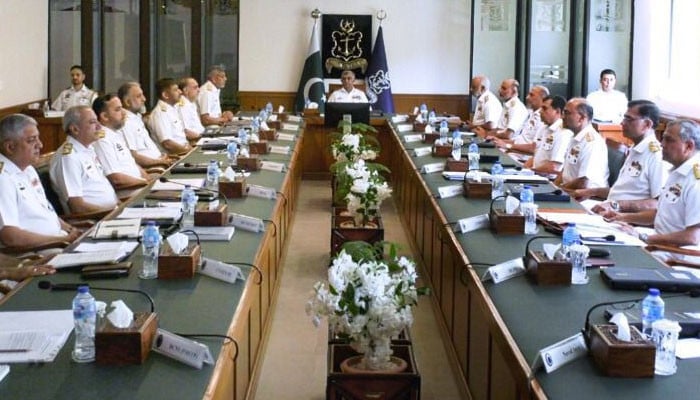
According to a statement issued by Inter-Services Public Relations (ISPR), the naval chief made these remarks while addressing the closing session of a two-day international conference titled “Emerging Technologies and the Future Warfare,” hosted by the Maritime Centre of Excellence in Karachi, where he attended as chief guest.
The conference brought together maritime experts, academics, policymakers and defence industry representatives to examine evolving geostrategic dynamics and the transformative role of emerging technologies in modern warfare.
In his address, Admiral Ashraf emphasised the need for stronger collaboration between industry, operational forces and academia to foster innovation and ensure adaptability in an increasingly complex security environment. He noted that such partnerships would be critical in promoting indigenisation and self-reliance, ultimately enabling Pakistan to build a cost-effective and globally competitive defence ecosystem with export potential.
Highlighting the strategic importance of the Indian Ocean, he stressed that the region serves as a vital artery for global trade, making its security essential not only for regional stability but also for the broader international economy.
Discussions at the conference underscored how rapid technological advancements — particularly in areas such as unmanned systems, artificial intelligence and precision weaponry — are blurring the traditional boundaries between civilian and military applications. Participants noted that this convergence presents both opportunities and complex challenges for defence planners.
The event was attended by senior military officials, diplomats, policymakers, industry leaders and students, and concluded with a consensus on the need for sustained intellectual collaboration to effectively navigate technology-driven transformations in warfare.
Earlier this year, the Pakistan Navy conducted a joint “Passage Exercise” with a Royal Oman Navy ship, KHASAB, demonstrating operational coordination and maritime cooperation.
Subsequently, naval forces carried out a comprehensive exercise in the North Arabian Sea, testing advanced capabilities including surface-to-air missiles, loitering munitions and an unmanned surface vessel.
Officials also recalled last year’s tensions between Pakistan and India, during which the Pakistan Navy successfully deterred the deployment of India’s aircraft carrier INS Vikrant in the North Arabian Sea through a coordinated maritime strategy.
According to officials, the navy not only confined Indian naval movements but also ensured the safety of Pakistan’s maritime trade routes and coastal regions during the standoff.
Prime Minister Shehbaz Sharif had earlier commended the navy’s operational readiness and professionalism, noting that the force stood prepared to undertake operations comparable to Operation Dwarka, though direct confrontation was ultimately avoided.
Comments
No comments yet. Be the first to join the discussion!