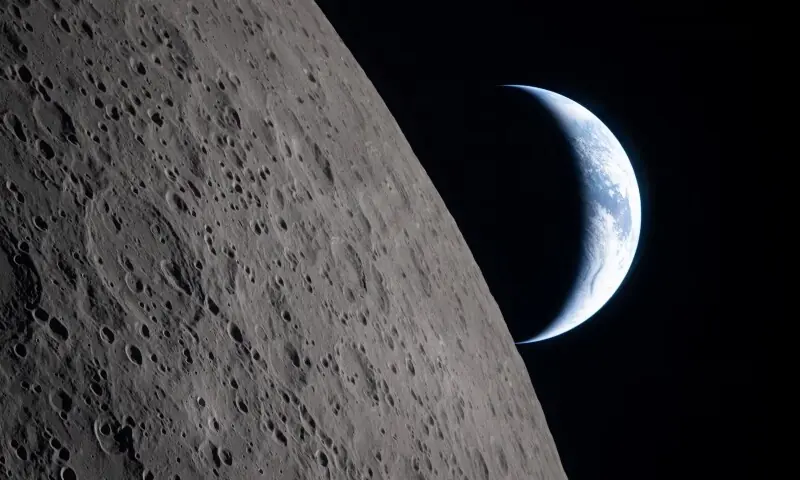
NASA moon mission raises pressure on China’s 2030 crewed landing plan
NASA’s Artemis progress has sharpened focus on China’s plan to land astronauts on the moon by 2030. The race carries both technical challenges and growing geopolitical significance.

Beijing: NASA’s latest Artemis mission has intensified attention on China’s plan to send astronauts to the moon by 2030, as the United States moves closer to returning humans to the lunar surface and competition between the two powers expands into space.
Four US astronauts on the Artemis II mission flew past the moon’s shadowed far side this week, travelling farther into space than any humans before them. The mission is intended to pave the way for Artemis IV, which is scheduled to land on the moon in 2028.
The planned US return to the moon after more than 50 years is being watched closely in China, which is building the full system needed for its first crewed lunar landing. That includes the Long March-10 rocket, the Mengzhou spacecraft and the Lanyue lunar lander.
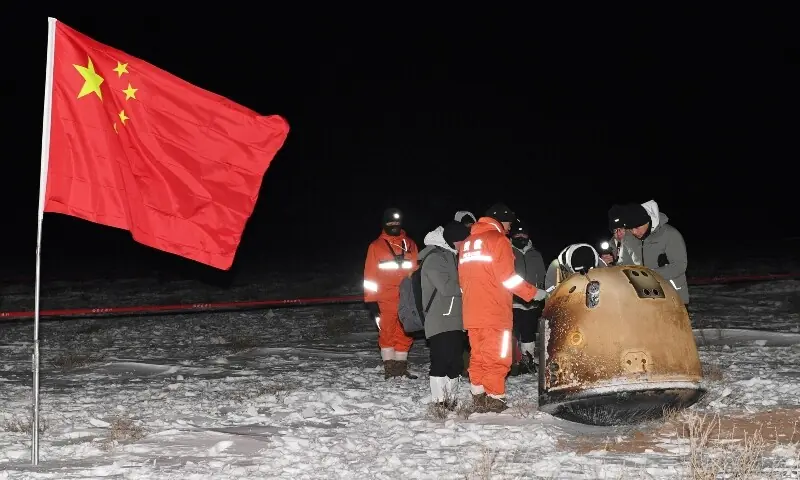
China has made notable progress in recent years, becoming the first country to bring back robotic samples from both the near and far sides of the moon. Its human spaceflight programme has also gained experience in operating space stations and managing emergencies in orbit.
Clayton Swope, deputy director of the Aerospace Security Project at the US-based Center for Strategic and International Studies, said, “There is no bigger prize for China on the table today than landing people on the moon, this is the essential next step for China on the road to preeminence in space.”
The United States and China are also advancing rival frameworks for future lunar activity. The US is promoting the Artemis Accords on lunar exploration, while China and Russia are backing the International Lunar Research Station. Kang Guohua, an aerospace professor at the military-linked Nanjing University of Aeronautics and Astronautics, told China’s state-backed Global Times last week that “The question now is no longer simply who gets there first, but who can stay longer and do more.”
New lunar hardware still under testing
A key challenge for Beijing is to validate an entirely new lunar mission architecture within the next four years. China must show that all of the systems being developed for the 2030 mission, from heavy-lift rockets to spacesuits, can operate reliably on their first use.
China’s manned space agency said in 2023 that the mission would use two Long March-10 rockets, with one carrying a crewed spacecraft and the other launching a lunar lander. The two vehicles would meet and dock in lunar orbit. Two astronauts would then descend to the surface, gather samples, return to lunar orbit, dock again with the spacecraft and travel back to Earth.
The Mengzhou spacecraft can carry up to seven astronauts, according to China’s manned space agency, although the agency has not announced the size of the 2030 crew or the identities of its members.
China’s recent robotic moon missions have provided experience in communications as well as rendezvous and docking operations around the moon. However, crewed missions require much stricter safety standards, and important parts of the mission sequence, including the rocket and spacecraft, are still being tested.
In February, China conducted the first low-altitude escape test for the Long March-10 with a Mengzhou spacecraft on board at a launch site on Hainan Island. The return capsule separated successfully after an abort command and landed safely at sea. Last year, the ascent and descent functions of the Lanyue lunar lander were also tested in Hebei province.
These were important milestones, but added that testing would need to move faster if China is to certify the system for a crewed moon landing by 2030. Even so, Swope said China appeared to be progressing steadily and that it seemed “very plausible” the country would meet its target. He added, “China has a history of setting deadlines for space activities and closely meeting those deadlines, there are no public signs of any missteps or setbacks to Beijing’s crewed lunar landing plans.”
Moon programme carries geopolitical weight
The contest is not only technological but also geopolitical. As rivalry between Washington and Beijing deepens in trade, technology and military power, lunar exploration has become another field of competition.
US analysts cited China’s rising defence spending, its use of space diplomacy to expand influence abroad, the growth of its private launch sector and its successful robotic lunar missions as signs that Beijing is strongly motivated to reach the moon quickly, even though it does not publicly frame the effort as a race.
Kathleen Curlee, a research analyst at Georgetown University’s Center for Security and Emerging Technology, said, “China might avoid directly using language that suggests there is a lunar or space race, but their overall strategic goal is to be the hegemon in space.”
At the same time, Chinese officials have suggested the 2030 target may leave room for an earlier achievement. Wu Weiren, chief designer of China’s lunar exploration programme, told Reuters last year that the deadline was intentionally conservative. “Eastern peoples always leave a little room when they speak,” he said, adding, “If I can do a 10, I tend to say eight or nine.”
1 Comment
No comments yet. Be the first to join the discussion!