Dar, Saudi FM push for urgent de-escalation as Pakistan steps up Middle East diplomacy
Deputy PM and Foreign Minister Ishaq Dar urged urgent de-escalation with Saudi FM Prince Faisal bin Farhan as US-Israel-Iran tensions escalate. The leaders agreed to stay in close contact amid regional attacks.

Second call in as many days as Islamabad intensifies high-level diplomatic outreach
Pakistan, Saudi Arabia stress dialogue, restraint amid US-Israel–Iran escalation
Development comes as Saudi Arabia, other Gulf nations face Iranian missile and drone attacks
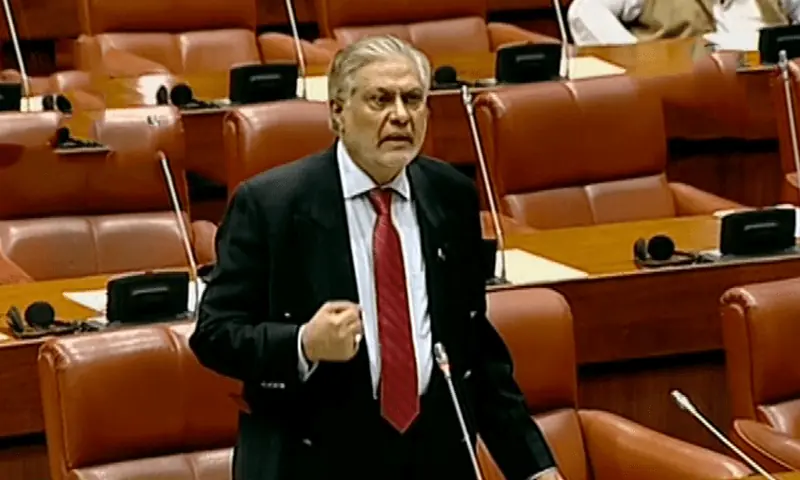
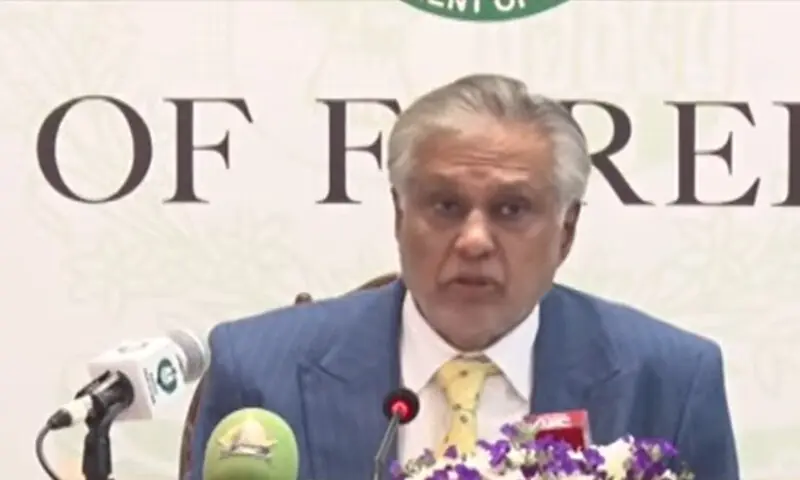
ISLAMABAD: Deputy Prime Minister and Foreign Minister Ishaq Dar on Sunday held a telephonic conversation with Saudi Foreign Minister Prince Faisal bin Farhan Al Saud, during which the two leaders reviewed the evolving situation in the Middle East and underscored the urgent need for de-escalation to ensure regional peace and stability, the Foreign Office (FO) said.
Deputy Prime Minister & Foreign Minister Senator Mohammad Ishaq Dar @MIshaqDar50 spoke with Saudi Foreign Minister HH Prince Faisal bin Farhan Al Saud @FaisalBinFarhan to review the latest regional developments.
Both leaders emphasized the urgent need for de-escalation to… pic.twitter.com/OgBxhHEMOB— Ministry of Foreign Affairs - Pakistan (@ForeignOfficePk) April 5, 2026
In a statement posted on X, the FO said both leaders agreed to remain in close contact as tensions continue to intensify in the region. This marked the second telephonic conversation between the two foreign ministers in as many days, reflecting heightened diplomatic engagement amid the ongoing conflict.
The Middle East has witnessed a sharp escalation, with the United States and Israel launching strikes against Iran, followed by Tehran’s counterattacks across the Gulf, raising concerns of a wider regional confrontation.
On Friday, Dar and his Saudi counterpart had also discussed the Pakistan-China five-point initiative aimed at defusing tensions arising from the US-Israeli war on Iran. The proposal — put forward during Dar’s recent visit to China — calls for an immediate ceasefire, initiation of peace talks, protection of civilian and commercial infrastructure including shipping lanes, and adherence to the United Nations Charter.
A day earlier, Dar held separate telephonic conversations with his counterparts from Egypt, Bahrain, and Iran, focusing on bilateral ties, the evolving regional situation, and coordinated efforts for de-escalation.
According to the FO, Dar spoke with Egypt’s Foreign Minister Badr Abdelatty, with both sides stressing the importance of dialogue and diplomatic engagement, and agreeing to remain in close coordination.
In a separate call with Bahrain’s Foreign Minister Abdullatif bin Rashid Al Zayani, Dar highlighted the Pakistan-China initiative and discussed multilateral diplomatic efforts, including at the United Nations Security Council. The Bahraini foreign minister appreciated Pakistan’s role in promoting dialogue and regional stability.
“FM Dar underscored the urgent need for de-escalation and emphasised the importance of dialogue and diplomacy,” the FO said.
Pakistan has increasingly positioned itself as a neutral facilitator amid escalating tensions between Washington and Tehran, offering Islamabad as a venue for dialogue as part of broader efforts to ease hostilities triggered by recent military strikes.
Earlier, Iranian Foreign Minister Abbas Araghchi expressed gratitude to Pakistan for its mediation efforts, stating that Tehran had “never refused to go to Islamabad” for talks. He said Iran’s position was being misrepresented in sections of the US media, adding that the focus remained on achieving a “conclusive and lasting end” to the conflict.
The conflict has had wider regional repercussions, with Saudi Arabia and other Gulf countries facing waves of Iranian missile and drone attacks since the outbreak of hostilities on Feb 28.
Last week, Prime Minister Shehbaz Sharif reaffirmed Pakistan’s “unwavering support” for Saudi Arabia, while Islamabad also hosted quadrilateral consultations with Saudi Arabia, Türkiye, and Egypt aimed at defusing tensions.
Pakistan and Saudi Arabia further strengthened ties with a landmark defence pact signed in September last year, under which aggression against one country would be considered an attack on both.
The FO has reiterated that Pakistan seeks to act as a “bridge builder” in the region, promoting diplomacy and dialogue to prevent further escalation in the Middle East.

Comments
No comments yet. Be the first to join the discussion!