At UNSC, Pakistan pushes for ‘restraint, diplomacy & dialogue’ amid raging Mideast conflict
Pakistan reaffirmed support for the GCC as a pillar of stability at the UNSC, condemning attacks on Gulf states and warning US-Israeli strikes on Iran could widen fallout. Calls for ceasefire, diplomacy and inclusive peace talks.

Ambassador Asim Iftikhar Ahmad hails GCC as ‘pillar of stability,’ condemning attacks on Bahrain, Saudi Arabia, UAE and others
Envoy warns US-Israeli strikes on Iran risk wider regional fallout, calling for immediate ceasefire, diplomacy and inclusive peace talks
Describing joint Pakistan-China roadmap as remedy for de-escalation, maritime security
Tells UNSC strikes on civilian infrastructure ‘unacceptable’, signals unified push for peaceful resolution
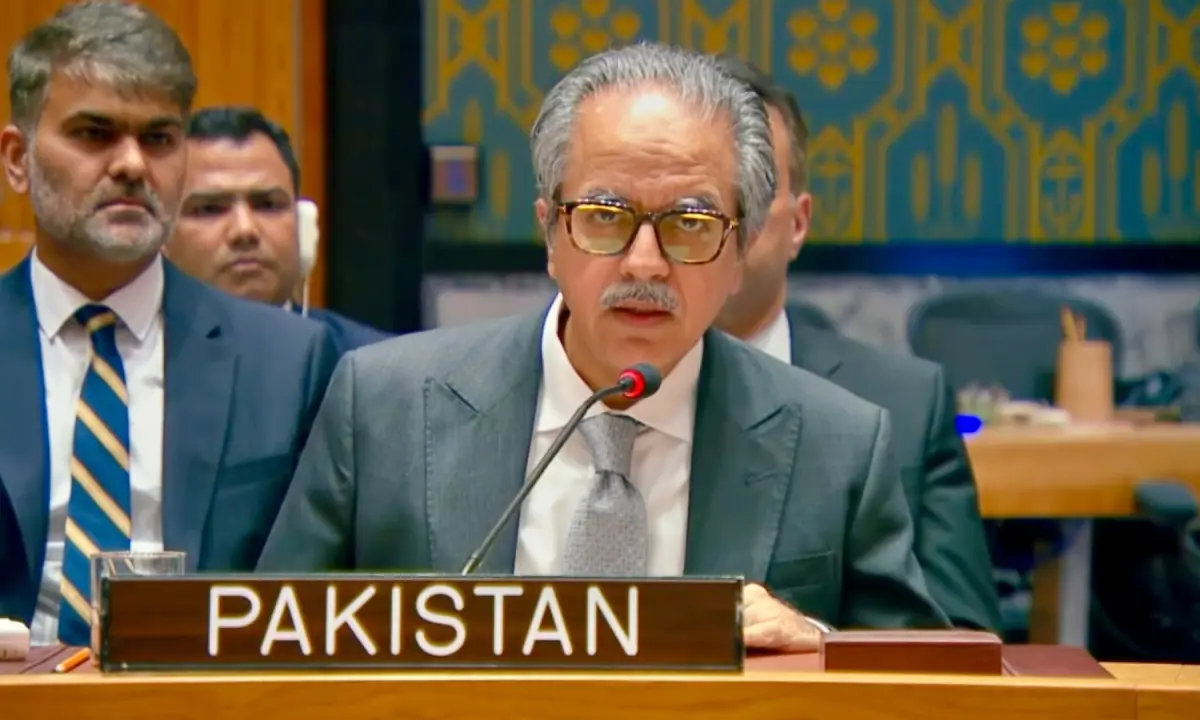
UNITED NATIONS: Pakistan on Thursday reaffirmed its unwavering support for the Gulf Cooperation Council (GCC), describing it as a “pillar of regional stability,” while strongly condemning attacks against its member states amid the intensifying Middle East conflict and urging restraint, dialogue and diplomacy to restore peace.
“We appreciate the strategic restraint demonstrated by GCC countries in the face of such provocation and aggression,” Pakistan’s Permanent Representative to the UN, Ambassador Asim Iftikhar Ahmad, told the UN Security Council during a meeting held under Bahrain’s presidency on strengthening cooperation between the United Nations and Gulf Arab states.
Reiterating Pakistan’s firm stance, the envoy condemned attacks targeting Bahrain, Kuwait, Oman, Qatar, Saudi Arabia and the United Arab Emirates, as tensions continue to spiral across the region.
At the same time, he expressed grave concern over the “deeply troubling developments,” particularly the US-Israeli coordinated strikes against Iran on February 28, warning that these actions have triggered dangerous escalation.
“These developments have undermined regional stability and carry serious implications for international peace and security, as well as the global economy and prosperity,” he said.
Ambassador Ahmad underscored that Pakistan “categorically condemns all attacks on civilians and civilian infrastructure,” stressing that strikes on power plants, energy facilities, educational institutions, hospitals and other essential sites are unacceptable.
“De-escalation and a complete cessation of hostilities must be our top priority,” he added.
Highlighting diplomatic efforts, he said Pakistan and China had jointly proposed a roadmap calling for an immediate halt to hostilities, the launch of inclusive peace talks, protection of civilians, restoration of maritime security in the Strait of Hormuz, and reaffirmation of the UN Charter and international law as the basis for a lasting political settlement.
Referring to a recent meeting in Islamabad involving the foreign ministers of Pakistan, Egypt, Turkiye and Saudi Arabia, the envoy said it reflected a shared urgency to de-escalate tensions, intensify diplomatic engagement, and pursue a peaceful resolution to the ongoing crisis.
He emphasized that Pakistan attaches great importance to its fraternal ties with GCC countries, rooted in shared religious and cultural values, mutual respect, and strong people-to-people connections, alongside robust cooperation in political, security, economic, trade, energy and development sectors.
The Pakistani diaspora in GCC states, he noted, serves as a vital bridge contributing to the prosperity of host nations and further strengthening bilateral relations.
“Pakistan will always stand firmly alongside the brotherly nations of Bahrain, Kuwait, Oman, Qatar, Saudi Arabia and the UAE,” he affirmed.
Ambassador Ahmad stressed that enhanced UN-GCC cooperation is both a “strategic necessity and a practical pathway” for more effective multilateral action, noting the GCC’s proactive role in addressing crises in Palestine, Yemen, Syria and Lebanon.
He also highlighted the UN General Assembly’s unanimous Resolution 79/296, which reaffirms support for deeper UN-GCC collaboration through high-level exchanges, joint initiatives and expanded cooperation across political, economic and social domains.
“We support its call to align priorities, promote multilateralism and strengthen collective responses to global challenges,” he said.
Earlier, UN Assistant Secretary-General Khaled Khiari warned the Security Council that the Middle East stands “at a dangerous precipice,” condemning US and Israeli strikes on Iran.
He also referred to last month’s Security Council Resolution 2817 (2026), which called for an immediate halt to all attacks by Tehran against Bahrain, Kuwait, Oman, Qatar, Saudi Arabia, the United Arab Emirates and Jordan.
GCC Secretary-General Jassim Albudaiwi told the Council that Iran had targeted critical civilian infrastructure, including airports, oil facilities, residential and commercial areas, fuel depots, service installations and diplomatic missions.
“The GCC strongly condemns these blatant Iranian attacks, which constitute a flagrant violation of the sovereignty of GCC states,” he said, stressing that they also breach international law, the UN Charter and principles of good neighbourly relations.
“GCC states do not seek war,” he added. “They seek the peace, security and stability that all peoples deserve.”
Comments
No comments yet. Be the first to join the discussion!