Holding on
The government continues to absorb rising fuel prices, but uncertainty looms as international costs rise. Can they maintain this strategy amidst economic pressures?

The government is absorbing the fuel price increase, but for how long?
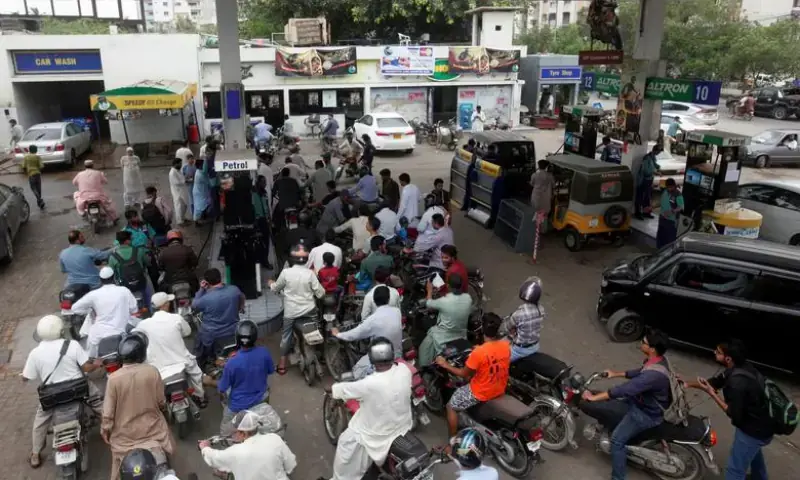
For the second week in a row, the government has held the line, and refused to raise the price of petrol or diesel. However, the Prime Minister, who appeared on national TV to announce the government’s resolve, did show some sign of cracking under the pressure of the steady hike in the international price, which is now nearly $107 per barrel. He said that he had rejected a summary to raise the petrol. price to Rs 361. He said that if price had been left to go up freely, the petrol price would have reached Rs 544 per litre, and that of diesel Rs 790. That shows that the government is uncertain about how much longer it can afford to bankroll the petrol price. Indeed, with one estimate of the international price crossing $190 per barrel, it does seem difficult for the government to hold the line.
The government is trying to do something very difficult, some would say impossible— meet the IMF’s conditions while giving some relief to the population. A number of austerity measures are not so much meant to cut fuel consumption by the government so much as save money for the subsidy it is giving. The whole idea is to cut spending in one area, so that the subsidy does not mean raising spending. Actually, that makes economic sense in more ways than one,, for if the government keeps down fuel prices, it will do so to curb inflation, but it it needs to print money to pay the subsidy, and that will prove inflationary as well, not to mention that it might bankrupt the government.
The only way out is for the Strait of Hormuz to reopen and the oil price to go down to pre-war levels. However, while Pakistan is in the forefront of the mediation process, there is little sign that that will happen anytime soon, especially with exchanges of ordnance still going on. If that was to happen anytime soon, then the government would be right to stay the course, but if the chances incline as they do towards a prolonged conflict, then the government might do well to let prices go where they will sooner rather than later. After all, voters are unlikely to remember how long prices were kept low, if they end up paying more. If the war does not end soon, that seems likely.

The Editorial Department of Pakistan Today can be contacted at: [email protected].
View all articles →Comments
No comments yet. Be the first to join the discussion!