Pakistan’s Clear Stance on Iran Issue, Gaza Board of Peace and Abraham Accords
Pakistan maintains a principled stance on Middle Eastern geopolitics, rejecting the Abraham Accords while supporting Palestine's right to self-determination. The Board of Peace is seen as a humanitarian initiative to address the Gaza crisis.

Standing on principle
Pakistan’s position on Middle Eastern geopolitics remains consistent and principled, particularly regarding Palestine, the Abraham Accords, regional security initiatives, and tensions involving Iran, and is firmly rooted in its historical, ideological, and moral foreign policy foundations.
Pakistan has repeatedly and unequivocally refused to join the Abraham Accords across all diplomatic platforms, not due to shifting alliances or external pressure, but because of its long-standing commitment to the Palestinian cause. Since its founding, Pakistan has supported the Palestinians’ right to self-determination and the establishment of an independent, sovereign Palestinian state based on pre-1967 borders with East Jerusalem as its capital, in line with UN resolutions and international consensus. Accordingly, its rejection of the Abraham Accords reflects a deliberate ethical stance rather than opposition to peace, as Pakistan believes such frameworks fail to adequately address the core political and humanitarian injustices faced by Palestinians and risk sidelining the central issue of occupation in favour of premature normalization.
This approach, while potentially foregoing certain immediate diplomatic or economic rewards offered by more transactional relationships, contributes decisively to Pakistan’s long-term credibility and stature. For many observers, analysts, and ordinary citizens within Pakistan, it is profoundly encouraging to witness their nation asserting its sovereign views with confidence, reinforcing the enduring belief that a truly strong and respected nation is one that can articulate its foundational principles clearly, defend them with reasoned argument, and pursue them with steadfast resolve in the great and enduring arena of international relations
In this broader and intensely complicated context, the recent emergence of the Board of Peace, joined collectively by eight nations striving to present a unified and common voice amid a cacophony of conflicting interests, has been cautiously welcomed by Pakistan as a potentially constructive and primarily humanitarian initiative. The Board of Peace is perceived within Pakistan’s diplomatic circles as a viable, albeit nascent, beacon of hope for alleviating the dire situation in Gaza and for refocusing international attention on the wider Palestinian issue, especially at a time when prolonged and brutal conflict, catastrophic humanitarian crises, and profound political paralysis within the international community have created almost unimaginable suffering and despair for Palestinian civilians.
Pakistan’s diplomatic association with, or expressed sympathy for, the humanitarian objectives of the Board of Peace is, however, often misunderstood, misinterpreted, or at times deliberately misrepresented by some external observers and commentators as being intrinsically linked to, or a subtle stepping stone toward, the Abraham Accords, or even misconstrued as an alternative, indirect pathway to eventual normalization with the State of Israel.
Pakistan has firmly, repeatedly, and at the highest levels rejected this speculative and inaccurate narrative, clarifying with utmost precision that its participation in or support for the humanitarian aims of the Board of Peace has absolutely no connection whatsoever with the political or strategic objectives of the Abraham Accords, nor does it signal— in any manner, shape, or form— the faintest shift or dilution in its firmly established, historically consistent position on non-recognition of Israel and unwavering support for Palestine.
The Board of Peace, in Pakistan’s official and carefully considered view, is interpreted strictly as a humanitarian and diplomatic platform designed to amplify collective international concern, promote dialogue, alleviate human suffering, and advocate for a just peace, rather than as a mechanism for political trade-offs, strategic realignments, or a backdoor process for normalization that ignores Palestinian rights.
Concurrently, and with equal clarity, Pakistan has also made it explicitly clear through its diplomatic channels that it has not taken any decision to join the proposed multinational Gaza Stabilisation Force, a stance that further underscores the fact that its foreign policy choices are guided by independent, careful, and sovereign assessment of national principles and long-term interests rather than by external pressure, fleeting regional trends, or the allure of tactical alliances.
The decision not to participate in such an international force reflects Pakistan’s deep-seated caution and strategic prudence regarding external military or quasi-military engagements in a highly volatile theatre that may, however well-intentioned, inadvertently complicate an already explosive situation, potentially draw participants into open conflict, or legitimize arrangements that circumvent a permanent political solution.
Pakistan’s philosophical and pragmatic belief holds that lasting peace and genuine stability in Gaza and the broader Palestinian territories cannot be achieved solely through security deployments, force-centric approaches, or externally imposed security architectures.
Instead, it consistently and vocally emphasizes the paramount importance of addressing the root political causes of the conflict, including but not limited to prolonged military occupation, the systematic denial of fundamental national and human rights, deliberate economic deprivation and blockade, and the tragic absence of a credible, inclusive, and time-bound political process under international auspices.
By maintaining a principled distance from initiatives that could be perceived as militarizing the management of the crisis or as substituting for political justice, Pakistan seeks to preserve its hard-earned moral credibility, maintain its diplomatic neutrality as a consistent advocate for the oppressed, and continue to be a voice prioritizing peaceful, negotiated, and just solutions grounded in international law.
Crucially, and as a definitive rebuttal to any speculation, Pakistan has emphasized repeatedly that its core position on the Palestinian question has not changed, will not change, and cannot change. The Palestinian cause holds profound emotional, religious, historical, and political significance for the people of Pakistan, cutting across all party lines, socio-economic divisions, and provincial identities, forming a rare and powerful unifying national consensus.
Any perception, however faint, of a deviation would not only severely undermine Pakistan’s international credibility among the Islamic and non-aligned worlds but would also fundamentally contradict the collective conscience and will of its citizenry. Recognizing this deep internal covenant, Pakistan’s leadership and diplomatic institutions have been meticulously careful to ensure that every international engagement, every official statement, and every nuanced policy decision is aligned with the expectations of the Pakistani people and the broader Ummah.
Pakistan has also articulated a clear and principled stance on Iran, particularly in the recent context of rising regional tensions and the risk of escalation. Pakistan has stressed, at forums like the United Nations and in direct bilateral communications, the urgent and unavoidable need to resolve all outstanding issues through diplomacy, dialogue, and peaceful engagement, while opposing any call for using military force against Tehran.
This position reflects Pakistan’s broader philosophical conviction, forged in the fires of its own regional conflicts, that military solutions to complex challenges most often exacerbate instability, unleash unintended consequences, and cause human suffering rather than resolve underlying disputes. Given Pakistan’s geographical proximity to Iran, Islamabad views any potential armed conflict involving Iran not as a distant event but as a direct and immediate threat to regional peace and to its own core national interests, including economic security and internal stability. Pakistan’s persistent advocacy for diplomacy and de-escalation is therefore both a principled stand against war and a pragmatic necessity.
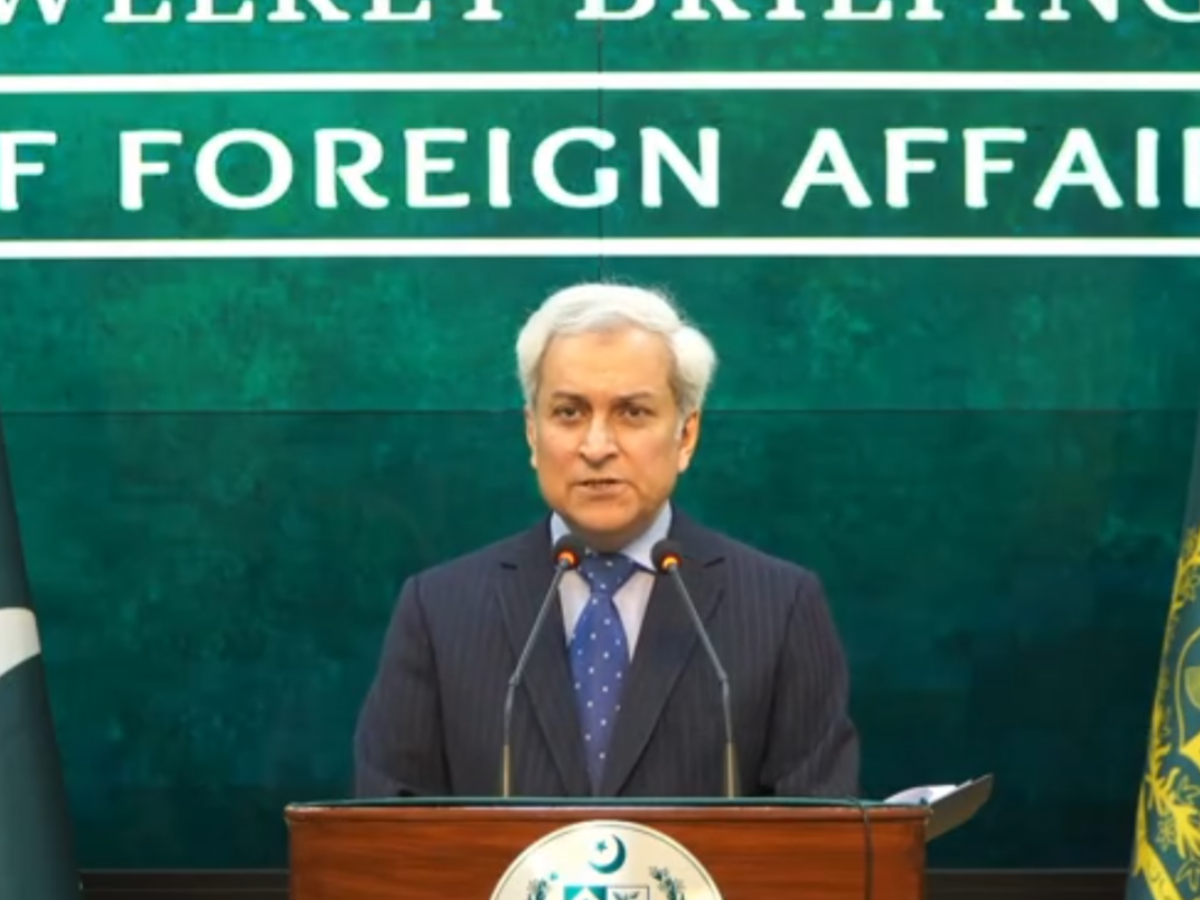
The Foreign Office has played an indispensable and central role in and projecting these nuanced yet firm positions in international diplomacy. This deliberate alignment between official state policy and overwhelming public sentiment has significantly reinforced the domestic and international legitimacy of Pakistan’s foreign policy choices and has tangibly strengthened public trust in its diplomatic institutions.
The unambiguous clarity and unwavering consistency of Pakistan’s messaging have served as a vital tool to counter misinformation or deliberate obfuscation, particularly regarding highly sensitive and easily conflated issues such as the distinction between the Abraham Accords and humanitarian initiatives, the nature of its association with the Board of Peace, and its reservations about Western-led regional security initiatives.
Domestically, the government’s clear and principled stance on these interconnected Middle Eastern issues has been widely appreciated and endorsed by the Pakistani populace. In an international environment often characterized by realpolitik, moral ambiguity, shifting loyalties, and purely transactional diplomacy, Pakistan’s willingness to openly, boldly, and freely express its point of view— even when it may not align with powerful global actors— stands out as a mark of sovereign dignity.
A significant plurality of Pakistanis view this diplomatic assertiveness not as mere defiance but as reflecting national strength. The widespread perception that Pakistan is standing firm on issues of global justice, human dignity, and the sanctity of international law resonates deeply. This popular appreciation transcends mere rhetorical support; it actively reinforces a powerful sense of national unity and pride, particularly in moments when Pakistan’s positions are seen to be in harmony with ethical, religious, and humanitarian convictions.
At the broadest level of strategic analysis, Pakistan’s calibrated and values-driven approach illustrates a sophisticated and ongoing attempt to balance pragmatic realism with immutable principle in an increasingly complex, multipolar, and often adversarial global order. By refusing to join the Abraham Accords, meticulously clarifying the strictly humanitarian and non-political nature of its association with the Board of Peace, thoughtfully declining participation in the Gaza Stabilisation Force, and proactively advocating for diplomacy over force in relation to Iran, Pakistan sends a coherent signal to the world that it seeks constructive and responsible engagement in world affairs without compromising the core values that constitute its national identity.
This approach, while potentially foregoing certain immediate diplomatic or economic rewards offered by more transactional relationships, contributes decisively to Pakistan’s long-term credibility and stature. For many observers, analysts, and ordinary citizens within Pakistan, it is profoundly encouraging to witness their nation asserting its sovereign views with confidence, reinforcing the enduring belief that a truly strong and respected nation is one that can articulate its foundational principles clearly, defend them with reasoned argument, and pursue them with steadfast resolve in the great and enduring arena of international relations.

Comments
No comments yet. Be the first to join the discussion!