

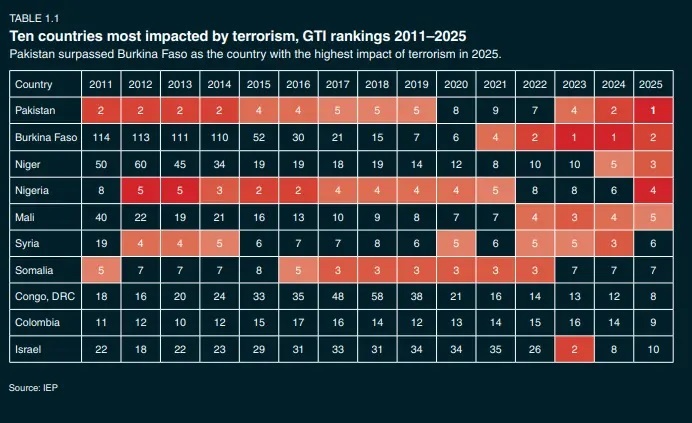
Pakistan tops Global Terrorism Index as deaths hit decade-high in 2025
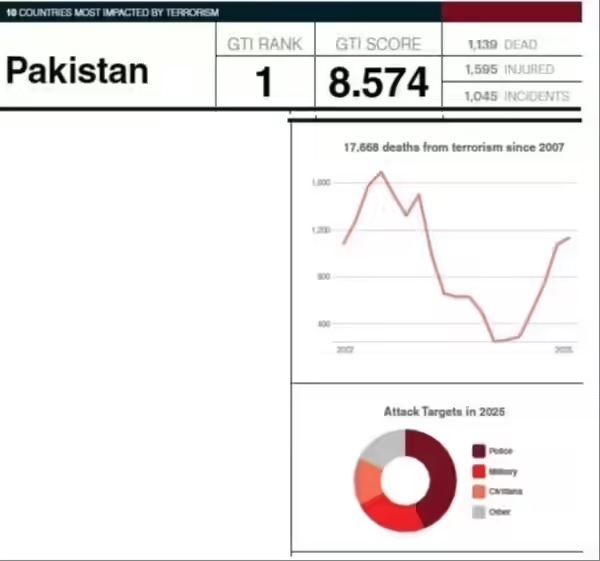
Pakistan has ranked first in the Global Terrorism Index 2026, with terrorism-related deaths rising to 1,139 in 2025, the highest since 2013. The TTP emerges as the deadliest group, responsible for 56% of fatalities.

Terror-related deaths rise 6pc to 1,139, in 2025, highest since 2013
Pakistan ranked most impacted among 163 countries covering 99.7pc of global population
TTP emerges as deadliest group, third deadliest globally and responsible for 56pc of deaths
Hostage cases surge to 655, driven by Jaffar Express attack involving 442 people
KP, Balochistan account for 74pc attacks, 67pc fatalities nationwide
Globally, terrorism declines 28pc, but West sees 280pc spike in incidents
ISLAMABAD: Pakistan has, for the first time, ranked at the top of the Global Terrorism Index (GTI), recording a six per cent increase in terrorism-related deaths to 1,139 in 2025, according to a report covering 163 countries representing 99.7 per cent of the world’s population.
The Global Terrorism Index 2026, published by the Institute for Economics and Peace (IEP), provides a comprehensive assessment of terrorism trends and patterns over the past two decades, ranking countries based on the impact of terrorism using indicators such as the number of incidents, fatalities, injuries, and hostages.
Last year, Pakistan ranked second in the Global Terrorism Index (GTI) 2025, with terrorism-related deaths rising by 45 per cent to 1,081.
According to the report, Pakistan’s “strained” relations with neighbouring countries—particularly Afghanistan—along with escalating violence by the banned Tehreek-i-Taliban Pakistan (TTP) and the banned Balochistan Liberation Army (BLA), have created “significant security” risks for the country.
“Deaths from terrorism in Pakistan are now at their highest level since 2013, with the country recording 1,139 terrorism deaths and 1,045 incidents in 2025,” the report said.
The report identified the TTP as the “deadliest” militant group operating in Pakistan and the third deadliest globally. “TTP attacks constitute over 67 per cent of total attacks in Pakistan since 2009, and it is responsible for five times as many attacks as the second most active group, the BLA,” it noted.
Among the four deadliest global groups—Islamic State (IS), Jamaat Nusrat Al-Islam wal Muslimeen (JNIM), TTP, and al-Shabaab—the TTP was the only group to record an increase in attacks over the past year.
“Incidents increased by 24 per cent in 2025, with 595 attacks compared to 481 in 2024. All of the group’s attacks occurred in Pakistan, primarily in Khyber Pakhtunkhwa near the border with Afghanistan,” the report said.
At least 637 deaths were attributed to the TTP in 2025—the highest since 2011—accounting for 56 per cent of all terrorism-related fatalities in the country. The report added that the group’s largest attack in 2025 was an armed assault on military forces that resulted in 21 deaths.
It further noted that the rise of the Afghan Taliban in Afghanistan has “profoundly impacted Pakistan’s security and stability,” providing the TTP with greater operational space, resources, and motivation to expand its reach, leading to a surge in violent extremism in the region.
The report highlighted that this marks the sixth consecutive year of rising terrorism-related deaths in Pakistan, even as there was a “slight decline” in the total number of attacks in 2025.
However, hostage-taking incidents surged sharply, increasing from 101 in 2024 to 655 in 2025. The spike was largely attributed to the Jaffar Express attack, during which 442 people were taken hostage, significantly contributing to global hostage figures.
“If this incident had not occurred, the overall number of hostages would have decreased by 30 per cent from 2024 to 2025,” the report said.
Regionally, Khyber Pakhtunkhwa and Balochistan remained the most affected provinces, accounting for over 74 per cent of attacks and 67 per cent of deaths in Pakistan in 2025.
Globally, the report recorded a “substantial fall” in terrorism, with deaths declining by 28 per cent to 5,582, while the number of attacks dropped by nearly 22 per cent.
The Islamic State and its affiliates remained the deadliest organisation worldwide, followed by JNIM, TTP, and al-Shabaab. “They were collectively responsible for 3,869 deaths, or 70 per cent of all terrorism fatalities,” the report said.
It further noted that nearly 70 per cent of global terrorism deaths occurred in just five countries—Pakistan, Burkina Faso, Nigeria, Niger, and Democratic Republic of the Congo—with Sub-Saharan Africa now emerging as the “global epicentre of terrorism.”
The report also pointed to a “significant increase” in terrorism incidents in Western countries, rising by 280 per cent and resulting in 57 deaths.
“This increase was largely driven by several mass-casualty attacks, including the New Orleans truck attack in the United States in January and the Bondi Beach shooting in Australia in December,” it said.
It also cited several “high-profile” incidents, including the assassination of a US conservative political influencer and the killing of two Israeli Embassy staff members in Washington, DC.

Comments
No comments yet. Be the first to join the discussion!


