

March 18, 2026
Large Hadron Collider discovers new particle, CERN's 80th find
CERN announces the discovery of a new particle named "Xi-cc-plus" by the Large Hadron Collider, marking the 80th particle found by the world's most powerful particle smasher.

March 18, 2026
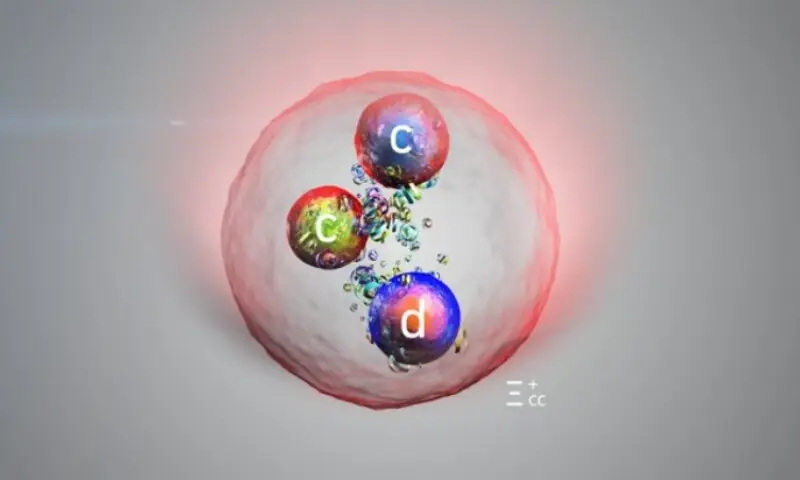
PARIS: The Large Hadron Collider (LHC), the world's most powerful particle smasher, has discovered a new particle — the 80th to be identified by the massive machine — Europe's CERN physics laboratory announced on Tuesday.
The newly discovered particle has been named "Xi-cc-plus," and scientists believe it could shed light on the strange behaviour of quantum mechanics. The particle is similar to a proton but approximately four times heavier, according to CERN.
What are baryons and quarks?
All the matter around us, including the protons and neutrons that make up the nucleus of atoms, is made of baryons. These common particles are composed of three quarks, which are considered the fundamental building blocks of matter.
Quarks come in six "flavours": up, down, charm, strange, top and bottom. Each flavour has varying mass and electrical charge, contributing to the diverse range of particles that make up the physical universe.
The Large Hadron Collider
The LHC is a 27-kilometre-long proton-smashing ring that operates approximately 100 metres beneath the border region of France and Switzerland. It has been instrumental in advancing humanity's understanding of fundamental physics since it began operations, and the discovery of the Xi-cc-plus particle marks another milestone in its scientific output.
Future Circular Collider plans
The latest discovery comes as CERN is planning to build an even larger particle smasher, known as the Future Circular Collider (FCC), to continue probing the mysteries of the universe. The proposed successor to the LHC would significantly expand the capabilities of physicists seeking to understand the fundamental forces and particles that govern the cosmos.
The identification of the Xi-cc-plus particle adds to the growing catalogue of subatomic particles discovered through high-energy physics experiments at CERN, reinforcing the facility's role as the world's leading centre for particle physics research. Scientists hope the new find will provide further insights into the quantum mechanical processes that underpin the structure of matter at the most fundamental level.
0 Comments
No comments yet. Be the first to join the discussion!


