















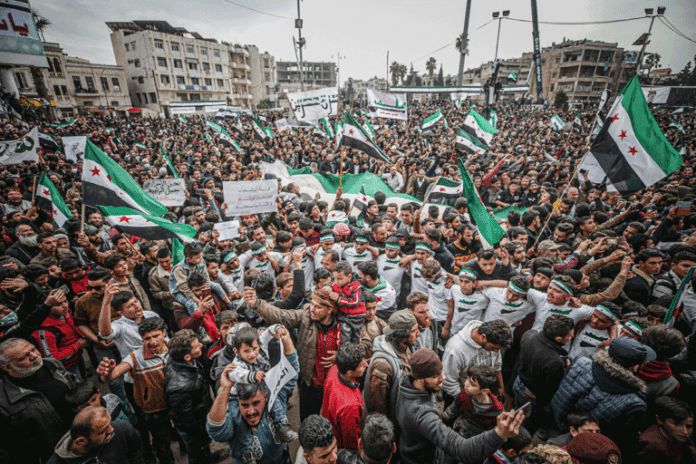
The January 18, truce between the new Syrian government under the former Jabhat al Nusra outfit leader Abu Mohammad al Sheraa Al-Jolani (the one who belongs to the occupied Golan Heights region) and the Syrian Democratic Forces or Kurd units from the days of the Syrian Civil war, under the watchful eyes of Turkish and US administrations; apparently a peace treaty, opens the floodgates for potentially more trouble in the coming days.
Apparently, trouble on the count that this allows the Jihadist establishment in Damascus, which is soft ob the IDF and hard on every other entity. The sketchy reports filtering out of the rebranded ISIS, specially the treatment of the inhabitant Kurds affiliated with the Syrian Democratic Forces, are indicative of the scheme of things going forward.
However, the trouble emanates from the fact, based on the previous experiences that the balance of power in the region was precariously compromised; when the ISIS after a bout with the then Baathist establishment in Syria and when it was still fighting on day to day basis with the Syrian Army, Hezbollah and other pro-Iranian units, crossed over from Raqqa to Mosul and practically besieged anything enroute and was just stopped before it could enter the suburbs of the Iraqi capital Baghdad.
The next few weeks will be of utmost importance. The ability of the Khamenei regime to survive, create a stalemate or otherwise. If the regime falls, any ground war between the IRGC, Iraqi mobilization units and possibly old remnants of the Syrian Democratic Forces on one side and the IDF-controlled ISIS or Daesh units cannot be avoided or ruled out. Here the IDF and USAF might take a full plunge into the war theatre. The sudden putting of the eggs in the ISIS basket through Jolani instead of decade-old US allies, the Kurds, spells sinister news for the region
The same imbalance is feared now on two counts. The Iranian regime is much weaker internally on account of domestic opposition; its network is in complete shambles; in terms of the human resource back-up and otherwise in the form of resources. Further, the IDF after completely crushing the resistance, namely Hamas and Hezbollah, and precipitating the formal exit of the Baath setup from Syria is in commanding position. Given the fact that the instabilities in the Middle Eastern societies, the IDF and Mossad have been never short of the agent provocateurs and compliant allies in the countries. The rise of armed Islamic Syrian resistance against an anti-IDF Baath set-up was not possible if there were no frustrated remnants of the Ikhwan-ul-Muslimoon in Syrian society. These very individuals rebranded as Jabhat al Nusra and ISIS under the tutelage of the interested intelligence agencies were propped up to create a credible existential threat to the Assad setup there.
What happened between the 2011 to 2019 period is history, well documented about the actions of all sides, human right violations, the stakes of the various states especially the regional states in the Syrian civil war and above all the stances taken by the Pentagon and IDF. The period invariably was marked by a dominant role of Tehran in the region, which is in complete shambles now after the side wars ignited after the Gaza campaign. Likewise, the agent provocateurs or the ‘non-state actor’ factor was on the run then; a factor which has been manipulated as witnessed in the current ‘staged street battles’ in the major cities like Tehran or Shiraz to name a few. Similarly leisurely ISIS militants can be again assigned new jobs if the geopolitical players demand that.
Down to the current scenario, there are a few reports of jail break in Raqqa, the former ISIS capital, where many Jihadists were kept in the jails after the group was routed by the Syrian Baath military units as well as the Iranian support. The immediate danger to the Kurdish community has already been reported, though sporadically, in the world media. These images are indicative of the threats, which the people of the region; the Kurds, the Iraqi communities faced when being routed by ISIS in the summer of 2014.
The videos released of the ISIS militants capturing the Kurd girls and women is likely to draw reaction from the related groups in the coming days. There can be a Kurd reaction to the problem; both through diplomatic means like dialogue with the USA as well as Israel, as both the powers have had stakes in the Kurdish society since long, since the days of the first Gulf war of 1991, when the no-fly zones and the autonomous Kurds were encouraged formally in 2003 after the final fall of the Iraqi Baath establishment.
However, any analyst can gauge well that for the time being, the line-up of the forces in the aftermath of the Gaza ethnic cleansing is that the rise of the ISIS former commander is a blessing for both the USA and IDF policy paradigm. A deeper look confirms that the rise of the ISIS former commander was facilitated by the West combined on the premise that he was a ‘lesser evil’ for the global unipolar world than the Baath in power in Damascus. Obviously, the West knew well that the rise of such a group and their entry into the decision-making corridors were fraught with risks to regional stability as well as the whole scheme of things.
Even now, there are dissenting voices in the European capitals about allowing the Syrian President Jolani to attend the Davos summit, treating that accommodation as literal recognition of the brutality of the former ISIS commander by what the dissenting groups call the ‘free and civilized world’.
If one looks for reactions; Iranians are too busy with keeping their house in order, the Middle East is preparing for ‘post recovery’ after the expected US strike on Iran, the IDF is calm as its plans are in place and the USA is preferring to look the other way. The Turkish stance, on the face of it a diplomatic welcoming of the happenings in the neighboring state, is punctuated with an approval of what has been already decided by the leaders of the unipolar world.
For the geopolitical analysts, any disintegration of the Iranian state, coupled with similar crumbling as seen in the case of December 2024 crumbling of the Baathist order in Syria can be followed by the ground incursions on behalf of the IDF in the region. The fall of the regime in Tehran will not only clear the way for the scion of Mohammad Raza but will also facilitate the IDF goals towards neutralizing opposition to its expansionism in the region, without setting its foots on the ground.
After the Jolani takeover, the IDF worked patiently, allowing the Jolani establishment to do things for them; the decimation of Syrian military assets, the renewed role for the Druze factions and finally the neutralization of the SDF and strengthening of the rogue ISIS units all seem to work in its favour.
The next few weeks will be of utmost importance. The ability of the Khamenei regime to survive, create a stalemate or otherwise. If the regime falls, any ground war between the IRGC, Iraqi mobilization units and possibly old remnants of the Syrian Democratic Forces on one side and the IDF-controlled ISIS or Daesh units cannot be avoided or ruled out. Here the IDF and USAF might take a full plunge into the war theatre. The sudden putting of the eggs in the ISIS basket through Jolani instead of decade-old US allies, the Kurds, spells sinister news for the region.





naturally like your web site however you need to take a look at the spelling on several of your posts. A number of them are rife with spelling problems and I find it very bothersome to tell the truth on the other hand I will surely come again again.