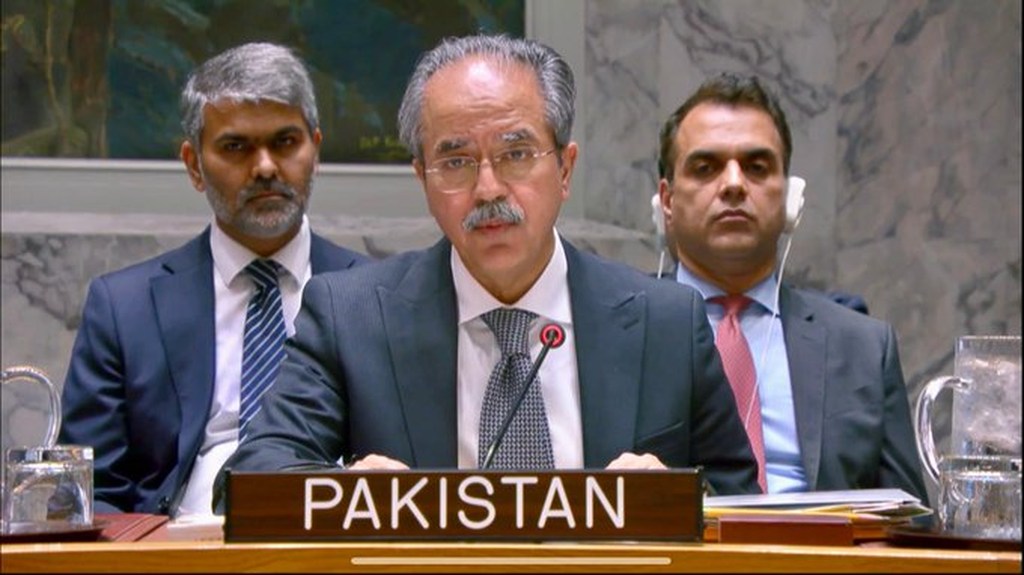
From regional defence to extended deterrence?
The recent Strategic Mutual Defence Agreement between Saudi Arabia and Pakistan raises questions about a potential shift in Pakistan's nuclear policy and regional security dynamics. This article examines the implications and historical context of the agreement.

A Strategic Mutual Defence Agreement was signed in September between Saudi Arabia and Pakistan. According to media and policy deliberations, the agreement could be a sign that Pakistan will no longer have the regionally based defensive strategy, but some open form of regional deterrence to Saudi Arabia. These propositions are of concern to the strategic priorities of Pakistan,proliferation, regional stability and so on.
Is the Saudi deal a major reorientation of nuclear policy in Pakistan or do opinions about extended deterrence overstate the implications of the deal, based on the nuclear and strategic factors and not considering the overall diplomatic/economic factors? What are the official views, historic behavioural tendencies and technology reaction?
Beginning in the late 1970s, consistent discourses have emerged about an Islamic bomb due to the close military collaboration between Pakistan and Riyadh and Saudi support of the defence sector in Pakistan. These stories now resurfed on a grand scale following the SMDA, because of its declaration that violence against one nation would be seen and dealt with as violence against the two nations.
These interpretations were also influenced by the time when the agreement was reached. Saudi Arabia is experiencing an increasing insecurity in the region following Israeli military activities and concerns surrounding the certainty of the US security provision owing to its weak reactions to the recent regional upheavals. In this view, the role of Pakistan as a nuclear power and defence ally appeared to other observers as an alternative source of strategic security.
However, these ideas are hampered by the historical behaviour of Pakistan. Within the context of military relations, Pakistan has largely escaped actual conflicts in the Gulf, notably, its non-intervention in the Saudi war in Yemen. In the same vein, the nuclear policy of Pakistan, which has always been based on the concept of deterrence in the South Asian region, has had no active interactions toward extending security to areas outside its immediate vicinity.
To start with, there is the great problem of interpretive ambiguity. The general term of mutual defence creates external interpretations which are outside the face value of the agreement. Such assumptions would have a risk of inflated expectations in Saudi Arabia and also create alarm among the regional actors without proper clarification.
The nuclear posture in Pakistan is regionally and strategically focused that is determined by the pragmatic reserves and the international norms as well as the strategic priorities that are based on South Asia. The fear of alarmism over the pact poses the threat of misunderstanding the intentions of Pakistan and the limit of its obligations. The agreement is a practical diplomacy and assurance to the two countries rather than a re-evaluation of the place of Pakistan in the nuclear hierarchy of the area.
The other consideration is the policy credibility. Pakistan has not signaled any change of its doctrines that it would employ its nuclear arms in supporting another state, neither has it made any command structures, operational arrangements or deployments that would bring to reality the political assurances.
There are also concerns about the international constraints. Saudi Arabia, a signatory to the Nuclear Non-Proliferation Treaty (NPT) is a non-nuclear state. Though Pakistan is not a signatory of the treaty, it has never been a rogue nuclear actor. A presumption of extension of nuclear protection by Pakistan will have backlash, sanctions, and negatively affect its own nonproliferation record.
Regional balancing may also be instigated. Strengthening security agreement with Saudi Arabia is not only dangerous to Pakistan Iran relations, but also would involve Pakistan in Middle Eastern conflicts inwhich Pakistan has no direct interest.
The response of Pakistan has been defined as moderate and ambiguous with calculated patience. The immediate post-SMDA official communication has emphasized on the continuity rather than the change and has claimed that the agreement was in line with decades of defence co-operation and that it did not aim to introduce new strategic commitments. Instead of referring to nuclear assurances, Pakistani officials have framed the agreement as a political statement of unity.
Politically, the agreement allows Pakistan to be relevant beyond South Asia but also, benefit economically and diplomatically, particularly Saudi financial support at a period of internal economic turmoil. At the same time, the incompetence of Pakistan to make operational commitments keeps it flexible and has it at the mercy of regional crises it does not have in its immediate strategic interests.
It is possible to note that the Saudi pact does not indicate a substantial alteration in the nuclear policy of Pakistan. Despite the speculation in the public there is no indication of a shift in doctrine, preparatory operations or declaratory policy to show that Pakistan is moving away toward regional defence instead of to the long-range nuclear deterrence.
The SMDA has given rise to debate on the nature of the Pakistan nuclear policy but upon closer examination, it can be seen that continuity rather than transformations is more than just a possibility in the equation. Despite the political and symbolic implications that the agreement carries, it does not reflect the change towards long-range nuclear deterrence.
The nuclear posture in Pakistan is regionally and strategically focused that is determined by the pragmatic reserves and the international norms as well as the strategic priorities that are based on South Asia. The fear of alarmism over the pact poses the threat of misunderstanding the intentions of Pakistan and the limit of its obligations. The agreement is a practical diplomacy and assurance to the two countries rather than a re-evaluation of the place of Pakistan in the nuclear hierarchy of the area.
Comments
No comments yet. Be the first to join the discussion!