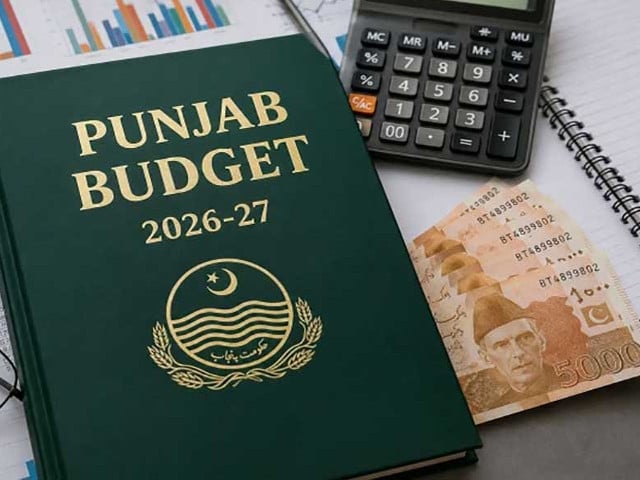
Punjab budget strain deepens under IMF surplus target
Punjab’s 2026-27 budget is facing pressure as the province tries to deliver a Rs910 billion surplus under the IMF programme while transferring Rs546 billion to the federal government. Economists and opposition lawmakers say the squeeze could limit development and social spending.


Punjab’s budget plans for 2026-27 are coming under growing scrutiny as the province tries to meet an IMF-linked surplus target of Rs910 billion while also setting aside Rs546 billion for transfer to the federal government, a combination critics say will squeeze development and public services.
The province’s Rs5.903 trillion budget includes roughly Rs650 billion for salaries, more than Rs400 billion for pensions and the Rs546 billion allocation listed as a “Grant to Federal Government”. In the Punjab Assembly, opposition MPA Imtiaz Sheikh said nearly Rs2.5 trillion would be consumed by salaries, pensions and the required surplus, leaving limited fiscal space for development spending.
Budget pressure has intensified as the government trims its development programme and prioritises completion of ongoing schemes over major new initiatives. Opposition members have also objected to the inclusion of projects that have not yet secured approval from the Executive Committee of the National Economic Council.
Imtiaz Sheikh told the assembly that projects needing ECNEC clearance had been placed in the budget without approval, calling it an example of poor planning. He also criticised allocations for education and healthcare, arguing that the province’s social sectors would remain under pressure despite higher headline spending.
Transfer to centre sparks constitutional and fiscal debate
The transfer to the federal government has triggered wider debate among legal and economic observers. Constitutional experts say Article 160 of the Constitution governs the National Finance Commission Award but does not expressly require provinces to return a portion of their share to the centre.
The Punjab government has defended the allocation as part of fiscal stability efforts and compliance with IMF commitments. Critics, however, argue that the move will further narrow the province’s room to fund development projects and social services.
Under the IMF programme, Punjab is required to maintain revenues above expenditures in order to generate the Rs910 billion surplus in 2026-27. Economists warn that failure to meet revenue targets could force the government to slow development work or delay projects to preserve that surplus.
Economists urge savings, governance reforms
Economist Dr Qais Aslam said Punjab was doing better than many other provinces, but cautioned that achieving such a large surplus would still be difficult. He said, “The government has not introduced new taxes while increasing allocations for education and healthcare and continuing subsidies. However, the province must still identify savings to comply with IMF conditions.”
Dr Aslam also criticised international financial institutions, saying they do not want Pakistan to achieve stronger economic growth. Other economists maintain that even with increased allocations, education and healthcare spending remains limited relative to Punjab’s large and growing population, and argue that better governance and more efficient use of resources are necessary for visible improvement in services.
Officials have also pinned part of the development financing strategy on foreign assistance, but grants and loans under Foreign Project Assistance are released only after project milestones are met and lenders approve disbursements. That means these funds are not immediately available to the provincial treasury.
The government says it will continue austerity measures by cutting unnecessary expenditure, tightening financial discipline and raising revenues. Economists say real savings will depend on reducing administrative costs, official vehicle expenses, energy consumption and other non-development spending.
Economic consultant Khalid Rasool said Punjab should focus more sharply on governance and agriculture, arguing that stronger growth depends on raising production and per-acre yields of wheat, cotton and sugarcane. He said, “Higher investment in research, technology and higher education is critical,” and warned that reduced university funding could hurt long-term economic development.
Comments
No comments yet. Be the first to join the discussion!