Modi faces challenge from activists over surveillance at India youth protest
Delhi High Court is hearing a challenge to AI-powered police surveillance used during student protests over exam paper leaks. Activists want protest data deleted and legal limits placed on facial recognition.

NEW DELHI: A legal challenge over AI-backed police surveillance at a major student protest in India has moved to the Delhi High Court, where activists are seeking deletion of data gathered during the demonstration and wider limits on how such technology can be used at public assemblies.
Student activist Aishe Ghosh has asked the court to declare mass surveillance of protesters unconstitutional, order the destruction of personal data collected during the protest, and direct authorities to frame guidelines for the use of surveillance technology. Judges heard arguments on Monday and are due to take up the matter again on Tuesday.
The case stems from last week’s student agitation over exam paper leaks, described as the country’s biggest youth protest in decades. Although the protest has since ended after Education Minister Dharmendra Pradhan resigned and Prime Minister Narendra Modi announced a panel to overhaul the exam system, Ghosh has continued with the petition.
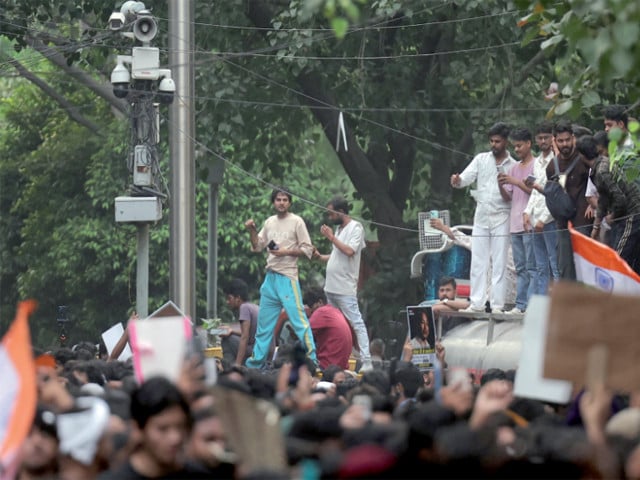
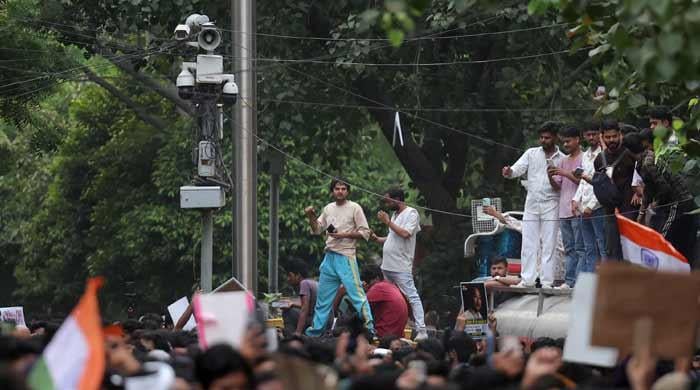
At the centre of the dispute is a mobile surveillance van seen at the main protest site in New Delhi. Demonstrators circulated images of the vehicle online, showing cameras mounted on a telescopic mast with a 360-degree view. The van carried the Delhi Police crest and the name “Ikshana”, Hindi for “vision”.
During a hearing on Friday, Solicitor General Tushar Mehta defended the police action, telling the court that privacy claims at a public gathering were “ironical” and that the checks were “absolutely necessary” and “in legitimate state interest.” On Monday, lawyers for Ghosh argued that intrusive mass surveillance of protesters was disproportionate and sought broader disclosure of the state’s surveillance policies during demonstrations.
Debate over legality and oversight
Digital rights advocates say India has no law governing police use of facial recognition technology and argue that surveillance at the New Delhi protest site breached legal protections. The government has maintained that such measures were lawful and necessary for public order, while rejecting wider criticism that it has expanded surveillance powers and tightened control over digital communications.
The Internet Freedom Foundation, a New Delhi-based advocacy group, wrote to Delhi’s police commissioner on July 24 demanding deletion of biometric data collected at the protest site. In a post on X on Sunday, Delhi Police said it had not “restricted anyone’s freedom through the use of facial recognition technology”.
Akash Karmakar, a technology law partner at Panag & Babu, said, “We need proportionality even if we are to claim national security risks. Accountability must flow both ways.” He added that if facial recognition was used to track protesters, it should also be used to identify police personnel who were allegedly operating without name badges during the crackdown.
Police were also seen writing down Instagram handles of people arriving at the site. Inspector Sunil Kumar said the checks were meant to ensure that no one with a criminal background entered the protest.
Questions over the technology
There is little public information about Ikshana. A 2023 post by Indian CCTV company CP Plus, identified as a development partner, said the system used “Advanced AI-powered” cameras, mobile cameras and “Varifocal Bullet Cameras” with adjustable lenses, but that post was removed over the weekend.
CP Plus later said it had supplied surveillance hardware forming part of the security infrastructure used by Delhi Police, while the operational deployment, databases and use scenarios were designed and carried out by the law enforcement authority.
A reporter who passed the van last week saw one computer display showing his face inside a green rectangular box alongside a “face accuracy” metric. Shortly afterwards, an officer inside shut the vehicle’s window. Police officer Raj Kumar Dahiya said, “The computers here help us identify those who have a criminal history and it highlights them.” He added, “AI also helps us count the number of protesters”.
Comments
No comments yet. Be the first to join the discussion!