

Kenyan footprints point to larger, group-travelling Paranthropus boisei
Ancient footprints at Kenya's Lake Turkana suggest Paranthropus boisei was larger than previously thought and may have travelled in all-male groups. Researchers identified 21 tracks made by eight individuals dating back 1.43 million years.

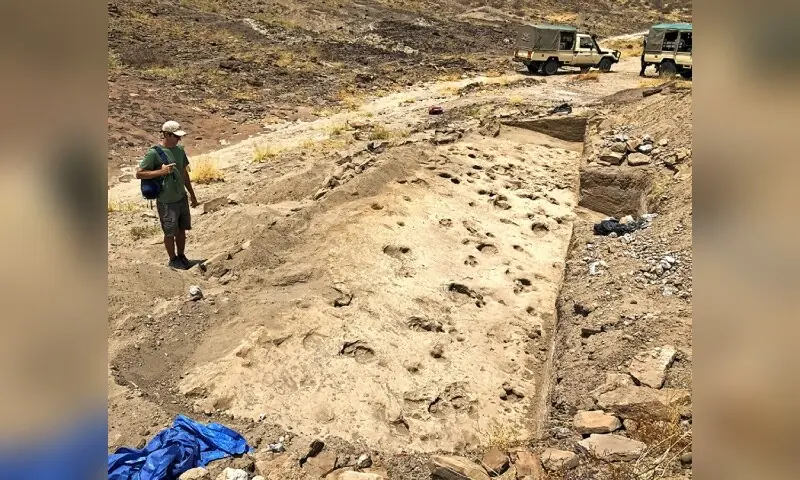
NAIROBI: A set of 21 footprints pressed into a muddy lakeshore in northern Kenya 1.43 million years ago has given researchers a rare window into the body size and social behaviour of Paranthropus boisei, an extinct human relative better known from skulls and teeth than from the rest of its skeleton.
The tracks, found along the eastern side of Lake Turkana, were attributed to eight individuals of the species based on foot shape and the way they moved. Researchers said the prints were probably made by adult males because of their size, raising the possibility that males of the species sometimes travelled together without females or young.
Lead author Kevin Hatala, a paleoanthropologist at Chatham University in Pittsburgh and the Max Planck Institute for Evolutionary Anthropology in Germany, said, "In all, this is another amazing snapshot that gives us insights into how these hominins looked, how they walked and how they engaged with each other and with their environments." The study was published in the journal Proceedings of the National Academy of Sciences.
Clues from a lakeshore mudflat
Study co-author Kay Behrensmeyer, curator of vertebrate palaeontology at the Smithsonian's National Museum of Natural History in Washington, said the eight individuals appeared to be moving at right angles to the shoreline, passing into and out of slightly deeper water. She said, "We don't know what they were actually doing there." The possibilities, she said, include getting food or water, carrying out a security patrol or simply moving together across the area.
Another co-author, Harvard University evolutionary biologist Neil Roach, said one explanation could be "a bachelor male group" like those seen in some primates, including gorillas, where one dominant male monopolises mating and pushes other males away from females. Roach said the footprints suggest the species' social system at least sometimes allowed males to tolerate one another.
Bigger than once thought
The footprint evidence also points to a larger body than previously estimated for Paranthropus boisei. The researchers said the individuals may have stood as tall as 6 feet (1.83 metres) and weighed about 165 pounds (74.84 kilogrammes), putting them in the same size range as Homo erectus.
Hatala said Paranthropus boisei had long been viewed as smaller than the contemporary Homo erectus, which is often regarded as very human-like in body form. He said, "But perhaps Paranthropus boisei was also able to achieve human-like body sizes despite a cranial anatomy that seems to indicate a very different kind of diet." He added that from the neck down, little had been known about the species' anatomy.
Paranthropus boisei is recognised for a heavily built skull, a crest on top of the head like that seen in male gorillas, and very large teeth adapted for powerful chewing. Its molars were three times the size of those of modern humans. Researchers said its diet may have included grasses, sedges, nuts and seeds.
An extinct branch of the human family
The researchers dated the prints using volcanic ash in surrounding rock. Animal tracks found nearby included those of hippos, antelope, wading birds and other species.
Footprints described in a 2024 study had already shown that Paranthropus boisei lived in the same region as Homo erectus, a hominin more closely related to humans and perhaps a direct ancestor. Hatala said the two species may have shared some food resources around lake margins even if other parts of their diets differed.
Paranthropus boisei first appeared about 2.3 million years ago and was the last of three species in the genus Paranthropus, which dates to about 2.7 million years ago. It is also thought to have been the last hominin species outside the genus Homo. Researchers believe it died out around 1.2 million years ago, during a period of climate change that may have disrupted food supplies, though competition from Homo erectus cannot be ruled out.
Our own species, Homo sapiens, appeared about 300,000 years ago.
Comments
No comments yet. Be the first to join the discussion!


