Historic Jhelum rail bridge still links communities
The Victoria Railway Bridge over the Jhelum River still carries trains, pedestrians and motorcyclists more than 150 years after it was built. But residents on both sides remain without a road bridge, forcing long detours and risky boat crossings.

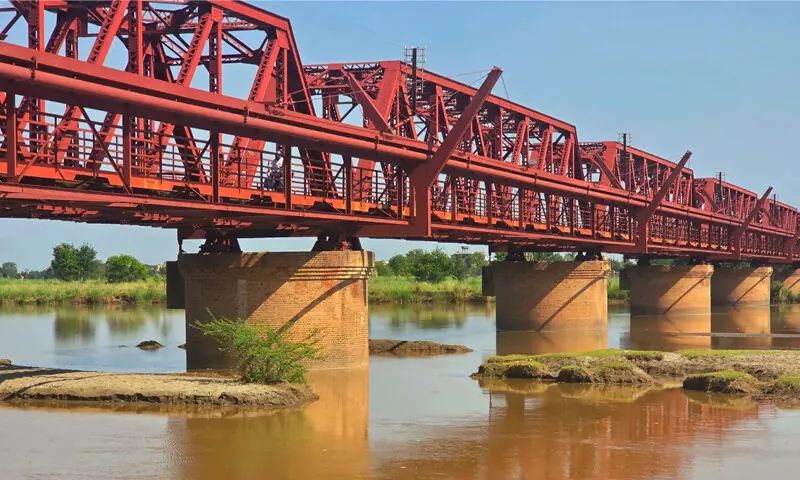
LAHORE: More than a century after it was built, the Victoria Railway Bridge over the Jhelum River remains a working rail and pedestrian crossing between Pind Dadan Khan and Malakwal, while residents on both sides still lack a road bridge for vehicles.
The steel structure stretches about 2,720 feet, or 829 metres, and continues to carry railway traffic as well as pedestrians travelling between Haranpur near Pind Dadan Khan and Khewra on one side and Chak Nizam village in Malakwal on the other. It stands at the junction of Mandi Bahauddin, Sargodha and Jhelum districts.
Bridge still central to local movement
The bridge was built about 150 years ago during British rule and is regarded as a notable example of colonial-era engineering. Its pedestrian tracks on both sides are used by walkers and motorcyclists, and the crossing has added importance because there is no road bridge over the river in the area.
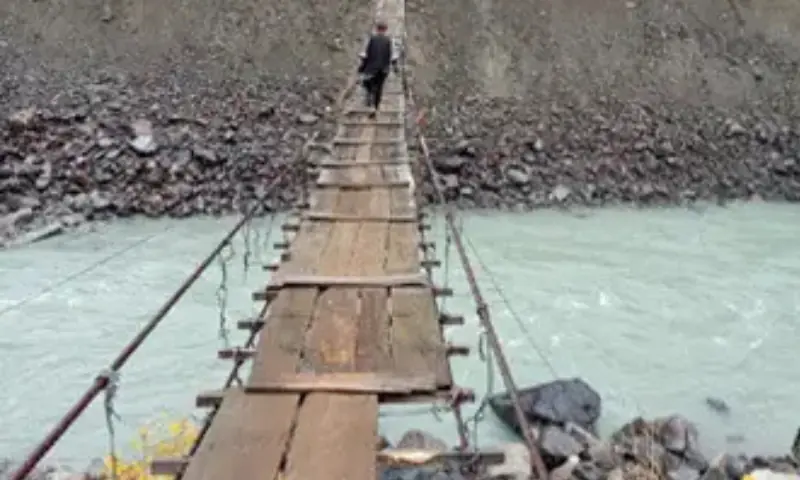
Muhammad Waseem Wasi, a journalist based in Pind Dadan Khan, said people from Pind Dadan Khan and Malakwal have to travel more than 170 miles to reach each other by road despite lying opposite one another across the river. He said many commuters also resort to boat travel with their vehicles, adding that several drowning incidents had claimed lives.
Wasi said successive governments had promised a vehicular bridge but had not delivered one at the meeting point of the Gujranwala, Sargodha and Rawalpindi divisions. He added that Provincial Minister for Communications Sohaib Ahmed Bharth recently assured journalists that the matter would be raised with the Punjab chief minister.
Rail operations remain limited
Pakistan Railways currently operates only one daily shuttle train between Malakwal and Pind Dadan Khan, according to Divisional Transport Officer Rawalpindi Waqarun Nisa. She said freight trains carrying coal and limestone could be run up to Khewra Station when required or on the orders of an industrial unit, but no passenger train is currently operating to Khewra.
Asked about using rail to move vans and other vehicles across the river, Waqarun Nisa said the proposal could be examined for feasibility. On possible tourism-focused rail operations for the Khewra Salt Mines, she said the department was facing a shortage of rolling stock and any final decision would have to be taken at a higher level.
Residents say the railway section from Pind Dadan Khan through Dandot to Khushab has remained abandoned for decades, even as they see potential for safari train services linked to the Khewra Salt Mines.
Colonial-era route with strategic and economic value
The railway network in Khewra was originally developed to transport pink salt, limestone and coal, along with troops from the region. Chaudhry Sarmad Ehsan Sadiq, a student at Oberlin College in the United States, said the bridge’s rapid construction was shaped by British strategic thinking during the Great Game.
He said, "An all-time-high imperial paranoia over the Great Game was the primary driver behind the expedited construction of the bridge." He added that after the bridge was completed in 1887, tracks were pushed onward to Pind Dadan Khan and Khushab as British engineers sought to extend the network toward the Indus River.
Sarmad said the British viewed the crossing as a way for forces stationed in Punjab to move quickly toward frontier flashpoints. Aqeel Ahmed, a social media activist focusing on Pothohar culture, called the structure "a living monument to the history of the Indo-Pak subcontinent, a heritage of the North Western Railway, and one of the finest examples of British-era engineering."
A metal plate on the bridge bears the inscription: "JESSOP & Co Ltd, DUM-DUM, 1939. Contract No. 20079/1885/1 Standard M.L. (B.G.) Loading of 1933." Jessop & Co. Ltd., based in the Dum Dum area of Kolkata, was known for manufacturing rail rollers, cranes and steel structures and was owned at the time by the British Government of India.
Elsewhere on the route, railway station buildings and residential colonies in Khewra and Pind Dadan Khan are in dilapidated condition, underscoring the state of assets inherited from the colonial period.
Comments
No comments yet. Be the first to join the discussion!