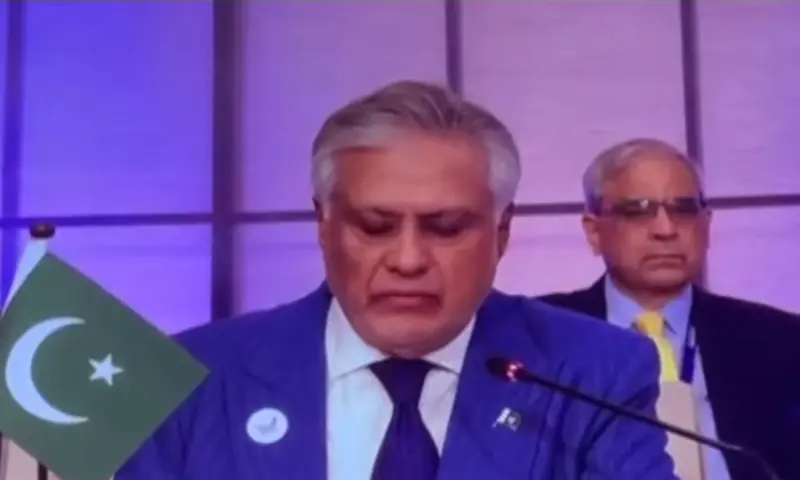
Dar raises Kashmir, Indus treaty and Gulf tensions at Asean forum
Ishaq Dar told the ASEAN Regional Forum that the Kashmir dispute and India’s move on the Indus Waters Treaty remain key sources of instability in South Asia. He also addressed Gulf tensions, Gaza, counter-terrorism, Afghanistan and climate change.

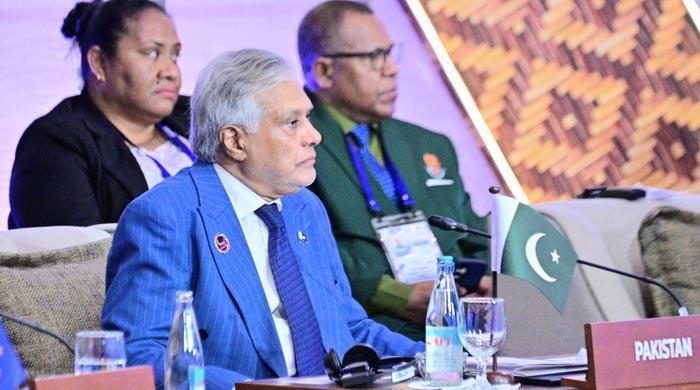
MANILA: Deputy Prime Minister and Foreign Minister Ishaq Dar told the 33rd ASEAN Regional Forum Ministerial Meeting on Thursday that unresolved regional disputes remain central to instability, identifying the Jammu and Kashmir dispute and India’s unilateral move to hold the Indus Waters Treaty in abeyance as major concerns for South Asia.
Dar outlined eight challenges affecting regional and global security: South Asian stability, the situation in the Gulf, Gaza, counter-terrorism, Afghanistan, Ukraine, the South China Sea, and climate change. He said the failure to settle long-running disputes, especially the Jammu and Kashmir issue between Pakistan and India, had intensified serious concerns over regional stability.
He reiterated Pakistan’s support for a just and peaceful resolution of the Kashmir dispute in line with the UN Charter, relevant Security Council resolutions, and the aspirations of the Kashmiri people. Dar also expressed concern over India’s decision on the Indus Waters Treaty, saying the attempted use of water resources as leverage violated international obligations and endangered the lives and livelihoods of 250 million people in Pakistan.
Speaking on the issue, Dar said:
"We simply cannot afford to let this serious, provocative development remain unaddressed. Let us all be the architects of peace and stability and work together to address the challenges posed by arbitrary, illegal, unilateral actions"He called on the international community, and ARF members in particular, to respond to what he described as arbitrary, illegal and unilateral actions and to uphold international law.
Gulf situation and Gaza
Turning to the Gulf, Dar said developments in the region had effects far beyond its immediate neighbourhood. He reaffirmed Pakistan’s role in supporting peace efforts and de-escalation, and referred to Islamabad’s diplomatic engagement, including help in facilitating a ceasefire and leadership-level talks that resulted in the signing of the Islamabad Memorandum of Understanding.
He also thanked the United States, Iran, Gulf countries, and other international partners for the confidence placed in Pakistan. Dar urged all sides to honour their commitments, exercise restraint, and back dialogue in support of regional stability, the reopening of the Strait of Hormuz, and the unconditional resumption of international shipping.
On the occupied Palestinian territory, Dar condemned what he described as atrocities in Gaza and restated Pakistan’s support for an independent, sovereign and contiguous Palestinian state based on pre-1967 borders, with Al-Quds Al-Sharif as its capital.
Counter-terrorism, Afghanistan and global issues
Addressing counter-terrorism, Dar said Pakistan had made immense sacrifices, with more than 90,000 lives lost and economic losses exceeding $150 billion. He urged the Afghan Taliban authorities to ensure that Afghan territory is not used by militant groups, including TTP, also referred to as Fitna Al-Khawarij, and affiliated factions against neighbouring countries.
He said that meeting these commitments would open broad trade and connectivity opportunities across South and Central Asia. Dar also reiterated Pakistan’s backing for diplomatic solutions in Ukraine and the South China Sea, while reaffirming the country’s adherence to the One-China policy.
On climate change, he said Pakistan remains highly vulnerable despite contributing less than 1% to global emissions, and called for international cooperation based on common but differentiated responsibilities.
Dar welcomed the adoption of the Manila Plan of Action 2026 and praised the Philippines as host. He reaffirmed Pakistan’s commitment to the core principles of the Treaty of Amity and Cooperation and to the ASEAN Regional Forum’s consensus-based approach. He said Pakistan values ASEAN’s model of cooperation and supports stronger joint work on both traditional and emerging challenges, including artificial intelligence, cybersecurity, climate change, food and energy security, disaster resilience, and public health preparedness.
He added that the ARF should continue promoting dialogue and practical cooperation while strengthening its ability to respond to changing regional and global security challenges.
Comments
No comments yet. Be the first to join the discussion!