

Murad orders tougher action against organised crime, drug trafficking
Sindh Chief Minister Murad Ali Shah has ordered intensified action against organised crime, drug trafficking and terrorism facilitators. A high-level security review was told major crimes and terrorism incidents declined in the first half of 2026.

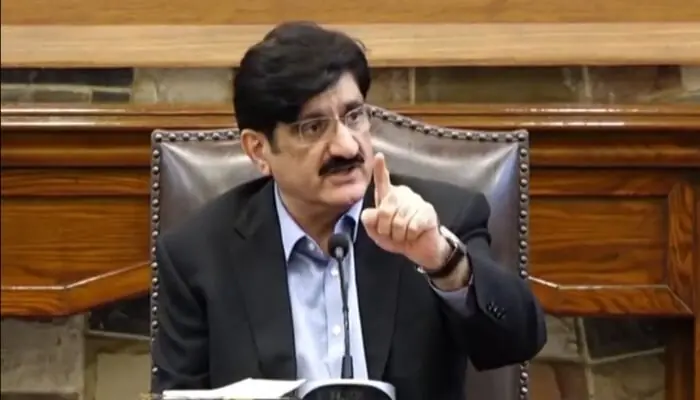
KARACHI: Sindh Chief Minister Syed Murad Ali Shah on Monday directed law-enforcement agencies to step up action against organised criminal networks, narcotics traffickers and those facilitating terrorism, while stressing stronger community engagement and greater public trust in policing institutions.
Chairing a high-level meeting at the Chief Minister House on the province’s security situation, he said safeguarding citizens’ lives and property remained the government’s foremost priority. The meeting was attended by Home Minister Ziaul Hassan Lanjar, Home Secretary Iqbal Memon, Inspector General of Police Javed Alam Odho, Additional IG Karachi Azad Khan and other senior officials. Participants reviewed crime patterns, counterterrorism efforts, anti-narcotics operations, action in katcha areas, and the performance of surveillance initiatives including the Safe City Project and the Sindh Smart Surveillance System, or S4.
The chief minister ordered agencies to intensify intelligence-based operations and remain alert at 139 inter-provincial border crossing points. He also called for strict security arrangements for Chinese nationals, foreign missions, sensitive installations and religious gatherings, and told all institutions to continue close coordination to maintain peace across Sindh.
Crime and terrorism indicators
According to a statement issued by the CM House, the meeting was told that the law and order situation in Sindh improved significantly in the first half of 2026, with major crimes and terrorism-related incidents declining because of intelligence-led policing and better coordination among agencies.
Officials informed the meeting that murders fell by 17.3 per cent, murders during robberies by 19.4 per cent and motorcycle snatching by 31.1 per cent compared to the same period last year. Terrorism-related incidents were reported to have dropped by 75 per cent.
The meeting was further told that between January and June 2026, dacoity and robbery decreased by 18.9 per cent, car snatching by 23.9 per cent and motorcycle theft by 22.1 per cent. Overall street crime was said to be down 11.77 per cent year-on-year. Fatalities in robbery incidents declined by 38.3 per cent and injuries by 39.1 per cent. Vehicle snatching went down 24.3 per cent, while motorcycle snatching dropped by 27.8 per cent. However, officials said mobile phone snatching had risen and needed focused intervention.
Operations and arrests
IGP Javed Alam Odho told the meeting that police carried out 2,184 encounters in the first six months of 2026, compared to 1,574 in the corresponding period last year. The chief minister was informed that police dismantled 1,087 criminal gangs, killed 187 criminals and arrested thousands of suspects. Officials also reported a notable rise in the recovery of illegal weapons.
Home Minister Lanjar said coordination was continuing among Sindh Police, Rangers, the Counter Terrorism Department, Special Branch and intelligence agencies. The meeting was told that the CTD carried out 777 intelligence-based operations and arrested 355 terrorists and suspects linked to banned outfits, including the Tehreek-i-Taliban Pakistan, Baloch insurgent groups and sectarian organisations. Large quantities of explosives, improvised explosive devices and grenades were also recovered.
On anti-narcotics efforts, officials said 7,027 raids were conducted, resulting in 7,468 cases and the arrest of 9,096 accused. Seized material included heroin, charas, ice and liquor. The meeting was also informed that targeted action had been taken against online drug sellers and dealers operating near educational institutions.
The participants were briefed on operations against extortion networks in Karachi, where an 81 per cent detection rate was reported. Several groups were broken up and four red notices were issued for suspects said to be operating from abroad.
Katcha areas and surveillance systems
Lanjar told the meeting that Operation Nijat-i-Mehran in the riverine katcha belt had produced major results. “Since January, police conducted 141 encounters, killed 275 dacoits and secured the surrender of several outlaws. In total, 550 dacoits were either arrested or surrendered,” he added.
The meeting was also told that under Phase-I of the Safe City Project, 1,325 surveillance cameras had been installed in Karachi, surpassing the original target. Officials said the system included facial recognition and automatic number plate recognition technology and had helped in arrests and vehicle recoveries.
On the Rs1.4 billion S4 project, participants were informed that 381 cameras had been installed at 40 toll plazas across Sindh, leading to the arrest of 496 criminals and the seizure of 349 vehicles.
The meeting also reviewed the Traffic Regulation and Citation System, or TRACS. Officials said it had issued more than 1.24 million digital traffic tickets and contributed to a 44 per cent decline in traffic accidents, a 19 per cent reduction in fatalities and a 27 per cent decrease in injuries.
Security arrangements at key inter-provincial and transitional border points, including Hub-Karachi, Jamshoro-Hub, Dadu-Khuzdar, Kashmore-Dera Bugti-Rajanpur, Ghotki-Rahim Yar Khan and coastal areas, also came under review. The home minister told the chief minister that security coverage had been strengthened through police posts, snap checking, mobile patrols and motorcycle patrol units at 139 crossing points across the province.
Comments
No comments yet. Be the first to join the discussion!


