PM declares security of Chinese nationals ‘paramount’ as Pakistan, China sign $440m healthcare investment deals
PM Shehbaz Sharif says security for Chinese nationals is “paramount” as Pakistan and China sign nearly $440m pharmaceutical and healthcare agreements under CPEC Phase-II.

Agreements span vaccines, biotechnology, drug manufacturing and technology transfer
Premier Shehbaz vows foolproof security for Chinese nationals and projects in Pakistan
Says deals mark another step in CPEC Phase-II’s business-to-business cooperation
Govt steps up protection around Chinese-backed projects amid security concerns
ISLAMABAD: Prime Minister Muhammad Shehbaz Sharif on Friday declared the security of Chinese nationals in Pakistan as his government's “paramount” priority, while Pakistan and China signed agreements worth nearly $440 million in the pharmaceutical and healthcare sectors, marking another major step towards expanding business-to-business cooperation under the second phase of the China-Pakistan Economic Corridor (CPEC).
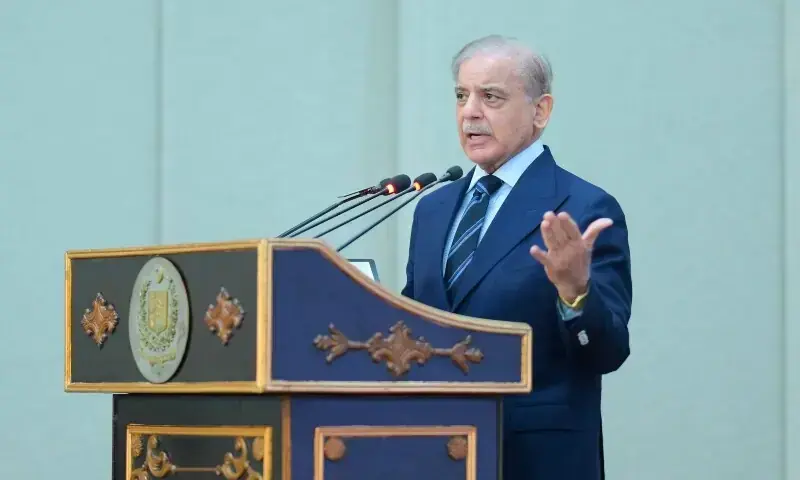
The prime minister made the remarks while addressing the Pakistan-China Pharmaceutical and Healthcare Business-to-Business Investment Conference in Islamabad, one of the largest sector-specific investment events held under CPEC Phase-II, which brought together around 300 Chinese delegates along with leading Pakistani and Chinese business representatives.
Prime Minister Muhammad Shehbaz Sharif addresses the Pak China Pharmaceutical B2B Conference. Islamabad, 17 July 2026. pic.twitter.com/vtWzUtjvMA
— Prime Minister's Office (@PakPMO) July 17, 2026
The conference took place amid heightened security concerns surrounding Chinese interests in Pakistan. Earlier this week, Minister of State for Interior Talal Chaudhry said Islamabad had received security concerns from Chinese operators at the Saindak copper and gold mine in early July and had directed all relevant agencies to enhance security for installations, personnel and cargo.
Prime Minister Muhammad Shehbaz Sharif witnesses the signing and exchange of agreements between Chinese and Pakistani Pharmaceutical Companies at the Pak China Pharmaceutical B2B Conference. Islamabad, 17 July 2026. pic.twitter.com/MJvx8oPyVr
— Prime Minister's Office (@PakPMO) July 17, 2026
According to Pakistan's National Counter Terrorism Authority (NACTA), 20 Chinese nationals were killed and 34 injured in militant attacks between 2021 and December 2024.
“I would like to say with fullest force at my command that the security of Chinese brothers and sisters in Pakistan is paramount for us, it is most important,” Prime Minister Shehbaz Sharif said. “We will leave no stone unturned to provide them with best possible security.”
Prime Minister Muhammad Shehbaz Sharif witnesses the signing and exchange of agreements between Chinese and Pakistani Pharmaceutical Companies at the Pak China Pharmaceutical B2B Conference. Islamabad, 17 July 2026. pic.twitter.com/hXxmEVReXR
— Prime Minister's Office (@PakPMO) July 17, 2026
The prime minister said the agreements signed during the conference would be transformed into “actions and implementable documents,” describing them as another significant milestone in advancing the second phase of CPEC, under which both governments envision shifting from state-led infrastructure development to business-to-business investment, industrial collaboration and technology partnerships.
He appreciated Pakistani entrepreneurs and industry leaders for their contribution to the country's pharmaceutical sector, saying they had made “great efforts just to show that these agreements will most definitely convert into action and implementable documents” that would further strengthen CPEC Phase-II.
“We have just witnessed a ceremony of agreements between the Pakistani and Chinese entrepreneurs valuing almost $440 million.”
وزیرِ اعظم محمد شہباز شریف نے اسلام آباد میں منعقدہ پاکستان اورچین کی فارما سیوٹیکلز کمپنیوں کی بزنس ٹو بزنس کانفرنس میں شرکت کی اور خطاب کیا۔ وزیراعظم نے پاکستان اور چینی کمپنیوں کے مابین فارما سیوٹیکلز کے شعبے میں 44کروڑ ڈالرسے زائد مالیت کے 9معاہدوں کا خیرمقد م کرتے ہوئے… pic.twitter.com/Q9y2xm5Hlp
— Prime Minister's Office (@PakPMO) July 17, 2026
According to a statement issued by the Prime Minister's Office, the conference was attended by the Chinese Ambassador to Pakistan, representatives of Pakistani and Chinese pharmaceutical companies, federal ministers, special assistants, senior government officials and a large number of business leaders.
The PM Office said the agreements were signed between the private pharmaceutical sectors of both countries and covered local vaccine production, biotechnology, pharmaceutical manufacturing, technology exchange and hepatitis prevention.
An agreement on cooperation relating to Pakistan's national protective vaccination programme was also finalized during the conference.
Describing China as Pakistan's “most trusted and most dependable friend,” Prime Minister Shehbaz said Beijing had played a pivotal role in Pakistan's economic development.
“China has supported Pakistan on all global forums, and $30 billion in investment has come under CPEC 1.0,” he said while thanking the Chinese leadership for its unwavering support.
The prime minister praised Chinese President Xi Jinping as a “visionary leader” who had “completely transformed Chinese society and economy.”
He described China's economic and strategic development as “unprecedented,” while paying tribute to the Chinese people for their achievements in education, research, innovation and other sectors.
The prime minister also appreciated the contributions of the business communities of both countries, the federal minister for health, the special assistant on industry and production, the Chinese ambassador to Pakistan and Pakistan's ambassador to China for promoting bilateral economic cooperation.
Referring to the recent US-Iran war, PM Shehbaz said the conflict had created significant challenges for the international community.
He said Pakistan had played an important mediating role between the United States and Iran, with friendly and brotherly countries, including China, extending full support to those diplomatic efforts.
The premier added that President Xi Jinping had also fully backed the initiative.
Reaffirming the enduring Pakistan-China partnership, the prime minister said the friendship between the two countries remained “higher than the Himalayas, sweeter than honey and stronger than steel.”
He also said China had supported Pakistan's mediation efforts between the United States and Iran that resulted in the signing of the Islamabad Memorandum of Understanding (Islamabad MoU), naming President Xi Jinping, Premier Li Qiang and Foreign Minister Wang Yi among those who supported the initiative.
Recalling the achievements of CPEC Phase-I, the prime minister said China had invested more than $30 billion in Pakistan, while the second phase would focus on strategic sectors including agriculture, information technology, manufacturing and healthcare.
He said the newly signed agreements would enable Pakistan to manufacture life-saving medicines and vaccines domestically while expanding exports to neighbouring countries, reiterating that China remained one of Pakistan's “most trusted” and “most dependable” friends.
The latest agreements follow an even larger round of investment understandings signed during Prime Minister Shehbaz Sharif's visit to China in May, when the Prime Minister's Office announced that 123 Pakistani and 436 Chinese companies had concluded around 207 memorandums of understanding worth $7.54 billion during a business conference in Hangzhou, covering sectors ranging from battery storage and artificial intelligence to seeds, fisheries and vaccine manufacturing.
Threat to Chinese security
Meanwhile, the federal government on Wednesday announced enhanced security arrangements around the Saindak copper and gold mine in Balochistan after terrorist violence disrupted supply routes linked to the Chinese-backed project.
Minister of State for Interior Talal Chaudhry had said the government received security concerns from the mine operator in early July and immediately instructed all relevant agencies to increase deployment for the protection of installations, personnel and cargo.
“We have directed the provincial authorities and all concerned security agencies to beef up deployment for all of their installations, personnel, logistics and transportation,” Chaudhry told Reuters.
“It is our priority to safeguard all projects run by international companies in Pakistan,” he said, adding that logistics and cargo shipments to the site would receive additional security protection.
Balochistan, which borders Iran and Afghanistan, hosts several major Chinese-backed development projects, including the strategically important deep-water port of Gwadar.
The Financial Times reported that the managing director of the Saindak project had warned Pakistan's energy ministry that mining operations could become unsustainable within a month because deteriorating security conditions were disrupting supply routes.
The Saindak mine is operated by the state-owned Metallurgical Corporation of China under a lease extended in 2022, with most of its production exported to China.
China's foreign ministry said it was unaware of the reported developments but reaffirmed that Beijing would continue working closely with Pakistan to ensure the safety and security of Chinese citizens, projects and institutions operating in the country.
Comments
No comments yet. Be the first to join the discussion!