Modi arrives in New Zealand as trade pact draws political backlash
Indian Prime Minister Narendra Modi has arrived in New Zealand for a short visit focused on trade, tourism and sport. His trip comes as criticism grows in New Zealand over migration-related aspects of a new trade deal with India.

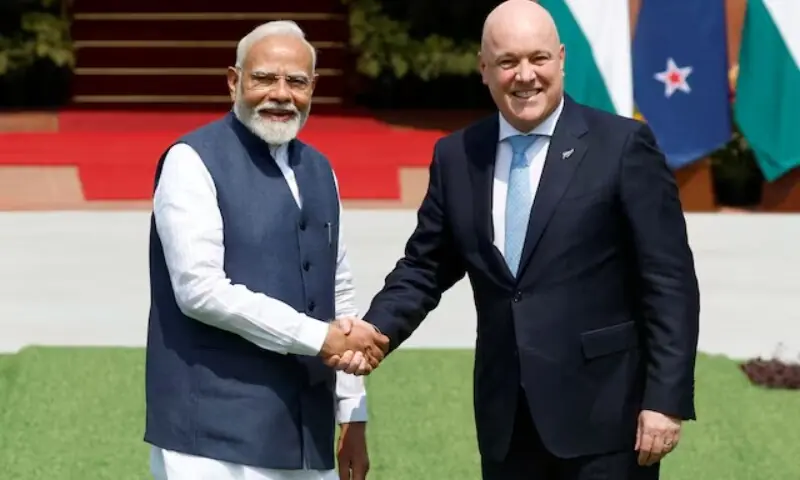
AUCKLAND: Indian Prime Minister Narendra Modi arrived in New Zealand on Friday on a visit centred on trade, tourism and sport, as political criticism in the host country over parts of a newly signed free trade agreement cast a shadow over the trip.
New Zealand Prime Minister Christopher Luxon has welcomed the April signing of the trade pact with India, describing it as a step expected to boost exports and bring jobs and investment. The agreement, signed with the world’s most populous nation, is widely expected to win approval in New Zealand’s parliament.
However, some members of New Zealand First, the populist party that is part of Luxon’s governing coalition, have objected to provisions related to migration and visas. Government minister Shane Jones drew condemnation over remarks made on a local radio programme.
“I don’t care how much criticism we get, I am just never going to agree with a butter chicken tsunami coming to New Zealand,” government minister Shane Jones told a local radio show.
An Indian community leader described Jones’s comments as outright racism.
Rhetoric around migrants and minorities
The visit also comes amid broader concerns over anti-migrant sentiment. Self-described apostle Brian Tamaki, an evangelical preacher, reacted to news of Modi’s impending arrival by accusing the Indian leader of targeting Christians in India and calling for retaliation in New Zealand.
“Let’s purge New Zealand of Hindus, Sikhs and Muslims,” Tamaki said on Instagram. “While we’re at it, if they’re burning churches down, why don’t we burn mosques and their temples down? Tit for tat,” he said, in comments condemned by New Zealand’s race relations commissioner as “utterly appalling”.
Earlier this year, Indigenous Maori activist Che Wilson was accused of insulting an Indian-born New Zealand lawmaker through a haka performance that allegedly included several race-tinged mocking references.
Massey University anthropologist Sita Venkateswar said Modi was visiting at a time when Indian-New Zealanders were being singled out and denigrated. She said South Asians were already the most frequent targets of racially motivated incidents in data collected by her team.
“A ‘ butter chicken tsunami’ , slurs set to a haka, graffiti on a school wall – South Asians are already the most frequent targets of racially motivated incidents in our data,” she told AFP . “That is real and it is wrong.”
Visit programme
Modi is due to remain in New Zealand for a little more than a day, at the end of a July 6-11 tour that has also included Indonesia and Australia. During the visit, he is scheduled to attend an official ceremony at Government House as well as a business and sport event in Auckland.
The trip is being described as the first by an Indian leader to New Zealand in 40 years. The main public event is expected to be Modi’s appearance before up to 10,000 members of the Indian diaspora at Auckland’s Spark Arena.
Despite criticism from some quarters, Luxon has projected a welcoming tone ahead of the visit. New Zealand is home to an Indian diaspora of about 300,000, and the prime minister said the trip was intended to highlight closer ties between the two countries.
“This visit is about celebrating a winning partnership between New Zealand and India — one that delivers for our people and supports greater prosperity and security for both our countries,” he said.
Comments
No comments yet. Be the first to join the discussion!