Sindh, IFC explore cooperation in digital infrastructure and renewable energy
The Sindh government and the IFC have agreed to explore cooperation in digital infrastructure, renewable energy, agriculture, healthcare and social sectors. Their talks also covered nursing training and climate-resilient PPP projects.

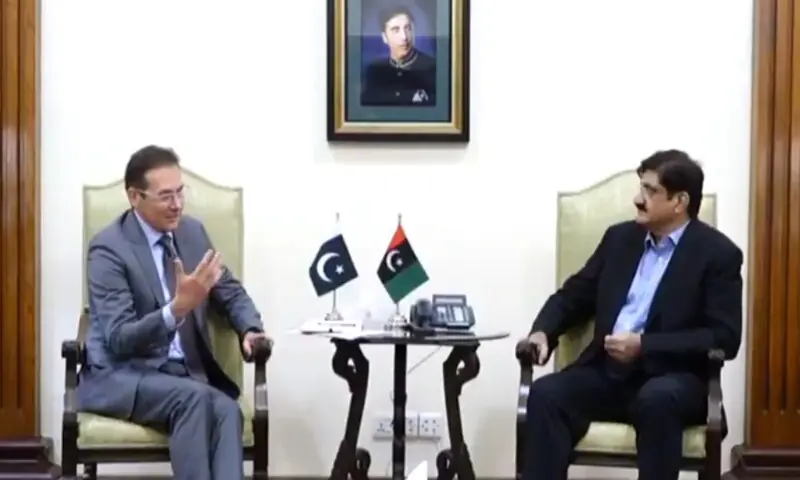
KARACHI: The Sindh government and the International Finance Corporation (IFC) agreed on Monday to explore cooperation across digital infrastructure, renewable energy, agriculture, healthcare, human capital development and social protection during a meeting at the Chief Minister House.
According to a statement issued by the CM House, Chief Minister Syed Murad Ali Shah met IFC Division Director for Pakistan Simon Andrews and discussed the provincial government’s push to attract investment in key sectors. The chief minister told the delegation that Sindh was seeking investment for strategic areas, including the establishment of an international data centre in the province and the expansion of renewable energy generation for the private sector.
Murad said the province was working to create conditions that support investment in emerging sectors. He said digital infrastructure and renewable energy were especially important for economic expansion and employment generation.
In the meeting, both sides also reviewed ways to strengthen agriculture value chains, improve storage and processing capacity, and support farmers’ incomes through mechanisation.
Andrews said the IFC was interested in backing efforts aimed at improving human capital, particularly in healthcare, nutrition and skills development. The discussions also covered possible collaboration on Sindh’s programme to reduce stunting and broader efforts to improve children’s health and education outcomes.
The chief minister said the province’s future depended on a young population that was healthy, educated and skilled. He said the government was investing in programmes focused on healthcare improvement, stunting reduction and equipping children with skills needed for the future economy.
According to the statement, the IFC director welcomed the provincial government’s reform agenda and reiterated the corporation’s support for sustainable and inclusive development. He said the IFC saw strong prospects for partnership with Sindh in areas including digital infrastructure, renewable energy, agribusiness, healthcare and human capital development.
Healthcare workforce and nursing training
The meeting also took up shortages in the healthcare workforce, particularly in nursing. Murad said the provincial government wanted to produce at least 15,000 nurses each year to meet domestic demand.
Both sides agreed to work on a comprehensive model covering basic nursing education as well as specialised training. The chief minister said the government wanted to turn the ideas discussed in the meeting into practical projects that would improve livelihoods, generate employment and enhance public services in Sindh.
Climate-resilient PPP projects
The meeting further reviewed prospects for cooperation on climate-resilient infrastructure and the inclusion of climate risk considerations in public-private partnership (PPP) projects. The IFC Sustainable Infrastructure Advisory Team offered technical assistance to help with climate risk assessment and adaptation measures in the planning and management of PPP schemes.
The Sindh PPP Unit sought advisory support in three areas: building the capacity of project teams, preparing climate resilience guidelines, and integrating climate risk assessment tools into project planning.
Murad said incorporating resilience into project planning was essential for sustainable development and added that infrastructure and development projects must be designed to cope with the increasing effects of climate change. Andrews said the IFC remained committed to helping Sindh develop climate-smart infrastructure, adding that integrating climate risk into project development and management could protect investments, improve sustainability and help infrastructure provide long-term benefits to communities.
Both sides agreed to continue consultations on a broader framework for climate risk assessment, adaptation planning and resilience-focused PPP project development in Sindh. Minister Jam Khan Shoro, Chief Secretary Asif Hyder Shah and Finance Secretary Fayaz Jatoi also attended the meeting.
Comments
No comments yet. Be the first to join the discussion!