

Japan releases snowman-like asteroid image after flyby
Japan’s JAXA has released a new image of asteroid Torifune taken during a close Hayabusa2 flyby, with scientists saying it resembles a snowman. The mission is part of wider efforts to improve planetary defence against dangerous space rocks.

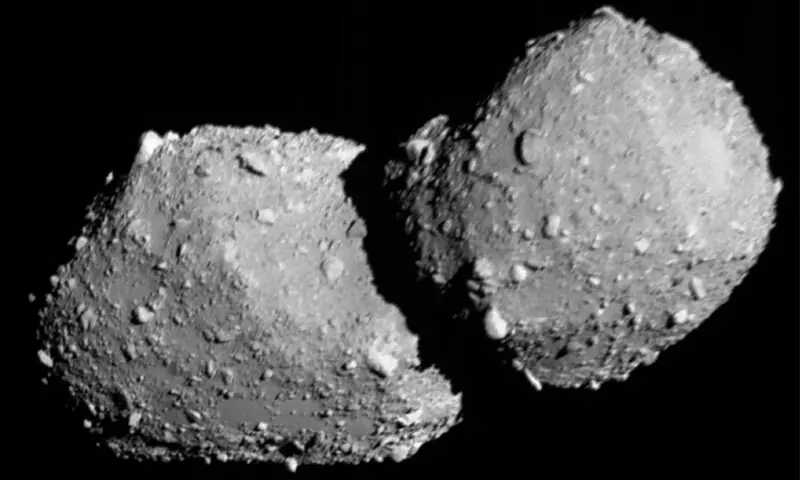
TOKYO: Japan’s space agency has released a new image of a near-Earth asteroid captured during a close flyby by the Hayabusa2 probe, with scientists saying the object appears to resemble a snowman.
The image was taken as the refrigerator-sized spacecraft passed asteroid Torifune on Sunday in a mission aimed at demonstrating techniques that could one day help divert a hazardous space rock away from Earth. According to the Japan Aerospace Exploration Agency (JAXA), the newly released image could support such work because near-Earth asteroids differ in their dimensions, shapes and surface features.
JAXA scientist Yuya Mimasu said the picture and the accompanying scientific data made a strong impression on him. He told reporters that the asteroid personally looked like a snowman.
He also said the black-and-white image, taken with a telescopic camera, appeared to show two rounded bodies linked together, and expressed surprise at the level of detail visible in the photograph.
Close approach and mission data
Before the encounter, Torifune had been known to have an elongated shape, but more detailed characteristics had not been established. Hayabusa2 was travelling at more than 18,000 kilometres per hour and was expected to pass within 800 metres of the asteroid, though JAXA said the exact distance would be analysed later. If that figure is confirmed, the operation would rank among the closest flybys of a near-Earth asteroid ever carried out.
JAXA said on Monday that data had also been successfully gathered from three other instruments. Those devices are intended to measure distance from the asteroid and investigate whether water is present.
Part of wider planetary defence efforts
The Torifune mission comes after NASA’s 2022 planetary defence test, in which the orbit of asteroid Dimorphos was altered by intentionally crashing a spacecraft into it.
JAXA and the European Space Agency are also working together on another planetary defence mission focused on the asteroid Apophis, which is due to pass close to Earth in April 2029.
Launched in 2014, Hayabusa2 previously landed on and collected material from asteroid Ryugu, about 300 million kilometres from Earth. Six years later, it returned samples from Ryugu — known in Japanese as dragon palace — helping scientists study conditions in the early solar system around 4.6 billion years ago.
After completing the Torifune flyby, Hayabusa2 is expected to attempt a rendezvous in 2031 with asteroid 1998KY26, a manoeuvre in which it would fly alongside or touch down on the object to collect more detailed data.
Comments
No comments yet. Be the first to join the discussion!


