

US reiterates support for Pakistan’s self-defence as UN adopts counterterrorism review
The US has reaffirmed support for Pakistan’s right to defend itself against terrorist attacks as the UN adopted the ninth review of its Global Counterterrorism Strategy by vote. Pakistan used the debate to press for reforms and highlight emerging threats.

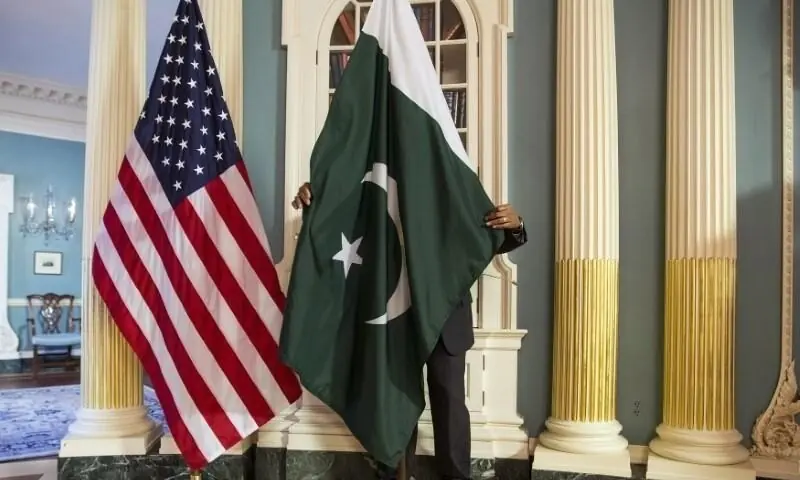
ISLAMABAD: The United States has again said it supports Pakistan’s right to defend itself against terrorist attacks, while the United Nations General Assembly has adopted the ninth review of its Global Counterterrorism Strategy after member states failed to reach consensus.
Washington said the Pakistani people had suffered heavily because of terrorism and backed Islamabad’s right to respond to such attacks. The remarks came after Pakistan carried out action on Sunday night against what it described as terrorist infrastructure along the Afghan border, following an attack on the Pakistan Rangers Sindh local headquarters in Karachi’s Gulistan-i-Jauhar area.
The latest US message followed a similar expression of support in February, when US Under Secretary of State for Political Affairs Allison Hooker said Washington was closely monitoring the situation and supported Pakistan’s right to defend itself against Taliban attacks.
UN vote breaks with past consensus
The US statement was issued as the UN reviewed its core global counterterrorism framework, first adopted in 2006 and periodically updated to guide international cooperation against terrorism.
At the General Assembly, the United States opposed the resolution and called for a recorded vote instead of the usual consensus-based adoption. The ninth review was ultimately approved on July 1 with 140 votes in favour, including Pakistan’s. The United States, Israel and Argentina voted against it. Japan abstained, though its representative later said the abstention was due to a technical error and that Tokyo had intended to vote in favour.
Washington described the draft as overextended and no longer fit for purpose, saying the text ran to more than 170 paragraphs and weakened core counterterrorism priorities by including excessive and non-operational language. The US also said the draft did not address multiple American red lines and policy objections. Israel said the document was outdated, lengthy and repetitive and did not reflect institutional modernisation, while Argentina said its vote against the text was meant to highlight the need for a review of the strategy.
On the other side, Pakistan, Egypt and Iran expressed regret that several proposals advanced by Islamic countries were not incorporated. Turkiye also said the text should have more strongly condemned repeated attacks targeting Muslims, including mosque desecrations and incidents involving the burning of the Holy Quran.
Pakistan outlines concerns at UN
Speaking at the UN General Assembly plenary meeting on the strategy, Pakistan’s Permanent Representative to the UN, Ambassador Asim Iftikhar Ahmad, said terrorism crossed borders and was now appearing globally in an increasingly interconnected but decentralised form. He said the strategy remained a living document that had to evolve in response to emerging threats.
Ambassador Iftikhar said Pakistan had remained on the front line of international counterterrorism efforts and had played an important role in operations against Al Qaeda and other militant groups, while also paying a heavy human cost. He said more than 1,200 Pakistanis were killed in terrorist attacks over the past year alone.
He also voiced disappointment that the ninth review process had failed to address longstanding gaps in the strategy or include concerns raised by the Organisation of Islamic Cooperation, whose member states include several countries heavily affected by terrorism. Pakistan, he said, believed that a future free of terrorism required a broad multilateral approach that dealt with physical and virtual threats, unresolved long-running conflicts, respect for human rights and the rule of law, and recognition of the right to self-determination under international law.
The ambassador rejected efforts to conflate what he called legitimate struggles for self-determination with terrorism, and called for stronger condemnation of state actions against populations living under foreign occupation. He also urged coordinated international action against xenophobia, racism and intolerance, along with stronger responses to violent far-right, neo-fascist, supremacist and xenophobic groups targeting vulnerable communities and places of worship.
Ambassador Iftikhar further called for reforms to the UN counterterrorism structure and sanctions regime, saying existing mechanisms should be more transparent, fair and protected from political influence. He urged tighter regulation of social media platforms to counter online radicalisation, recruitment, extremist propaganda and misinformation, and said digital financial systems, virtual assets and cryptocurrencies should also be regulated to prevent their exploitation by terrorist networks.
He added that intergovernmental bodies such as the Financial Action Task Force should remain impartial, transparent and free from political use by any state. Pakistan also noted that despite what it described as flexibility shown by Islamabad and the OIC, three years of negotiations did not produce meaningful improvements in the review process. Ambassador Asim described the absence of agreement as a wake-up call underscoring the need for renewed international cooperation against terrorism.
Comments
No comments yet. Be the first to join the discussion!


