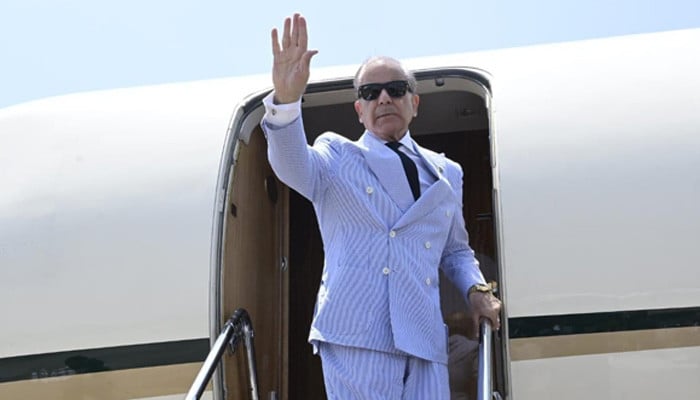
PM Shehbaz to visit Iran, Türkiye as Pakistan intensifies regional diplomacy
Prime Minister Shehbaz Sharif will visit Iran and Türkiye from July 3 to 5, attending Ayatollah Khamenei’s funeral, holding talks with Erdoğan and addressing a business conference to boost trade and investment.

ISLAMABAD: Prime Minister Shehbaz Sharif will undertake official visits to Iran and Türkiye from July 3 to 5, reaffirming Pakistan's commitment to regional peace, strategic partnerships and economic cooperation, the Foreign Office (FO) announced on Thursday.
Briefing the media, Foreign Office spokesperson Tahir Andrabi said the prime minister would first travel to Iran to attend the funeral of Iran's late Supreme Leader Ayatollah Ali Khamenei, before proceeding to Türkiye for high-level talks with President Recep Tayyip Erdoğan aimed at deepening bilateral trade, investment and regional cooperation.
The spokesperson said Deputy Prime Minister and Foreign Minister Ishaq Dar, federal ministers and senior government officials would accompany the prime minister during the two-nation tour.
During his visit to Tehran, Prime Minister Shehbaz will convey condolences on behalf of the government and people of Pakistan to the Iranian leadership and the bereaved family while expressing solidarity with Iran following the assassination of Ayatollah Khamenei in US-Israeli strikes earlier this year.
Following the Iran visit, the prime minister will travel to Istanbul at the invitation of President Erdoğan for wide-ranging discussions covering bilateral relations, economic cooperation and regional developments.
According to the Foreign Office, the two leaders will review the entire spectrum of Pakistan-Türkiye relations, with particular emphasis on expanding trade, investment and economic collaboration.
Regional peace and security will also feature prominently during the leadership-level talks.
As part of his visit, Prime Minister Shehbaz will address a Pakistan-Türkiye Business Conference aimed at showcasing Pakistan's investment potential in priority sectors, including Special Economic Zones (SEZs), energy, information technology, trade and privatisation.
The conference is expected to bring together leading Turkish investors, business executives, government officials and representatives of the private sector to explore new avenues of commercial cooperation.
The Foreign Office said the prime minister's visits underscore Pakistan's longstanding historical, cultural and fraternal ties with both Iran and Türkiye and reflect Islamabad's continued commitment to strengthening strategic partnerships in the region.
Pakistan Continues Mediation Efforts on US-Iran Peace Process
Highlighting Pakistan's diplomatic engagement following the recent US-Iran conflict, Andrabi said Islamabad had intensified consultations with regional and international stakeholders to facilitate implementation of the Islamabad Memorandum of Understanding (MoU) signed between Washington and Tehran on June 18.
The 14-point agreement provides a framework for ending hostilities, reopening the Strait of Hormuz and initiating negotiations on key bilateral issues within 60 days.
The spokesperson said recent talks between the United States and Iran held in Doha had produced encouraging progress on various aspects of the agreement.
He reaffirmed Pakistan's commitment to continue playing a constructive facilitative and mediatory role in coordination with Qatar to help advance the peace process.
Andrabi noted that Deputy Prime Minister Ishaq Dar has remained actively engaged through high-level consultations with his counterparts to sustain diplomatic momentum.
India cannot use water as 'instrument of coercion'
Responding to questions on the Indus Waters Treaty (IWT), the Foreign Office spokesperson strongly rejected India's attempt to treat the Indus river system as a strategic asset that could be controlled or manipulated.
He said New Delhi's allegations linking terrorism with its decision to place the treaty in abeyance were unfounded and served merely as a pretext for obstructing Pakistan's lawful share of the Indus waters.
"The real issue is not terrorism," Andrabi said. "The real issue is the growing tendency within the Indian leadership to treat a shared international river system as a strategic asset that can be controlled, withheld, or diverted at will."
He maintained that such an approach violates both international law and the spirit of the Indus Waters Treaty.
"Water is not a tool of coercion or political pressure," he said, warning that any attempt to deny Pakistan its legitimate water share would constitute a clear breach of India's international legal obligations and undermine confidence in treaty-based relations.
Referring to the international seminar on the Indus Waters Treaty held in Islamabad earlier this week, Andrabi said participants, including Deputy Prime Minister Ishaq Dar and international experts, unanimously rejected the weaponisation of water and stressed that disputes must be resolved through legal and diplomatic mechanisms rather than unilateral actions.
He reiterated Pakistan's position that the six-decade-old treaty cannot be suspended or terminated unilaterally and described India's decision to place it in abeyance as illegal and without legal foundation.
Asked whether Pakistan faced the risk of becoming water-scarce because of India's actions, Andrabi replied: "No country can do that. Not India, nor any other country has the power to do that."
FO distances itself from civil society letter
Responding to a question regarding a recent open letter by Pakistani and Indian civil society figures calling for renewed dialogue between the two countries, Andrabi said private citizens were free to express their views.
He clarified, however, that the government and the Foreign Office neither endorsed nor rejected the initiative and therefore had no official comment on it.
Pakistan defends prisoners list
Addressing concerns over discrepancies in the exchange of prisoners' lists between Pakistan and India, the spokesperson said Pakistan had submitted an authentic and meticulously compiled list of 753 Pakistani nationals believed to be in Indian custody.
He noted that India's response contained details of 439 prisoners identified as Pakistani or believed to be Pakistani.
According to Andrabi, Pakistan's list includes all reported detainees identified through official channels, media reports and information provided by affected families.
Action taken over Farooqabad Gurdwara
The Foreign Office also rejected India's criticism regarding the reported demolition of a historic gurdwara in Punjab's Farooqabad town.
Andrabi explained that the structure had long ceased to function as a place of worship due to the absence of a local Sikh population and had deteriorated to a point where it posed a serious safety risk.
He said unauthorised work initiated by private tenants without the approval of the Evacuee Trust Property Board (ETPB) was immediately halted on June 24 after authorities became aware of the situation.
The tenancy has since been cancelled, and authorities are examining options for preserving and renovating the historic structure.
The spokesperson stressed that only a limited portion of the building was affected before the work was stopped and reaffirmed Pakistan's commitment to protecting its religious heritage and places of worship.
Comments
No comments yet. Be the first to join the discussion!