

June 23, 2026
Karachi’s air grows more hazardous by the day
Experts at a Karachi University climate conference warned that the city’s air quality has exceeded WHO limits and poses serious health risks. Speakers also highlighted tree loss, shrinking green cover, waste mismanagement and weak implementation of environmental protections.

June 23, 2026
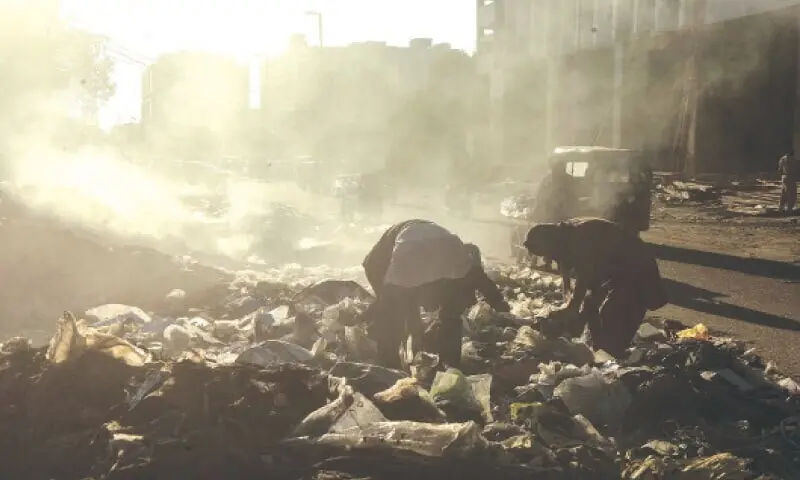
KARACHI: Environmental experts and academics at a conference held at Karachi University on Tuesday voiced concern over what they described as a sharp deterioration in the city’s environment, warning that Karachi’s air quality has reached dangerous levels and poses a serious threat to public health. They also questioned the lack of official response as trees continue to be cut down for development schemes and housing projects.
The Climate Matters Conference was organised by the Institute of Environmental Studies at the Chinese Teachers Memorial Auditorium at Karachi University in connection with World Environment Day. The event carried the theme inspired by nature, for climate, for our future.
Speaking at the event, Institute of Environmental Studies Director Dr Farrakh Nawaz said Pakistan was among the countries most exposed to climate change, but public awareness and seriousness about the issue remained very limited. He said environmental pollution and rapidly shifting climate patterns had become major national challenges and called for urgent steps to address threats to human survival.
Dr Nawaz said Karachi’s air quality index had gone well beyond World Health Organisation limits and warned that this carried severe health implications. He also told participants that the city produces nearly 16,000 tonnes of solid waste every day, while between 450 million and 600 million gallons of untreated wastewater are discharged into the sea. He stressed that meaningful improvement would not be possible without responsible waste management and environmental protection.
Faculty member Dr Amir Alamgir of the university’s Institute of Environmental Studies said scientific research had already established the worldwide effects of climate change, but practical action remained insufficient. He said there was a disconnect between the growing body of global and local research and the lack of concrete measures on the ground, adding that social behaviour had also failed to change in line with environmental advocacy.
Dr Alamgir also drew attention to widespread tree cutting in Karachi to make way for development activity and housing schemes. He said that trees now appeared to be safe only in graveyards, where human interference was limited, and called for constructive behavioural change at both the individual and collective levels to confront climate-related challenges.
Meezan Bank Head of Sustainable Operations Mahboob Alam Khan said Karachi’s green cover had fallen to just three per cent and warned that even this remaining vegetation was under threat because of rapid urban construction. He urged policymakers to frame laws and strategies aimed at stopping tree cutting and encouraging plantation.
Karachi University Vice Chancellor Dr Khalid Mahmood Iraqi said climate change and its effects were not only an environmental concern but a matter of human survival. He said teachers, students, policymakers and citizens all had a responsibility to play an active role in environmental protection. He also expressed concern over what he described as insufficient government action, saying that knowledge, expertise and research to help address climate change already existed, but implementation remained the central challenge.
Referring to the continued use of plastic bags despite widespread awareness of their harmful effects, Dr Iraqi said legal measures and official notifications alone were not enough. He said there was a need for stronger government commitment, strict monitoring and more effective enforcement of environmental laws and rules. He also warned that Pakistan could face a serious water shortage in the near future if negligence over water conservation and environmental issues continued.
Riaz Ahmed, representing Meezan Bank, called on people to adopt environmentally responsible lifestyles for future generations. He said Karachi, once known as the city of lights, was now grappling with air pollution, improper waste disposal and broader environmental decline, and urged citizens to begin environmental protection efforts from their homes and neighbourhoods.
Other speakers included Dr Hina Mudassir, director of the Office of Research, Innovation and Commercialisation at the Federal Urdu University of Arts, Science and Technology, as well as representatives of non-governmental organisations. They discussed the dangers arising from climate change, possible mitigation measures, and the role of government, private entities and social institutions in protecting the environment.
0 Comments
No comments yet. Be the first to join the discussion!

