

June 23, 2026
Islamabad master plan revision remains delayed amid rapid urban expansion
Islamabad’s master plan revision remains pending despite repeated summaries and more than 50 amendments to the city’s blueprint. Officials say the delay comes as the capital faces rapid urban growth, unregulated construction and environmental strain.

June 23, 2026
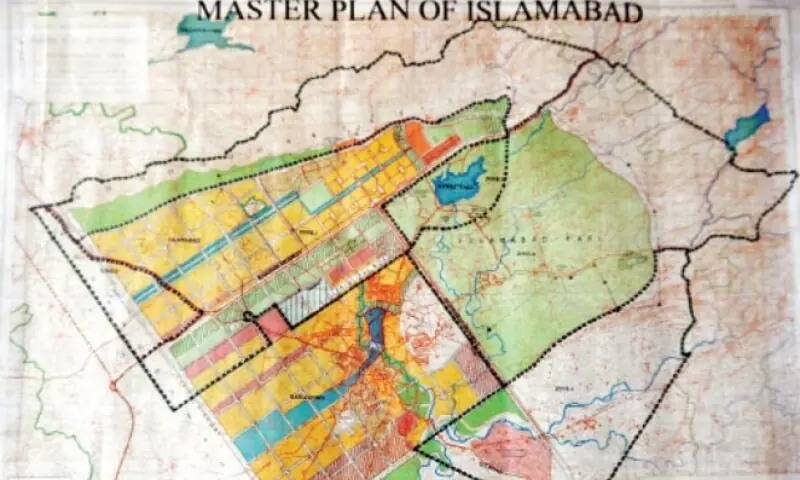
ISLAMABAD: The long-pending revision of Islamabad’s master plan remains stalled even as the capital continues to expand quickly, with the federal government and the Capital Development Authority focusing largely on development schemes instead of updating the city’s planning framework.
The master plan has been awaiting a comprehensive revision for decades, while more than 50 selective amendments have already been made to it over the years. The latest summary for forming a commission to undertake the revision was moved in February this year and included the names of 18 proposed members, though the outcome is still pending.
An official said development work in Islamabad had increased over the last two years, but argued that the government should give similar attention to the city’s long-delayed planning overhaul. Summaries for the proposed commission have been forwarded and sent back multiple times over the last four years, with repeated changes in the suggested membership, yet the commission has still not been formally notified.
CDA spokesperson Shahid Kiani said the authority had already sent the matter of reconstituting the Commission for the Revision of the Master Plan to the federal government and that the final decision on its composition and notification lies with the federal government.
Planning pressures and unregulated growth
The delay has come as Islamabad faces a range of planning, housing and environmental challenges. The city, long regarded as one of the world’s best-planned and most attractive capitals, still retains planned urban development, substantial green cover and a comparatively cleaner environment despite repeated piecemeal changes to its blueprint.
At the same time, officials say the absence of an effective mechanism for regulating rural areas, particularly private land in Zone III, has created serious pressures. Zone III includes the national park and adjoining areas outside it. While privately owned land outside the park cannot legally be built upon, the CDA also lacks a regulatory system for those localities, including Shah Allah Ditta, parts of Bhara Kahu and a two-kilometre area within Rawal Dam limits. Construction continues in these areas without planning controls, while residents maintain that they should be allowed to build homes on their own land. Officials believe the matter should be addressed through the master plan commission.
Built-up area expands sharply
Islamabad’s built-up area grew from 2,693 hectares in 1990 to 18,465 hectares in 2020. Over the same period, the city also saw rapid growth in both authorised and unauthorised housing schemes, along with slums, including in upscale sectors such as F-6, F-7, G-7, G-8 and F-8.
The capital is also grappling with water shortage and urban flooding. Several people died in floods last year.
Repeated amendments instead of full revision
Successive governments did not act on the recommendation of Doxiadis Associates, the Greece-based firm that prepared Islamabad’s master plan in 1960, which had advised that the plan should be reviewed every 20 years to keep pace with the city’s changing needs. Instead, governments continued making selective changes without expert consultation.
So far, 51 amendments have been made to the master plan, including four under the current government. The Pakistan Tehreek-i-Insaf government had earlier constituted a commission that introduced some revisions and regularised construction in certain areas, including Bani Gala, but left the broader revision to international firms to be hired by the CDA. That commission’s tenure later expired, and no replacement has since been formed.
0 Comments
No comments yet. Be the first to join the discussion!


