June 19, 2026
Sindh CM defends budget approach amid fiscal challenges
Sindh Chief Minister Murad Ali Shah has defended the Rs3.652 trillion FY27 budget as a responsible plan shaped by falling federal transfers and fiscal pressure. He also outlined austerity steps and major infrastructure proposals, including Keti Bandar and a financial centre in Karachi.

June 19, 2026
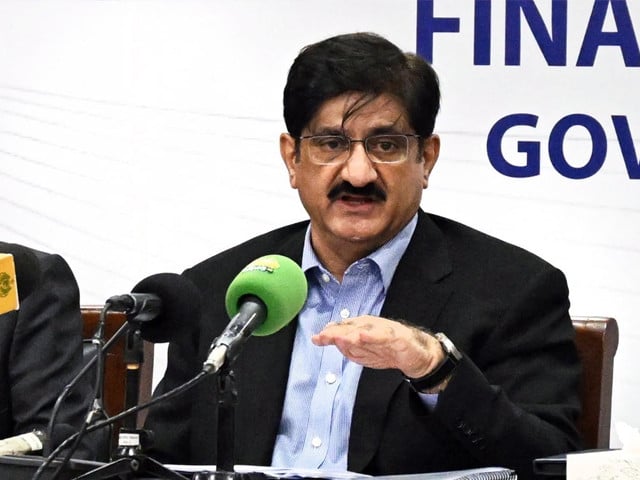
KARACHI: Sindh Chief Minister Murad Ali Shah on Thursday defended the province’s Rs3.652 trillion budget for fiscal year 2026-27 as a responsible financial plan drawn up under mounting fiscal pressure, citing lower federal transfers, higher expenditures and broader economic uncertainty.
Speaking at a post-budget press conference at the Sindh Assembly Auditorium, Shah said Sindh’s fiscal deficit was projected at about Rs300 billion because of a shortfall in federal transfers and weaker-than-expected provincial tax collection. He said the province had received Rs1.644 trillion in federal transfers by May 2026, which was Rs441 billion less than projected. Even if another Rs200 billion is received by the end of the fiscal year, he said, a gap of around Rs250 billion would still remain.
He added that provincial tax revenues were also expected to miss the target by Rs52 billion against the Rs676 billion goal. Despite those constraints, the chief minister said the government had kept development activity going, with Rs930 billion released under the previous year’s record Rs1.018 trillion Public Sector Development Programme.
Receipts, expenditure and allocations
For the coming fiscal year, the provincial government has estimated total receipts at Rs3.525 trillion. Shah said this includes Rs3.038 trillion in own-source revenue, with Rs2.263 trillion expected from federal divisible pool transfers and Rs456 billion from provincial revenues.
He said Sindh had used its constitutional authority for the first time to contribute to national defence requirements, allocating Rs260 billion as a federal grant. According to the chief minister, all provinces had agreed to support the federation despite their financial pressures. He also paid tribute to the framers of the Constitution, especially Zulfikar Ali Bhutto, for including the relevant provisions.
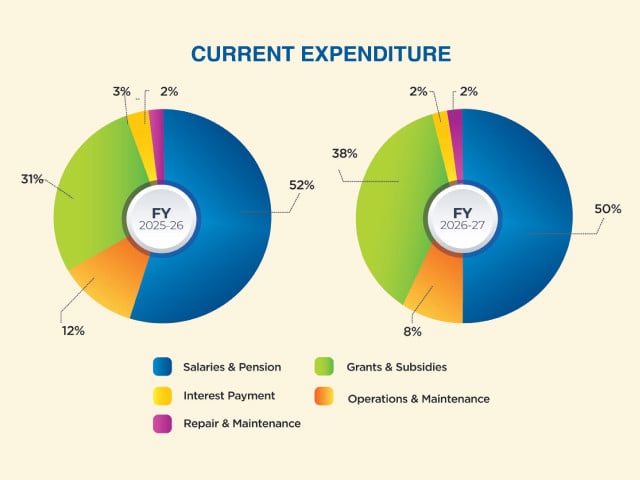
Total current expenditure for FY27 has been estimated at Rs2.560 trillion. Shah said that after excluding the defence-related transfer, administrative spending stood at Rs2.3 trillion. He said Rs1.264 trillion had been set aside for salaries and related expenses, adding that previously announced ad-hoc relief allowances had been merged into basic pay. The minimum monthly wage has also been increased to Rs43,000.
The chief minister said local governments would receive Rs155 billion, while public universities had been allocated Rs48 billion. He added that grants for hospitals, universities and autonomous bodies total Rs686 billion, while Rs54.2 billion has been earmarked for debt servicing.
Austerity and development plans
Shah said the government had reduced non-development expenditure under austerity measures, bringing it down from Rs61.87 billion to Rs36 billion. He said the Annual Development Programme had been cut from Rs1.018 trillion to Rs720 billion, with no new schemes included in the coming year’s plan.
Instead, the government will focus on completing 2,056 ongoing projects, he said. Shah also said Sindh would continue to pursue major infrastructure schemes through public-private partnerships, a model he described as having received international recognition.
Among the projects announced, he said a deep-sea port would be developed at Keti Bandar in Thatta under a public-private partnership framework. Consultations with Chinese partners and other investors were already in progress, he added, while the federal government had also been invited to join the project. Calling it a game changer for Sindh’s maritime economy, Shah said the scheme had been discussed at the highest political level.
He also announced progress on the Sindh International Financial Centre in Karachi, saying three possible sites had been identified and the project would be completed during the current government’s tenure. In addition, Shah said the province would set up a green energy-powered data centre using Sindh’s solar potential, adding that excess electricity generated from renewable sources could be supplied to international technology companies and data centre operators.
0 Comments
No comments yet. Be the first to join the discussion!