June 17, 2026
The story of a burning earth
A deadly heatwave grips cities across Sindh as temperatures near 48–50°C and humidity spikes. Experts warn it reflects a new climate normal driven by human-caused warming.

June 17, 2026

A rising heat storm spreading from Sindh to the World
By: Irfan Haroon
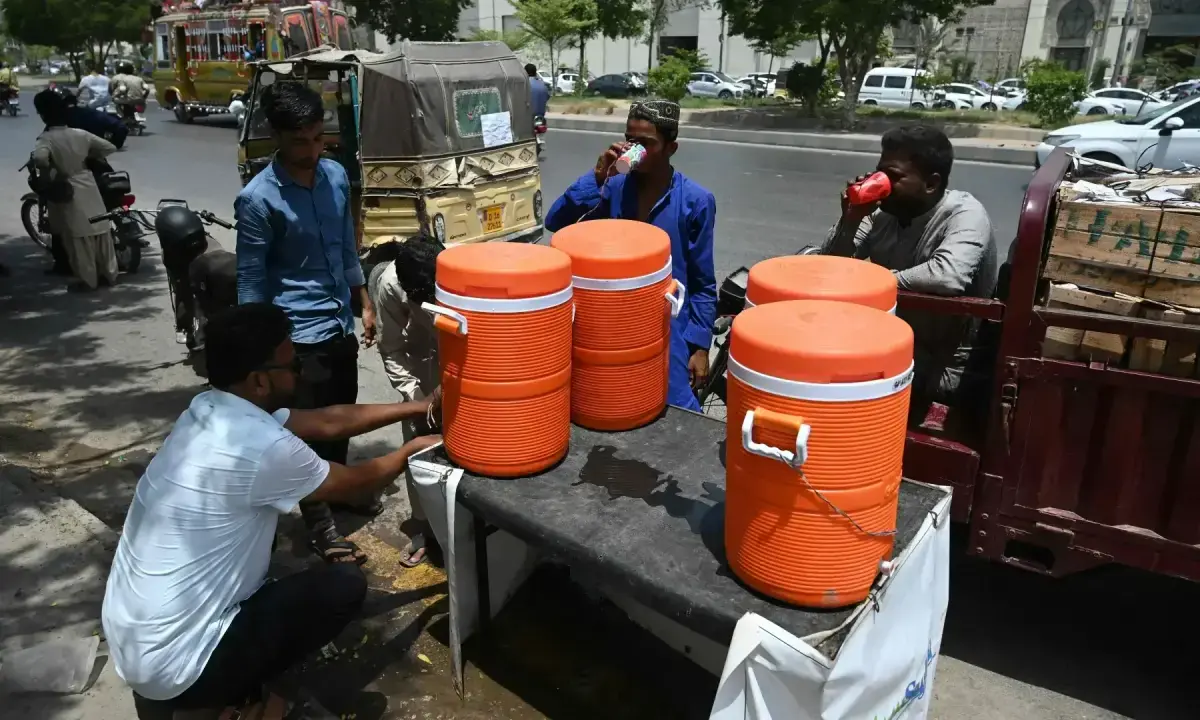
The cities of Sindh, including Hyderabad, Nawabshah, Dadu, Sehwan, Khairpur, Mirpurkhas, Mithi, and especially Jacobabad and Sukkur, are currently gripped by an extreme and unusual heatwave. This is not merely a temporary weather fluctuation; rather, it is a clear and alarming signal of a rapidly changing ecological system on Earth. In several of these cities, temperatures have repeatedly approached 48°C to 50°C, while humidity has pushed the heat index close to the limits of human survival.
Streets have become deserted, winds feel like blasts from a furnace, and the ground itself gives the impression that the sun has drawn it dangerously closer. This is no longer an exceptional event but part of a continuous pattern that global climate experts describe as a dangerous shift toward what is being called a “new climate normal.”
This condition is not confined to Sindh or Pakistan alone; it is part of a much larger global environmental crisis. According to reports by the World Meteorological Organization (WMO) and the Intergovernmental Panel on Climate Change (IPCC), the Earth has been steadily warming over recent decades. The period from 2015 to 2024 is widely regarded as the hottest decade in recorded human history, with each successive year breaking previous temperature records.
In recent years, global average temperatures have remained dangerously close to 1.5°C above pre-industrial levels and in some instances have temporarily exceeded this threshold. Although this rise may appear small in numerical terms, even such a marginal increase disrupts the entire climate system of the planet on a massive scale.
The Earth’s temperature system is inherently stable, yet when even a small rise persists over time, it begins to alter weather patterns, rainfall distribution, ocean currents, and atmospheric pressure systems. This is why many regions of the world are now experiencing weather conditions that lie far outside their historical norms.
From a historical perspective, during the 1980s there were comparatively fewer extreme heat days, and their intensity was not as dangerous as what we are witnessing today. Summers were manageable, and although uncomfortable, they did not disrupt daily life to the extent seen in the present era. Today, however, the situation has fundamentally changed. Heatwaves are not only more frequent but also significantly more intense and longer lasting.
Scientific studies further reveal that in many regions, the number of extreme heat days has increased two to three times over the past four decades. South Asia, the Middle East, and large parts of Africa are among the most severely affected regions. This is not merely a seasonal variation but a clear indication of deep structural changes in the Earth’s climate system.
The primary driver of this transformation is human activity. Since the Industrial Revolution, humanity has relied heavily on coal, oil, and gas to meet its energy needs. Transportation systems, factories, power plants, and rapid urbanization have released enormous quantities of carbon dioxide, methane, and other greenhouse gases into the atmosphere. These gases form a blanket around the Earth, trapping heat that would otherwise escape into space, a process known as the greenhouse effect.
It is important to understand that the greenhouse effect itself is not a negative phenomenon; in fact, it is a natural and essential process that keeps the Earth warm enough to sustain life. Without greenhouse gases, the planet would be frozen and uninhabitable.
However, over recent decades, human activities, particularly industrial expansion, deforestation, fossil fuel consumption, and unplanned urban growth, have severely disrupted this natural balance. As a result, the greenhouse effect has intensified beyond its natural limits and has now turned into a serious environmental challenge. This imbalance is manifesting in the form of rising temperatures, melting glaciers, sea level rise, and increasingly severe weather events.
The temperature of the Earth is no longer an abstract scientific concept but a lived reality affecting human survival every day. The burning lands of Sindh, the scorching afternoons of Nawabshah, and the dangerous heat of Jacobabad are sending a clear and urgent message that time is running out. If decisive action is not taken now, future generations may inherit a world where extreme heat is not a seasonal condition but a permanent and unbearable reality.
In essence, what once served as a blessing for life has now, due to human negligence and unsustainable practices, transformed into one of the greatest environmental challenges of our time, requiring urgent attention and decisive action.
The oceans also play a critical role in this system. According to international scientific research, oceans absorb nearly 90 percent of the excess heat trapped on Earth. Without this buffering effect, global temperatures would rise at an even faster rate. However, this has led to a steady increase in ocean temperatures, severely affecting marine ecosystems, coral reefs, and aquatic biodiversity. It has also contributed to stronger storms and increasingly unpredictable rainfall patterns.
Asia is currently among the fastest warming regions of the world, experiencing a rate of temperature increase higher than the global average. South Asia, particularly Pakistan, India, and Bangladesh, is at the frontline of this crisis. Within Pakistan, Sindh has emerged as one of the most vulnerable and heat-exposed regions.
Cities such as Jacobabad, Nawabshah, and Dadu are frequently listed among the hottest habitable places on Earth. On certain days, temperatures approach or exceed 50°C, creating extremely dangerous conditions for human survival, especially when combined with high humidity that pushes the heat index beyond physiological limits.
Other cities in Sindh, including Hyderabad, Sukkur, Mirpurkhas, Khairpur, and Mithi, are also experiencing a noticeable shift from moderate summer conditions to prolonged and intense heatwaves. In regions such as Tharparkar, where water scarcity is already severe, rising temperatures further intensify hardship and threaten livelihoods.
Heat is no longer just a seasonal inconvenience; it has become an all-encompassing challenge affecting every aspect of life. In the health sector, there is a rising incidence of heatstroke, dehydration, and cardiovascular and respiratory complications. In agriculture, crop yields are declining and soil fertility is being adversely affected. Water resources are under immense pressure, while increased electricity demand is straining energy systems, leading to frequent load shedding and economic disruption.
A particularly important dimension of this crisis is climate inequality. Countries such as Pakistan contribute very little to global carbon emissions, yet they are among the most severely affected by climate change. This imbalance is widely referred to as climate injustice. Developing nations bear the heaviest consequences of a crisis they did not primarily create, while industrialized countries continue to account for the majority of emissions.
At the individual level, the question arises regarding what role ordinary people can play in addressing such a vast crisis. The reality is that responsibility does not lie solely with governments; every individual can contribute to slowing the pace of environmental degradation. Responsible energy use, reduction of unnecessary electricity consumption, prevention of water wastage, and tree plantation can collectively make a meaningful difference.
Urban populations can also help by shifting from private vehicles to public transport, thereby reducing emissions and urban heat buildup. Small changes at home, workplaces, and educational institutions, such as energy efficiency, adoption of solar power, and promotion of recycling, can collectively produce a significant positive impact.
Equally important is the cultivation of public environmental awareness because without civic engagement and behavioural change, even the strongest policies will remain insufficient.
Governments, on their part, must prioritize renewable energy sources such as solar and wind power, expand large scale afforestation programs, modernize urban planning, and improve water management systems. Developed countries must also take responsibility by reducing emissions and supporting developing nations financially and technologically.
International institutions continue to warn that if global temperatures continue to rise at the current pace, the coming decades will witness more severe heatwaves, prolonged droughts, devastating floods, and worsening food insecurity. This is therefore not a localized issue but a shared global challenge facing all of humanity.
The temperature of the Earth is no longer an abstract scientific concept but a lived reality affecting human survival every day. The burning lands of Sindh, the scorching afternoons of Nawabshah, and the dangerous heat of Jacobabad are sending a clear and urgent message that time is running out.
If decisive action is not taken now, future generations may inherit a world where extreme heat is not a seasonal condition but a permanent and unbearable reality.
The writer is a freelance columnist.
0 Comments
No comments yet. Be the first to join the discussion!