June 17, 2026
South African jazz icon Abdullah Ibrahim dies at 91
South African pianist and composer Abdullah Ibrahim has died at 91, his family and South Africa’s presidency confirmed. The jazz great’s career spanned more than 70 years and became deeply intertwined with resistance to apartheid.

June 17, 2026
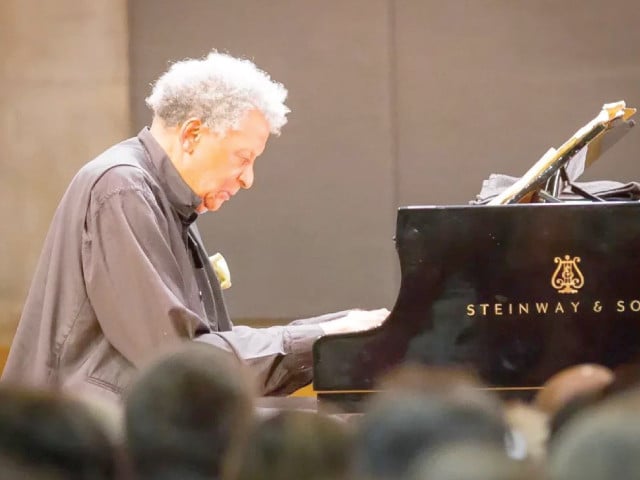
CAPITAL CITY: Abdullah Ibrahim, the South African pianist and composer whose work became closely associated with both African jazz and opposition to apartheid, has died at the age of 91, his family and the office of President Cyril Ramaphosa confirmed on Monday.
Ibrahim died peacefully in Germany after a short illness. No cause of death was immediately announced. His death brings to a close a career of more than seven decades during which he carried the sounds of South African townships to audiences around the world.
Born Adolph Johannes Brand in Cape Town in 1934, Ibrahim grew up amid a mix of African, European and Asian cultural influences. His early musical grounding was shaped by church hymns, Khoi-San melodies and his mother’s piano playing. He also suffered a personal loss at a young age when his father was killed when he was four.
He began performing professionally in his teenage years. In 1958, he formed the Dollar Brand Trio and later became part of the Jazz Epistles, a multiracial group that included trumpeter Hugh Masekela. Their 1960 release is regarded as the first jazz album recorded by a Black South African group and is seen as a landmark in the country’s musical history.
As apartheid restrictions intensified, Ibrahim was among the musicians who left South Africa in the early 1960s. He went into exile with his partner, jazz singer Sathima Bea Benjamin. A major breakthrough came in Zurich, where Duke Ellington heard his music and invited him to record in Paris, opening the way for his international career.
He later moved to New York and performed with leading jazz musicians including John Coltrane, Ornette Coleman and Archie Shepp. In the late 1960s, he briefly returned to South Africa, converted to Islam and adopted the name Abdullah Ibrahim. This period marked a deep artistic and spiritual transformation that shaped much of his later output.
His 1974 composition Mannenberg – Is Where It’s Happening became one of the best-known musical works linked to the anti-apartheid movement. Named after a township inhabited by forcibly relocated communities, the piece came to be widely regarded as an unofficial anthem of resistance, reflecting both hardship and endurance under segregation.
Ibrahim’s music remained tied to political struggle. After the 1976 Soweto uprising, he performed at an illegal concert in support of the banned African National Congress. He continued recording widely in the United States and Europe and also wrote music for ballet, opera and film.
When Nelson Mandela was freed in 1990 after 27 years in prison, Ibrahim returned to South Africa. He later performed at Mandela’s 1994 inauguration, a moment that linked his music with the country’s democratic transition. Although he spent much of his life outside South Africa, he maintained a strong creative and emotional connection to the country, often describing his work as rooted in the landscapes, memories and everyday sounds of Cape Town and its townships.
Over the course of his career, Ibrahim released more than 70 albums, including 3 in 2024, recorded shortly before his 90th birthday.
0 Comments
No comments yet. Be the first to join the discussion!