June 17, 2026
IHC rebukes senior sessions judge for poorly reasoned ruling
The Islamabad High Court has referred a senior sessions judge’s conduct to the Member Inspection Team after finding major legal and procedural flaws in an execution order in an Allied Bank case. The bench said the matter required serious institutional attention.

June 17, 2026
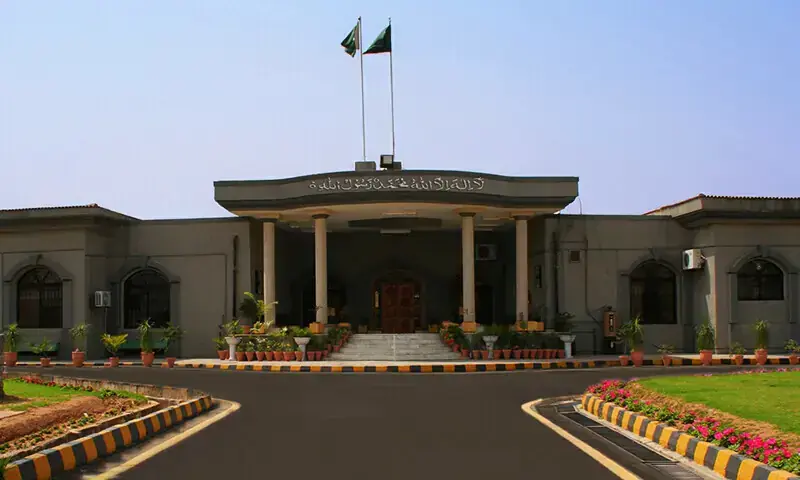
ISLAMABAD: The Islamabad High Court (IHC) has referred the conduct of a senior sessions judge to the Member Inspection Team (MIT) for scrutiny and possible further action after finding serious flaws in an order passed in an execution petition filed by M/s Allied Bank Limited.
A division bench comprising Justice Mohammad Azam Khan and Justice Raja Inaam Ameen Minhas said Sessions Judge (East) Mohammad Yar Gondal had assumed jurisdiction in a matter that had already reached finality and then issued an order affecting substantive rights arising from a decree. The bench held that this reflected a serious failure to observe basic procedural safeguards.
In its judgement, the bench said the impugned order suffered from a fundamental jurisdictional defect. It held that the executing court had failed to properly understand the meaning of obligation under Section 3 of the Financial Institutions (Recovery of Finances) Ordinance, 2001, and had ignored the legal consequences of default by replacing the statutory method of calculation, already affirmed by the decree, with its own formula.
"Such an exercise is clearly impermissible in law and cannot be sustained in appellate scrutiny," the bench observed.
Court questions limits of execution jurisdiction
The judges said the issue was not merely a technical mistake but a basic misunderstanding of procedural finality and jurisdictional limits. According to the judgement, the executing court had effectively reopened and altered the decree while acting in execution proceedings, which the bench described as impermissible under the law.
The bench further said the executing court introduced a qualification that neither emerged from the original judgement nor found support in the statutory framework governing execution. It clarified that an obligation under the ordinance is fixed when default occurs and is not recalculated because of later payments. By ordering a fresh calculation of the cost of funds on a reduced principal amount, the executing court, the bench said, substituted the decree’s basis of computation with a method of its own making.
"The role of the Executing Court is not to reassess the correctness of the decree or to introduce a new basis of computation, but to ensure faithful execution of its terms," the judgement stated.
The bench warned that allowing such lapses to go unchecked would erode established procedural norms, weaken the authority of court orders and create uncertainty in the enforcement of rights, especially in execution matters involving final decrees. It concluded that the lapse should not be seen as a simple error of appreciation but as an issue requiring institutional attention because it touched the core of judicial discipline and the proper exercise of jurisdiction.
Reference sent for scrutiny
The matter has been sent to the MIT for examination and onward placement before the chief justice for appropriate action. The development comes at a time when concerns about accountability in the lower judiciary have been raised by lawyers in the federal capital.
At a joint press conference, representatives of the Pakistan Bar Council, Islamabad Bar Council, Islamabad High Court Bar Association and Islamabad District Bar Association alleged that cases in the district judiciary were being decided on a done basis and that judicial officers were approached for favourable judgements even before cases were instituted.
The Dawn report noted that the two judges who issued the order against Judge Gondal also serve as inspection judges for the Sessions Divisions East and West and supervise the affairs of the sessions courts. Judge Gondal was posted to Islamabad after administrative changes in the IHC in February last year following a change of command in the high court.
0 Comments
No comments yet. Be the first to join the discussion!