June 15, 2026
Economy debate triggers sharp exchange in National Assembly
A sharp exchange broke out in the National Assembly as ministers defended the federal budget as a recovery plan and PTI lawmakers called it IMF-driven. The debate centred on tax relief claims, economic indicators, farmers’ losses and the FBR revenue target.

June 15, 2026
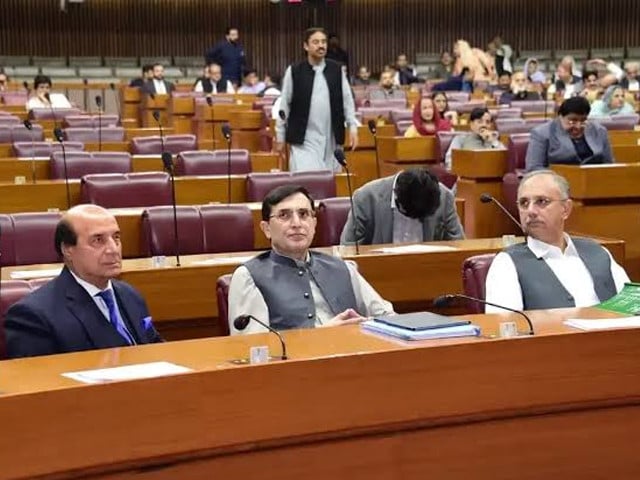
ISLAMABAD: A tense budget debate unfolded in the National Assembly on Sunday as treasury and opposition members clashed over the government’s economic claims, with ministers portraying the federal budget as a plan for recovery and PTI lawmakers dismissing it as an IMF-driven framework that offered little relief to the public.
Opening the government’s defence of the budget, Information Minister Attaullah Tarar said the fiscal plan had given meaningful relief to salaried people and argued that the opposition should acknowledge those steps instead of opposing them for political reasons. He said Prime Minister Shehbaz Sharif had chosen to protect the state during a difficult economic period and maintained that the government had taken charge of an economy close to collapse before restoring stability through hard decisions.
Tarar said there would be no income tax on salaries of up to Rs50,000 a month, while those earning between Rs50,000 and Rs100,000 monthly would face a one percent tax rate. He said the government had revised tax slabs in response to demands and tried to reduce the burden on taxpayers. He also accused the opposition of fuelling confrontation in the House, referring to earlier episodes in which documents were torn and books were set alight on assembly desks.
While defending the government’s broader economic approach, Tarar said reforms in the Federal Board of Revenue would produce lasting benefits and create a fairer tax structure. He said the burden had long fallen on people already paying taxes, while nearly 3.6 million retailers had remained outside the tax net. He added that FBR digitisation was under way and said international organisations, including the Gates Foundation, had backed reform efforts. He also argued that engagement with the International Monetary Fund had helped avert economic collapse and rebuild confidence.
Tarar said exchange rate volatility had previously disrupted business activity and that letters of credit could not be opened when inflation had climbed to 38 percent, but claimed the situation had since stabilised and inflation had eased sharply. He credited state institutions and the economic team led by the prime minister for better indicators, saying foreign exchange reserves had risen to $17.2 billion and interest rates had fallen significantly from earlier levels. He further claimed that enforcement action by the Finance Ministry and FBR had brought in an additional Rs800 billion during the last fiscal year.
The minister also cited measures for the housing sector, including lower taxes on small residential plots and homes, along with the continuation of low-cost housing schemes under which deserving families would be able to obtain loans of up to Rs10 million.
"There was a time when people were betting on Pakistan's default. The prime minister stood firm and said he would save the state regardless of the political cost," he said.
Tarar said while defending the government’s handling of the economy. "The biggest injustice in the past was that those who paid taxes were carrying the burden of those who did not," he added.
Opposition rejects relief claims
Former National Assembly speaker and PTI leader Asad Qaiser rejected the government’s account of economic improvement and described the budget as an IMF budget. Speaking during the debate, he said official claims of relief did not match the difficulties being faced by the public and challenged the treasury to point to any major sector that had received substantial support under the budget.
"Ninety multinational companies have left Pakistan. Unemployment has increased. Tell us what relief has actually been provided to the people," Qaiser said.
He also rejected allegations that PTI had acted against national interests and defended the party’s stance on judicial independence and democratic governance. "We have always spoken for Pakistan and presented our point of view honestly," Qaiser said.
Qaiser called for a comparison of borrowing by successive governments and questioned the effectiveness of current economic policies. He said wheat farmers in Punjab had suffered losses of Rs2.2 trillion because of government policies and argued that meaningful solutions required transparent policymaking and political stability.
"The farmer has been devastated. The government must explain how much new investment it has brought into the country and what concrete steps it has taken to provide real relief," he said.
The debate led to repeated interruptions as members from both sides argued over taxation, governance and overall economic performance.
Ahsan Iqbal joins debate, Khosa criticises budget in Lahore
Planning Minister Ahsan Iqbal also entered the discussion and accused the PTI government of weakening democratic norms during its tenure. Responding to Qaiser, he said the budget debate should rest on facts rather than what he called political misrepresentation. He also alleged that opposition members under the PTI administration had struggled to obtain production orders for detained lawmakers and accused the former government of using politically motivated cases against rivals.
Iqbal also referred to development work in Swabi, Qaiser’s constituency, including a university whose foundation stone he said he had personally laid.
Separately in Lahore, senior PTI leader Sardar Latif Khosa described the budget as IMF-driven and tilted in favour of the elite, saying it would deepen the hardship of people already dealing with inflation and poverty. He questioned the government’s plan to raise FBR revenues to Rs15.264 trillion in the next fiscal year, arguing that the target would result in more taxation and heavier pressure on ordinary citizens.
0 Comments
No comments yet. Be the first to join the discussion!