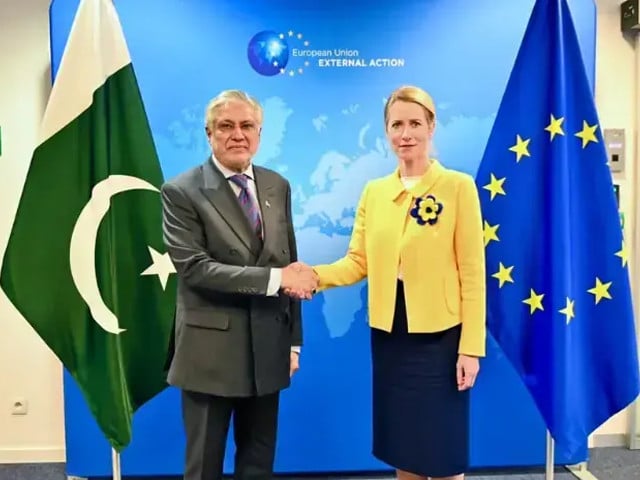
Kaja Kallas arrives in Islamabad for 8th Pakistan-EU strategic dialogue
EU foreign policy chief Kaja Kallas has arrived in Islamabad to co-chair the 8th Pakistan-EU Strategic Dialogue with Ishaq Dar. Her visit includes meetings with Pakistan’s top civilian and military leadership and comes amid continued engagement on trade and GSP+ matters.

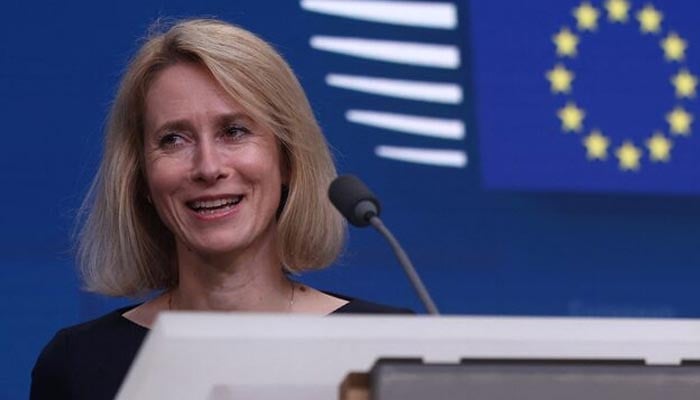
ISLAMABAD: European Union foreign policy chief Kaja Kallas arrived in Pakistan on Monday for the 8th Pakistan-EU Strategic Dialogue, the highest-level mechanism for structured engagement between the two sides, according to the Foreign Office.
Kallas, who is the EU high representative for foreign affairs and security policy and also serves as vice-president of the European Commission, is visiting Pakistan at the invitation of Deputy Prime Minister and Foreign Minister Ishaq Dar. The Foreign Office said Dar and Kallas will co-chair the latest round of the strategic dialogue in Islamabad.
State-run PTV showed Kallas being received at the Ministry of Foreign Affairs by Dar and meeting officials. The EU said Kallas was scheduled to hold a joint press conference with Dar at 12:30pm local time.
The Foreign Office said the visit reflects increasing momentum in high-level political exchanges and both sides’ commitment to deepening their broad-based partnership. Pakistan attaches great importance to its longstanding relationship with the European Union, describing it as rooted in shared values, strong economic cooperation and a common commitment to multilateralism.
Meetings with Pakistani leadership
During her stay, Kallas is expected to meet President Asif Ali Zardari, Prime Minister Shehbaz Sharif and Chief of Defence Forces and Chief of the Army Staff Field Marshal Asim Munir, according to an EU statement. The Foreign Office also confirmed that she would meet Pakistan’s senior leadership, including the president and prime minister.
Kallas is also expected to meet representatives of think tanks and academia, in what it described as part of the EU’s broader engagement with policymakers, researchers and civil society stakeholders.
According to the EU, the current round offers an opportunity to review bilateral ties under the Strategic Engagement Plan signed in June 2019.
Trade and GSP+ framework
The European Union remains Pakistan’s second-largest trading partner. Both reports said the GSP+ arrangement has played an important role in trade ties by allowing duty-free or low-duty access for many Pakistani exports to European markets. Pakistan received GSP+ status on January 1, 2014 after ratifying 27 international conventions and committing to implement them.
The EU has described GSP+ as a special incentive for developing countries to pursue sustainable development and good governance, in return for zero duties on two-thirds of tariff lines. Countries benefiting from the scheme are required to implement 27 international conventions covering human rights, labour rights, good governance and the environment.
GSP+ has been pivotal in bilateral trade, reporting that from 2014 to 2022 Pakistan’s exports to the EU rose by 108pc, imports from the bloc increased by 65pc, and total trade volume grew from 8.3 billion euros in 2013 to 14.85 billion euros. Pakistani exports benefiting from the arrangement include garments, bedlinen, terry towels, hosiery, leather, sports goods and surgical products.
The European Parliament voted unanimously in October 2023 to extend GSP+ until 2027 for developing countries, including Pakistan. It also cited EU Ambassador to Pakistan Raimundas Karoblis as saying last November that Pakistan needed to do better in meeting its obligations, particularly on blasphemy, enforced disappearances and minority rights. The EU in December 2025 welcomed some steps taken by Pakistan under the GSP+ framework while also stressing the need for further reforms in the medium and long term.
The visit comes as Pakistan and the European Union continue cooperation in trade, development, climate issues, migration and regional stability, with both sides seeking to expand engagement through regular high-level contacts and institutional dialogue.
Comments
No comments yet. Be the first to join the discussion!