

AUKUS partners to develop payloads for uncrewed undersea vehicles
The US, Australia and Britain have announced the first AUKUS Pillar 2 signature project to develop payloads for uncrewed undersea vehicles. The move comes amid growing concern over threats to subsea infrastructure.

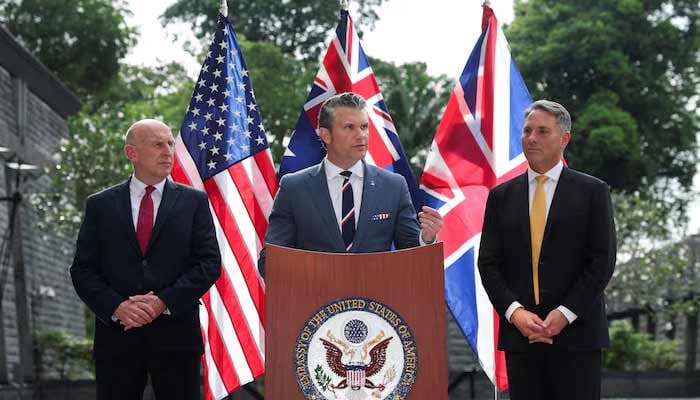
SINGAPORE: The United States, Australia and Britain are moving ahead with a new AUKUS project to develop advanced payloads for uncrewed undersea vehicles, US Defense Secretary Pete Hegseth said on Saturday after talks with his Australian and British counterparts on the sidelines of the Shangri-La Dialogue.
The three ministers reviewed progress under the trilateral security partnership, which is intended to strengthen their presence in the Indo-Pacific and other regions. Hegseth said the newly announced initiative would be the first signature project under AUKUS Pillar 2.
Speaking at a briefing at the US embassy in Singapore, Hegseth said the project would focus on deploying advanced uncrewed undersea vehicles, or UUVs. He said the effort would produce adaptable, multi-mission payloads designed to support undersea operations and preserve the three countries’ shared edge in the maritime domain.
Today, we’re pleased to announce the first AUKUS Pillar 2 signature project, focused on fielding advanced uncrewed undersea vehicles, or UUVs
This signature project will deliver a suite of highly adaptable multi-mission UUV payloads designed to support undersea operations and maintain our collective advantage in the maritime domain
AUKUS structure and focus
Under the AUKUS framework, Pillar 1 centres on Australia’s planned acquisition of conventionally armed, nuclear-powered submarines. Pillar 2 is aimed at combining the defence industry capabilities of the three countries to develop advanced military technologies.
The partnership is presented by its members as support for a free and open Indo-Pacific, although it is widely seen as a response to China’s growing power. Beijing has strongly opposed the pact.
British Defence Secretary John Healey said the planned capability would include a range of advanced sensors and weapons systems for undersea drones, adding that the technology would quickly provide their forces with the most advanced battlefield tools. He also said the systems would be installed on uncrewed underwater vessels.
Focus on underwater infrastructure
Security of underwater infrastructure has been a major issue at the Singapore defence summit, where delegates have discussed rising risks to subsea assets.
Australian Defence Minister Richard Marles told delegates earlier that the seabed had become a major area of contest over the past 18 months. He said there had been a series of attacks on subsea critical infrastructure at a scale and frequency that were historically unprecedented.
The seabed has become a major field of contest over the past 18 months
We have witnessed a series of attacks against subsea critical infrastructure at a scale and frequency that is historically unprecedented.
In the past two years, several incidents have been reported in which seabed cables were damaged by ships in both the Baltic and parts of Asia.
Australia’s top diplomat has also highlighted the country’s dependence on undersea links, noting that nearly all of Australia’s internet traffic passes through just 15 subsea cables. He said the functioning of a modern economy and state depended heavily on infrastructure that is exposed and immobile, and warned that, as seen in the Baltic, it could be severed with an anchor during the night.
Our ability to operate as a modern economy and a functioning state, all of it is critically dependent on infrastructure that is exposed, that cannot move.
As we’ve now seen demonstrated in the Baltic, (it) can be cut with an anchor in the middle of the night
Comments
No comments yet. Be the first to join the discussion!


