

Israeli plan to expand control in Gaza draws alarm and Hamas warning
Hamas has condemned Benjamin Netanyahu’s plan to expand Israeli-controlled areas in Gaza from 53% to an initial 70%. Britain and Germany also voiced concern, warning of deeper humanitarian consequences and renewed violence.

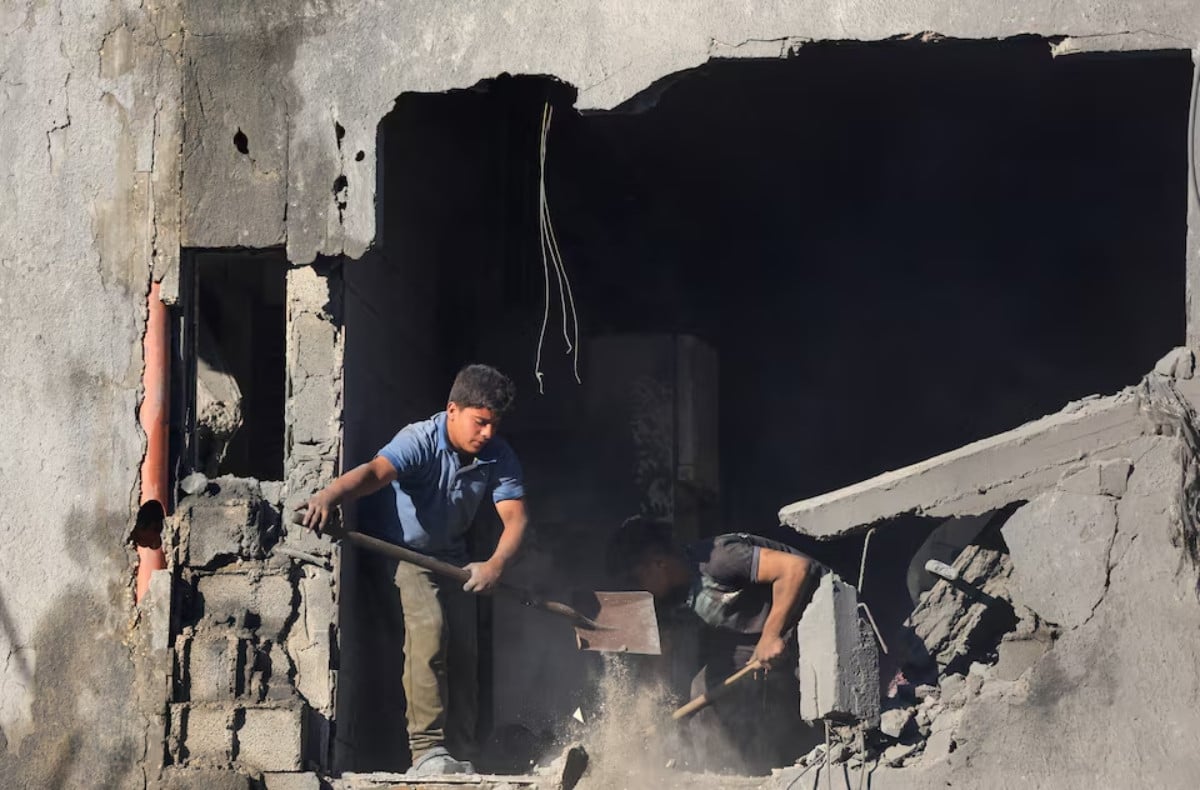
GAZA CITY: Hamas on Friday called Israeli Prime Minister Benjamin Netanyahu’s statement that Israel would widen the area it controls in Gaza a dangerous escalation, as European governments and Palestinians in the enclave also voiced concern over the plan.
Under an October ceasefire arrangement, Israeli forces were to remain in control of 53% of Gaza. Netanyahu said on Friday that this would be increased to an initial 70%, though he did not provide details or a timetable. Hamas described the remarks as a plan aimed at ethnic cleansing and the forced displacement of Palestinians.
Ismail al-Thawabta, head of the Gaza government media office, rejected the proposal and said any move to create what he described as a new occupation reality in Gaza would have no legitimacy. He said Netanyahu’s announcement represented a dangerous escalation.
More than eight months after the ceasefire began, the conflict in Gaza remains unresolved, with Israeli attacks continuing, aid supplies to civilians still limited and the possibility of a major new flare-up persisting while international attention is focused on the war in Iran.
Control area already expanded
Israel has already enlarged the area it controls in Gaza beyond the 53% set out behind the ceasefire’s yellow line, to about 64%, according to a restricted zone shown on maps shared with aid organisations. Any further reduction in the space available to Gaza’s more than two million residents, most of whom are living in tents in the small coastal territory, could deepen an already severe humanitarian crisis.
A resident in Khan Younis, Mohammed al-Shagra, described the situation in stark terms, asking where people were expected to go when there was no room left. Another displaced resident, Mohammed al-Jundi in Gaza City, said people saw no real ceasefire while Israeli forces kept moving beyond the yellow line and questioned how long the world would remain silent.
The ceasefire deal, brokered last year by US President Donald Trump, created a Board of Peace to supervise a phased truce and was later endorsed by the United Nations Security Council. But several of the most difficult issues were deferred to later stages, including Hamas’s disarmament, a full Israeli withdrawal and the composition of a future Gaza administration.
Negotiators from the Board of Peace have been in contact with both sides on the disarmament question. Israel and Hamas have repeatedly accused each other of breaching the truce. Since the ceasefire began, Israeli strikes in Gaza have killed more than 900 Palestinians, while Palestinian attacks have killed four Israeli soldiers.
International concern and risk of renewed violence
Israel’s military and the prime minister’s office did not immediately respond to a Reuters request for further information and comment on Netanyahu’s statement. A spokesperson for the Board of Peace also declined to comment.
Britain’s foreign ministry said any further expansion of Israeli control in Gaza would be unacceptable and would risk worsening an already dire humanitarian situation. Germany’s foreign ministry said it was concerned by the Israeli plans and opposed any permanent division of Palestinian territory. France, another permanent member of the UN Security Council, did not immediately respond to requests for comment.
According to Max Rodenbeck, Israel-Palestine Project Director at the International Crisis Group, Netanyahu may be trying to strengthen his domestic political position ahead of elections this year and amid pressure over Israel’s failure to secure its strategic objectives in the wars in Iran and Lebanon.
Rodenbeck said Netanyahu was trying to project toughness before voters and warned that, unless the Trump administration pushed back, the move could lead to a return to much bloodier violence. He also pointed to other Israeli pressure tactics, including continued restrictions on aid entering Gaza and strikes targeting Hamas figures.
Inside Israel, however, supporters of a harder security approach see increased military pressure as the only way to force Hamas to disarm and secure a more durable arrangement. Kobi Michael, a researcher at Israel’s Institute for National Security Studies and a former official in the strategic affairs ministry, said the situation appeared to be moving toward another confrontation, though he believed it could be shorter and might open the way to a different future.
Comments
No comments yet. Be the first to join the discussion!


