

Khawaja Asif says Pakistan’s US-Iran mediation is moving towards positive outcome
Defence Minister Khawaja Asif says Pakistan’s mediation between the US and Iran is moving towards a positive outcome. He also says the conflict has badly affected Pakistan’s economy and reversed recovery.

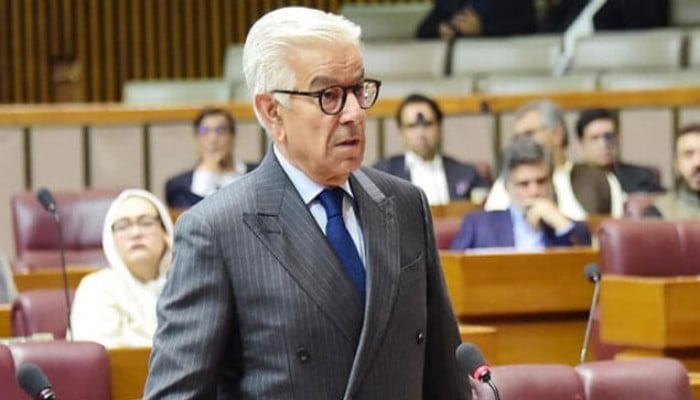
ISLAMABAD: Defence Minister Khawaja Asif said on Saturday that Pakistan’s mediation efforts between the United States and Iran were gradually advancing towards what he described as a positive result, while voicing hope that the process would help bring peace to the region and beyond.
Speaking to Geo News in Sialkot, Asif said Pakistan had moved closer to progress in the diplomatic engagement between Washington and Tehran.
In remarks carried by the broadcaster, he linked that assessment to the presence of Chief of Army Staff and Chief of Defence Forces Field Marshal Asim Munir and Interior Minister Mohsin Naqvi in Iran, saying their visit indicated that the matter was approaching resolution.
We have slowly moved closer to a positive result in the US-Iran mediation.
Asif said.
High-level visit to Tehran
Field Marshal Munir arrived in Tehran on Friday as Pakistan intensified its diplomatic push aimed at helping end the US-Israel war on Iran. During the visit, he was accompanied by Naqvi, who was already in the Iranian capital.
The Pakistani delegation held meetings with Iranian Foreign Minister Abbas Araghchi, President Masoud Pezeshkian and Parliament Speaker Mohammad Bagher Ghalibaf. The discussions focused on regional de-escalation and the mediation efforts under way.
Pakistan’s mediation role
Pakistan became an important intermediary between Washington and Tehran after six weeks of fighting that began on February 28. Islamabad played a central part in ceasefire efforts and backchannel contacts.
The conflict began after the United States and Israel carried out coordinated strikes on Iran, after which Tehran responded by attacking US bases in the region and closing the Strait of Hormuz.
Hostilities came to a halt on April 8 when Pakistan helped secure a two-week ceasefire. That was followed by direct talks between the United States and Iran in Islamabad on April 11 and 12.
Those negotiations ended without a permanent settlement, with the two sides remaining divided on several issues, including Iran’s blockade of the Strait of Hormuz as well as its missile and nuclear programmes.
Despite the lack of a final agreement, Pakistan continued efforts to mediate between the two countries and also helped prolong the ceasefire.
Economic impact highlighted
Asif also spoke about domestic economic pressures, acknowledging the burden of inflation on the public and saying lower-income groups were facing the greatest hardship because of rising prices.
We were in a recovery phase, but because of this war our economy has suffered badly.
he said, adding that the recovery process had not only stopped but had gone into reverse.
The defence minister said Pakistan was working to avert a wider international crisis and expressed confidence that the country’s diplomatic efforts would ultimately succeed.
Comments
No comments yet. Be the first to join the discussion!


