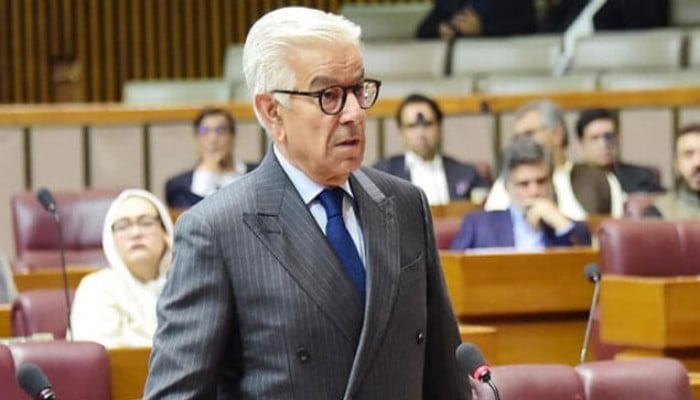
Khwaja Asif optimistic on US-Iran deal, says peace will secure Pakistan's borders
Defence Minister Khawaja Asif expressed optimism about a potential US-Iran agreement, saying Pakistan could gain from lifted sanctions, improved border security, and greater regional stability amid renewed Gulf tensions.

ISLAMABAD: Defence Minister Khwaja Asif on Friday expressed optimism over a possible agreement between the United States and Iran, saying Pakistan would emerge as one of the biggest beneficiaries of any peace settlement, particularly through enhanced border security and regional stability.
His remarks came amid renewed tensions in the Gulf following recent clashes between US and Iranian forces and attacks on the United Arab Emirates, developments that have threatened a month-old ceasefire and raised fresh concerns over the prospects for diplomacy.
Hope for a breakthrough resurfaced after Washington reportedly conveyed a proposal to Tehran through Pakistani mediation, with the US expecting Iran’s response on Friday. US Secretary of State Marco Rubio said the development could pave the way for serious negotiations.
Speaking on a private television programme, Asif said Pakistan was now far more confident on the security front compared to a year ago, crediting the country’s armed forces for strengthening national stability.
“About a year ago, there was uncertainty on multiple fronts, including security, but today we are much more confident because of our armed forces,” he said.
Highlighting Pakistan’s mediation efforts between Tehran and Washington, the minister said Islamabad shared deep historical, geographical and religious ties with Iran and had managed those relations with balance and responsibility.
He said Pakistan had diplomatically played a role in convincing the United States to support efforts aimed at restoring peace in the region. “We will also be among the major beneficiaries of this peace,” he added.
Asif said that if sanctions on Iran were lifted following an agreement, Pakistan could directly import commodities such as gas and oil through land routes instead of relying on distant international markets.
“The biggest benefit would be a secure border with Iran, from where terrorism has occasionally infiltrated into our territory,” he said, while noting that Pakistan’s border with Afghanistan remained a security concern and discussions on the issue were also continuing with China.
The defence minister linked Pakistan’s rising international stature to what he described as the country’s “historic victory” against India during last year’s Operation Bunyanum Marsoos and Marka-e-Haq.
“Pakistan is now recognised internationally as a country capable of standing up to a much larger adversary,” he said, adding that the outcome had strengthened global confidence in Pakistan as an “honest negotiator”.
He further claimed that the world was increasingly treating Pakistan and India on equal footing diplomatically and militarily, with Pakistan in some cases receiving greater international recognition.
“Pakistan is now accepted as a power to reckon with,” he remarked.
Commenting on regional tensions, Asif alleged that India was pursuing proxy warfare against Pakistan through Afghanistan, accusing extremist Hindutva elements of fuelling unrest along Pakistan’s western border.
He maintained that India’s broader strategy was aimed at surrounding Pakistan, but stressed that Islamabad’s strong ties with Iran had helped secure the nearly 1,100-kilometre border between the two neighbours.
The minister added that if cross-border militancy from Afghanistan was curbed through dialogue and a negotiated settlement, Pakistan would be in a much stronger strategic position in dealing with regional challenges.
The author is a working journalist, a television anchor and publisher of Pakistan Today
View all articles →Comments
No comments yet. Be the first to join the discussion!