A firm reaction
India’s Army Chief questioned whether Pakistan wanted to remain part of “geography and history.” Pakistan’s ISPR responded, citing sovereignty, nuclear deterrence, and warning that any war could escalate.

Indian COAS’s statement decisively rebutted
The exchange between Indian Army Chief Gen Upendra Dwivedi and Pakistan’s military media wing, Inter-Services Public Relations, highlighted the deep historical, ideological, and psychological tensions between India and Pakistan.
General Dwivedi’s statement questioning whether Pakistan wanted to remain part of “geography and history” was taken in Pakistan as a challenge to the country’s ideological foundation rooted in the two-nation theory and the creation of Pakistan in 1947. It revived fears that India has never fully accepted partition and still aspires to an “Akhand Bharat.”
The ISPR responded by reaffirming Pakistan’s identity, sovereignty, and permanence as a nation of more than 240 million people with nuclear capability and a secure place in South Asian history. Pakistan’s status as a recognized nuclear power was emphasized as the core guarantee of sovereignty that fundamentally changes the nature of any conflict and makes attempts to erase Pakistan politically unrealistic and militarily catastrophic.
The response also criticized “Hindutva thinking,” identifying it as an ideology that defines India as a Hindu nation at the expense of minorities and seeks regional dominance, while Pakistan positioned itself as supporting mutual respect and peaceful coexistence. Pakistan’s geographical and historical importance was underscored through its borders with India, China, Afghanistan, and Iran, the strategic role of Gwadar Port and the China-Pakistan Economic Corridor, the Indus River system, and its place in regional geopolitics involving the United States, China, and Russia.
References to the Indus Valley Civilization, the Gandhara, Maurya, Ghaznavid, Mughal, and British Raj empires, and Pakistan’s 76 years of independent statehood, wars, democratic transitions, and struggle for recognition reinforced the claim that Pakistan’s existence is rooted in both geography and history. The ISPR also stated that India had failed to learn the lessons of eight decades since partition, including four wars, repeated border clashes, and diplomatic crises, maintaining that military threats and aggressive rhetoric only deepen mistrust, fuel arms races, push South Asia toward catastrophe, and divert resources away from development, healthcare, education, and poverty reduction in one of the world’s poorest regions.
The ISPR characterized India’s attitude as arrogant, narrow-minded, and belligerent, saying that questioning Pakistan’s right to exist reflected “mental bankruptcy. India’s rhetoric was contrasted with the restraint expected of responsible nuclear powers such as the USA and Russia during the Cold War, where rivalries were managed through communication and mutual recognition of survival rather than threats of erasure.
The ISPR also accused India of state-sponsored terrorism, alleging involvement in Balochistan and Karachi, and claiming India spreads misleading information internationally to isolate Pakistan diplomatically and financially while diverting attention from human rights concerns in Kashmir. It further stated that India’s aggressive rhetoric stems from frustration over failing to weaken Pakistan despite diplomatic isolation campaigns, economic pressure, and alleged false surgical strike claims, while Pakistan continues to strengthen its military capabilities, maintain relations with countries such as China and Turkey, and remain active in regional and international affairs.
The ISPR then issued a warning against pushing South Asia toward another war, stressing that any conflict would not remain confined to geographical boundaries and could extend into asymmetric warfare, attacks on major cities and economic centres, and potentially nuclear escalation. It warned that the political and strategic costs for India would become unacceptable regardless of military objectives and that a full-scale conflict could draw in outside powers such as China, force involvement or mediation by the USA and European countries, disrupt global trade routes, raise oil prices, and create worldwide fear of nuclear war, making India’s aggressive rhetoric dangerous not only for South Asia but for the broader international community.
Therefore, the ISPR concluded, India must recognize the importance of Pakistan and pursue the path of peaceful co-existence. The word “importance” here is carefully chosen. It is not just about respect or friendship. It is about recognizing that Pakistan is a major regional power with legitimate interests that cannot be ignored or suppressed. Peaceful co-existence, in this context, means accepting that the two countries will have disagreements but those disagreements must be managed through dialogue, not through threats of erasure or war. It means respecting each other’s sovereignty and territorial integrity, refraining from cross-border terrorism and propaganda, and working together on common challenges such as poverty, climate change, and regional connectivity.
The language of civilizational superiority and existential threats has no place in a nuclearized South Asia. The only responsible way forward is through dialogue, restraint, and a genuine acceptance of each other’s right to exist. Until India is ready to take that path, the Pakistan Army and the people of Pakistan remain vigilant, united, and prepared to respond to any challenge with the utmost firmness and resolve. The message from Pakistan is loud, clear, and backed by the ultimate deterrent. It is a message that the Indian leadership would do well to hear and heed before pushing the region any closer to the brink.
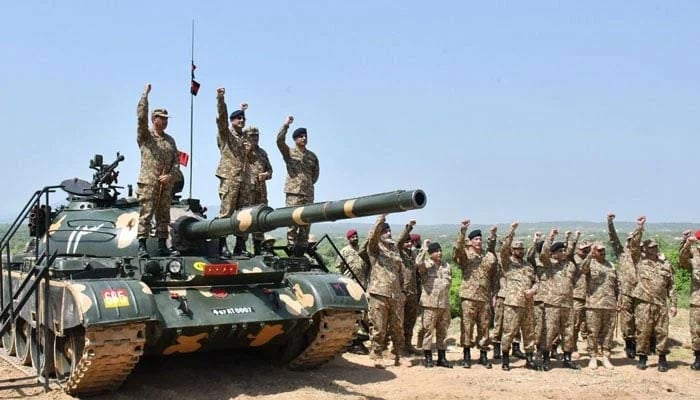
Turning to the domestic reaction within Pakistan, it is important to elaborate on how the nation has rallied behind the Pakistan Army in response to this incident. The ISPR’s statement was immediately welcomed by political leaders from across the spectrum. In a rare display of unity, the ruling coalition and the opposition parties issued separate but similarly worded statements condemning the Indian Army Chief’s remarks and praising the Pakistan Army for its firm response.
The public reaction has been overwhelmingly supportive of the military. Ordinary Pakistanis expressed their anger and disappointment at the Indian Army Chief’s words, but they also expressed pride in how their army responded. People from all four provinces, from Karachi to Khyber, from Lahore to Quetta, voiced their full support for any action the military might take to protect the country’s honour and security.
The statement that the whole nation is ready to teach India a strict lesson once more in response to any dirty intentions in the future is not merely rhetorical. It reflects a deep and genuine readiness among the Pakistani public to support their military in any future conflict. This readiness is rooted in decades of lived experience.
Therefore, when the ISPR says that the whole nation is ready to teach India a lesson, it is not an exaggeration. It is an accurate reflection of a population that has been socialized into viewing India as an existential threat and the Pakistan Army as its ultimate defender. This popular support gives the Pakistan Army enormous leverage and credibility. It means that if the government or the military decides to escalate the situation in response to Indian provocation, they will have the backing of the people. Conversely, it also means that India cannot rely on internal divisions within Pakistan to weaken the country’s resolve. The nation stands united behind its army, and this unity is a strategic asset that should not be underestimated.
Furthermore, the people’s determination to stand with the Pakistan Army to tackle strictly all internal and external enemies of Pakistan shows a holistic understanding of national security. The phrase “internal and external enemies” is important because it acknowledges that Pakistan faces threats not only from India but also from terrorist groups.
By pledging to stand with the army against all enemies, the Pakistani people are endorsing a comprehensive security doctrine that prioritizes national unity, law and order, and the elimination of terrorism. This is not just about India. It is about creating a stable and secure environment in which Pakistan can grow and prosper. The Indian Army Chief’s statement, by attacking Pakistan’s very right to exist, has inadvertently strengthened this internal cohesion. This is a common pattern in international relations, where external aggression often leads to a rally-around-the-flag effect.
The reaction of the Pakistan Army to the Indian Army Chief’s provocative statement has been comprehensive, firm, and multilayered. The Indian Army Chief’s statement, intended perhaps to project strength and confidence, has instead exposed what Pakistan sees as India’s inability to accept the reality of a separate, nuclear-armed Muslim state on its western border. The exchange has deepened the mistrust between the two countries, but it has also clarified the stakes.
Pakistan will not be erased from geography or history. It will not be intimidated by threats or rhetoric. It will continue to defend its sovereignty with all the means at its disposal, including its nuclear arsenal. And it will do so with the full support of a united nation that has proven time and again its resilience in the face of adversity. The path forward remains uncertain, but one thing is clear.
The language of civilizational superiority and existential threats has no place in a nuclearized South Asia. The only responsible way forward is through dialogue, restraint, and a genuine acceptance of each other’s right to exist. Until India is ready to take that path, the Pakistan Army and the people of Pakistan remain vigilant, united, and prepared to respond to any challenge with the utmost firmness and resolve. The message from Pakistan is loud, clear, and backed by the ultimate deterrent. It is a message that the Indian leadership would do well to hear and heed before pushing the region any closer to the brink.

Comments
No comments yet. Be the first to join the discussion!