Debate over Federal Constitutional Court’s status intensifies after Supreme Court ruling
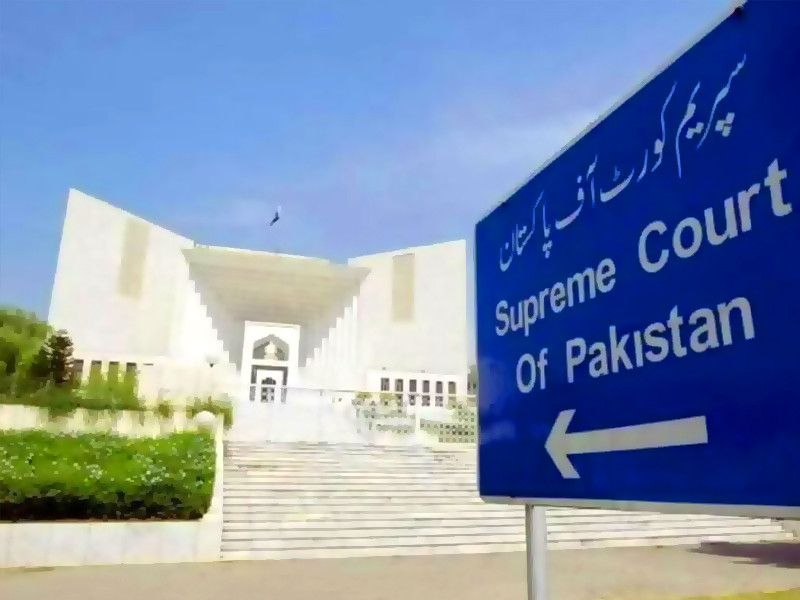
A legal debate has intensified after Chief Justice Yahya Afridi ruled that the Supreme Court and Federal Constitutional Court are coordinate apex courts. The dispute centres on powers shifted under the 27th Amendment and the scope of Article 189.


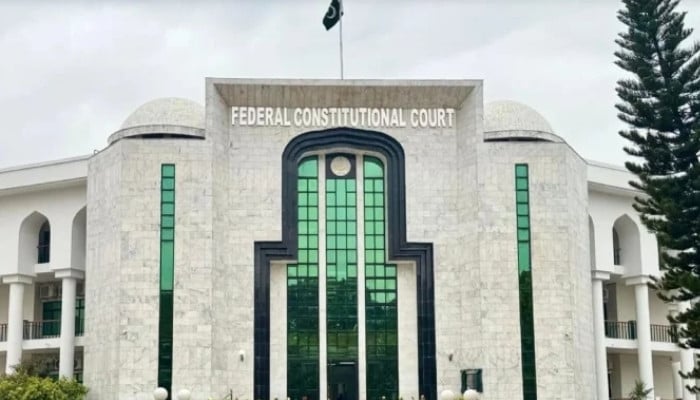
ISLAMABAD: A fresh legal debate has emerged over the relationship between the Supreme Court and the Federal Constitutional Court (FCC) after Chief Justice of Pakistan Yahya Afridi ruled earlier this month that the two are coordinate apex courts and that neither is subordinate to the other.
The ruling came against the backdrop of a series of recent decisions by the FCC that, increasingly asserted the court’s position at the top of the judicial structure. The dispute has its roots in the 27th Constitutional Amendment, passed late last year, which created the FCC and replaced Pakistan’s previous single-apex-court model with a two-court arrangement.
Shift in judicial structure
Before the amendment, the Supreme Court was the final adjudicating authority in matters ranging from presidential references and inter-governmental disputes to missing persons cases and tenancy matters. The constitutional change split that role between the Supreme Court and the newly created FCC, while leaving unresolved the precise relationship between the two institutions.
The stated justification for the reorganisation was that the Supreme Court had become overburdened with political and constitutional litigation, affecting its ability to deal with routine civil and criminal appeals. Under that rationale, constitutional and political matters were to move to the FCC, allowing the Supreme Court to focus on ordinary appellate work and reduce its backlog.
However, the constitutional design does not guarantee that division in any permanent sense. It notes that Article 175 allows parliament to grant appellate jurisdiction to the FCC through ordinary legislation, meaning parts of the Supreme Court’s traditional appellate role can be transferred over time.
NAB appeals moved to FCC
As one example, the NAB (Amendment) Act, 2026, under which new Section 32A sends second appeals in NAB cases from the high courts directly to the FCC. Such appeals had previously gone to the Supreme Court, effectively removing the top court from NAB matters.
This change carries political significance because criminal appeals involving PTI leadership, including party founder Imran Khan, may now come before a court whose first chief justice and initial judges were appointed by the president on the prime minister’s advice.
It further states that the same legislative approach could also be extended to election, anti-terrorism and other accountability-related appeals, potentially narrowing the Supreme Court’s role substantially.
Article 189 at centre of dispute
A central issue in the debate is Article 189 of the Constitution, which states:
Any decision of the Federal Constitutional Court shall, to the extent that it decides a question of law or is based upon or enunciates a principle of law, be binding on all other courts in Pakistan, including the Supreme Court.
This wording gives the FCC sweeping authority because it is not limited to constitutional interpretation alone and extends to any question of law, including ordinary statutory matters.
The FCC’s appellate jurisdiction covers cases from the high courts involving “a substantial question of law as to the interpretation of the Constitution.” It argues that, in Pakistan’s legal system, where constitutional and ordinary legal questions are often intertwined, that threshold may be easier to meet than it appears.
Case transfers and precedent concerns
On Nov 13, 2025, the Supreme Court had 56,608 pending cases. By Dec 24, 22,910 of them had been transferred to the FCC, amounting to nearly 40 per cent of the docket in five weeks. Most of those matters came through petitions for leave to appeal under Article 185(3), including many appeals arising from writ petitions.
The Supreme Court has lost original constitutional jurisdiction in public-interest matters involving fundamental rights, including the jurisdiction under which suo motu notices were taken. It notes that 243 such cases were initiated between 2005 and 2021.
On precedent, the FCC starts without a body of precedent of its own and is not bound by Supreme Court precedent under Article 189. It adds that, in principle, even a two-member FCC bench could overturn a full court judgment of all 34 sanctioned Supreme Court judges or depart from long-standing legal authority.
Chief justice’s position
The Supreme Court’s recent response has been to assert coordinate status with the FCC, and that this position was personally authored by Chief Justice Afridi. It further says that, at the time of the 26th and 27th constitutional amendments, three judges had asked him to convene a full court, but he did not do so. Two of those judges resigned on the day the 27th Amendment became law.
The current dispute is a direct consequence of the constitutional restructuring introduced by the 27th Amendment, with the question of final judicial authority now at the centre of Pakistan’s evolving legal order.
Comments
No comments yet. Be the first to join the discussion!